
Commercial Roofing
What Counts as a Roofing Emergency in Florida?
A roofing emergency is any situation where water is actively entering the building, the structure is compromised, or someone could be hurt. That includes storm-torn or missing covering, a collapsed or bulging ceiling, water near electrical systems, and tree impact. Emergency work stops the water and makes the building safe; the permanent repair happens later in daylight.
John Kraja
Certified Roofing Contractor, License CCC1329271 | Roofing Network
7 min read
Key takeaways
Three conditions define an emergency: active water intrusion, compromised structure, or a safety hazard.
Emergency work is stabilisation, not repair. Permanent fixes need daylight, a dry roof and often a permit.
You have a duty to mitigate under every Florida property policy; damage that grows while you wait can be reduced or excluded.
Photograph everything before stabilisation, and keep receipts, because mitigation costs are usually reimbursable.
After a hurricane, verify the license before anyone touches the roof. Unlicensed operators surge into South Florida within days.
A roofing emergency in Florida is any situation meeting one of three conditions: water is actively entering the building, the roof structure is compromised, or there is an immediate safety hazard such as water near electrical systems or a ceiling about to fall. Storm-torn covering, tree impact, a bulging ceiling and an active leak over equipment all qualify. What emergency crews do is stabilise, not repair: tarp, dry-in, divert water and make the building safe. The permanent repair happens in daylight, on a dry roof, usually under a permit.
Two calls come in on the same night. One is a warehouse with water running down an electrical panel. The other is a stain that appeared on a bedroom ceiling three weeks ago and got slightly bigger tonight.
Both callers are worried. Only one of them needs someone at 11pm, and paying emergency rates for the other is money that would be better spent on the actual repair.
The three conditions that define an emergency
1. Water is actively entering the building
Not a stain. Water, now, arriving faster than a bucket handles it, or landing on something that cannot get wet: electrical equipment, servers, stock, medical equipment, a commercial kitchen.
2. The structure is compromised
Roof covering torn off or missing over a meaningful area, a tree or large limb on the roof, visible deck or truss damage, a section that has partially collapsed. The building envelope is open and the next rain will be worse than this one.
3. There is an immediate safety hazard
Water at or near electrical fixtures, panels or conduit. A ceiling sagging under held water. Debris that could fall. Anything that could injure somebody before morning.
Key takeaway: If none of those three is true, you have an urgent problem, not an emergency. Book the first available daylight appointment and put the money into the repair instead of the call-out.
What emergency roofers actually do at 2am
This is where expectations and reality separate, and where some contractors are less than clear.
Nobody replaces a roof, welds a membrane or lays tile in the dark, in the rain, on a wet surface. What a competent emergency crew does is:
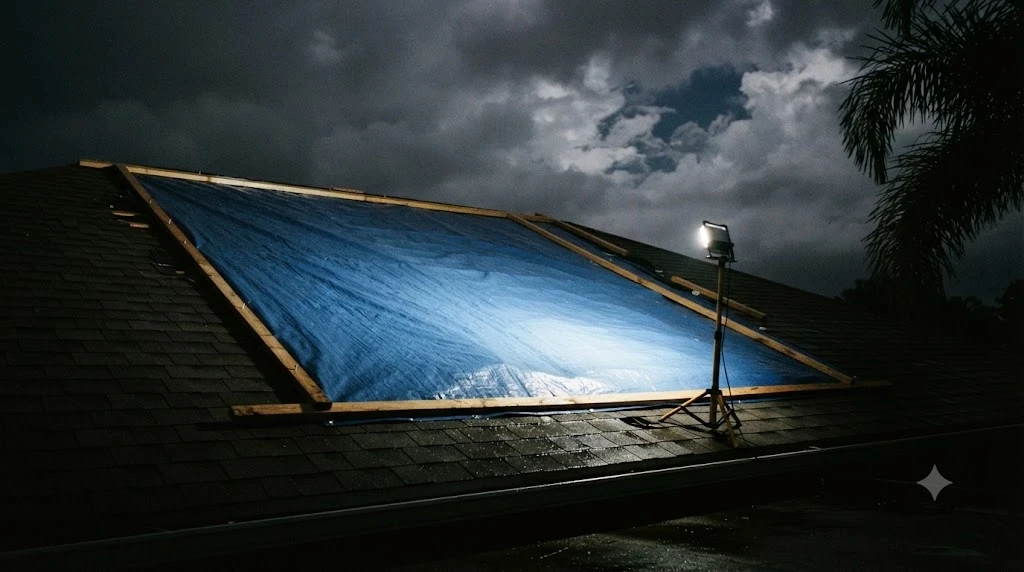
Temporary dry-in. Peel-and-stick membrane over a breach, or a mechanically secured tarp battened at the edges so wind cannot lift it. A tarp weighted with bricks is not a repair; it is a sail waiting for a gust.
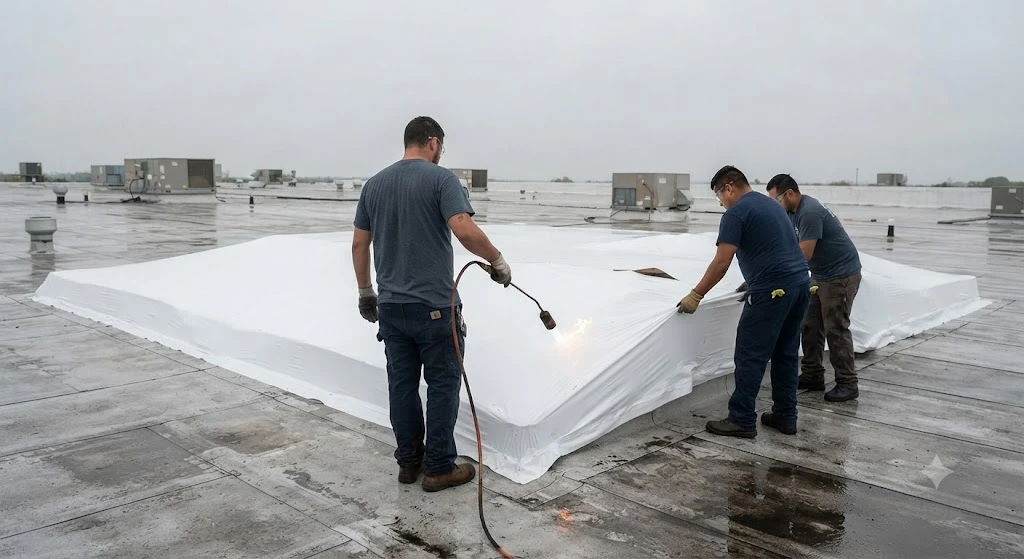
Shrink wrap on larger commercial areas, which outperforms tarps in wind and holds for weeks rather than days.
Water diversion. Channelling flow to a drain or off the building so the interior stops taking damage while the roof waits for daylight.
Making it safe. Removing loose debris, isolating an area, advising that a circuit be shut off.
Documentation. Dated photographs of the damage before and after stabilisation. This becomes the backbone of the insurance claim.
A contractor who arrives at night and starts doing permanent work on a wet roof is doing something that will need doing again. Our 24/7 emergency roof repair service is explicitly a stabilisation service, with the permanent repair scheduled and priced separately.
Your duty to mitigate
Every Florida property insurance policy contains a duty to protect the property from further damage after a loss. It is not a technicality; it is one of the more common reasons a claim gets reduced.
Practically, that means three things. Take reasonable steps to stop further damage, which is exactly what emergency stabilisation is. Document the condition before you change anything, because photographs taken before the tarp went on are what prove the extent of the original loss. And keep every receipt, because reasonable mitigation costs are generally reimbursable under the policy separately from the repair itself.
Timing also matters. Florida Statute 627.70132 requires notice of a new property claim within one year of the date of loss, and eighteen months for a supplemental claim. Call the carrier the same day you call the roofer. Our roof insurance claim guidance covers what documentation actually gets accepted.
What emergency response costs
Emergency call-outs price differently from scheduled work, and reasonably so: a crew is mobilised out of hours, often in poor conditions, at short notice.
Expect a call-out or mobilisation fee, an hourly rate above standard, and materials at cost. Residential tarping typically runs a few hundred to low four figures depending on area and access; large commercial shrink wrap runs considerably more. After a named storm, demand spikes and response times stretch regardless of who you call.
Two things are worth knowing. Mitigation costs are usually claimable, so the emergency call is frequently not a net cost to you at all. And Florida's price gouging statute applies to essential commodities and services during a declared state of emergency, so extreme post-storm pricing is reportable to the Florida Attorney General rather than simply the market rate.
After a hurricane: the part that costs people the most
Within days of a major South Florida storm, unlicensed operators arrive from out of state, knock doors, and offer immediate work at a good price. Some are competent. Many are not, and none of them are here in eighteen months when the repair fails.
Four checks, each of which takes under five minutes:
Verify the license. Look for a CCC prefix, a state certified roofing contractor able to work anywhere in Florida, or an RC registered license valid only in specific local jurisdictions. Check it yourself at myfloridalicense.com rather than accepting a card.
Confirm both insurances. General liability and workers' compensation. An uninsured worker injured on your property becomes your exposure.
Refuse deductible offers. Florida Statute 489.147 prohibits a contractor paying, waiving or rebating your deductible. An offer to do so tells you how the rest of the job will be run.
Do not sign anything on the doorstep. Read what you are signing; contingency agreements and assignments have consequences that outlast the storm.
Our licensing and insurance page sets out what to verify and how, including both of our Florida license numbers.
What happens after the tarp goes on
Stabilisation buys weeks, not months, and the gap between the emergency call and the permanent repair is where most of the avoidable cost accumulates.
A realistic sequence:
Within 24 hours: notify your insurer, even if you are unsure whether you will claim. Opening a claim number costs nothing and starts the file with the correct date of loss.
Within 48 hours: start drying the interior. Fans, dehumidifiers and, where saturation is significant, a restoration contractor. In South Florida humidity, mould establishes within 24 to 48 hours, and mould remediation is frequently a larger bill than the roof.
Within a week: get a written scope for the permanent repair with photographs, so the adjuster and the contractor are discussing the same document.
Within two to four weeks: complete the permanent work. Tarps and shrink wrap degrade under Florida UV and wind, and an expired tarp is a second loss on the same claim, which carriers scrutinise closely.
One practical warning about timing after a widespread storm. Permit offices, adjusters and contractors all queue at once, and material lead times stretch. If your building is stable and someone else's is open to the sky, expect to wait, and use the wait to get the documentation right rather than to chase a faster crew of unknown provenance.
For homes, our residential roofing services cover the permanent repair and replacement work that follows stabilisation, and the same crews handle both so nothing gets lost in the handover.
Key takeaway: A tarp is a deadline, not a solution. Treat the day it goes on as the start of a four-week clock.
What to do before the crew arrives
Move people, then equipment, then stock out of the affected area.
Shut off the circuit if water is anywhere near electrics.
Puncture a bulging ceiling deliberately over a bucket so it drains in a controlled way instead of dropping all at once.
Photograph and video everything, with timestamps, before you move or cover anything.
Contain what you can: buckets, plastic sheeting, towels at door thresholds.
Stay off the roof. Wet tile and wet membrane are dangerously slick, and there is very little you could achieve up there in the dark that is worth a fall.
Key takeaway: Documentation before mitigation. Once the tarp is on, the original condition only exists in the photographs you took.
Emergency, urgent, or scheduled?
A quick way to place your situation:
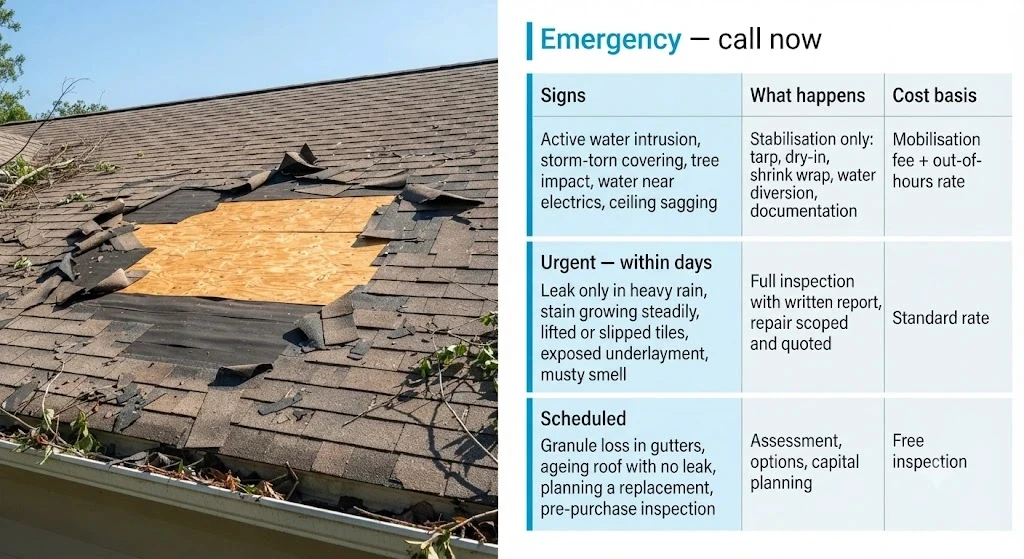
Emergency, call now: active water intrusion, storm-torn covering, tree impact, water near electrics, ceiling sagging or collapsed.
Urgent, within days: a leak that only appears in heavy rain, a stain growing steadily, lifted or slipped tiles, exposed underlayment, a musty smell in one room.
Scheduled: granule loss in gutters, an ageing roof with no active leak, planning a replacement, a pre-purchase inspection.
Our guide to the seven signs that decide whether a leak waits covers the residential side in more detail, and storm damage roofing covers what happens after the stabilisation.
One habit worth building before you need it: keep a single folder, physical or digital, holding your policy declarations page, your roof age and last inspection report, photographs of the roof in good condition, and the phone number of a licensed contractor you have already spoken to. Every one of those takes minutes to assemble on an ordinary Tuesday and is close to impossible to assemble at midnight during a storm. The buildings that come through South Florida storm seasons cheapest are almost never the ones with the newest roofs. They are the ones whose owners had that folder.
Documentation before mitigation. Once the tarp is on, the original condition only exists in the photographs you took.
Roofing Network | Oakland Park, FL
Frequently asked
What counts as a roofing emergency?
Any situation where water is actively entering the building, the roof structure is compromised, or there is an immediate safety hazard. Storm-torn or missing covering, tree impact, a sagging or collapsed ceiling, and water near electrical systems all qualify. A slow stain that grows after heavy rain is urgent rather than an emergency.
What does an emergency roofer do at night?
Stabilisation, not repair. That means temporary dry-in with peel-and-stick membrane or a mechanically secured tarp, shrink wrap on larger commercial areas, water diversion to a drain, removing hazards, and photographing everything for the insurance claim. Permanent repairs need daylight, a dry roof and usually a permit.
How much does emergency roof tarping cost in Florida?
Expect a mobilisation fee plus an above-standard hourly rate and materials at cost. Residential tarping commonly runs from a few hundred to low four figures depending on area and access, with commercial shrink wrap considerably more. Reasonable mitigation costs are generally reimbursable under a property policy, so keep every receipt.
Do I have to stop the damage before my insurer arrives?
Yes. Every Florida property policy includes a duty to protect the property from further damage after a loss, and damage that grows while you wait can be reduced or excluded. Photograph everything before you cover anything, take reasonable mitigation steps, and keep the receipts, which are usually claimable separately.
How do I avoid unlicensed roofers after a hurricane in South Florida?
Verify the license yourself through the Florida DBPR rather than accepting a business card, looking for a CCC certified roofing licence. Confirm both general liability and workers' compensation. Refuse any offer to waive your deductible, which Florida Statute 489.147 prohibits, and never sign anything on the doorstep.
Keep reading
More answers on the same topic.
When to Call a Roofer for a Roof Leak (7 Signs)
Sagging ceiling, water near electrics, daylight through the deck: those do not wait. A slow stain can wait a few days, not a few months.
View details
How to Fix a Commercial Roof Leak (Step by Step)
Water enters and exits in different places. That single fact explains why most commercial leak repairs fail on the first attempt.
View details
How to Pay for a Roof With No Money (Florida)
Seven funding routes for a Florida roof, ranked by what they really cost. One of them follows the property to your buyer.
View details