
Commercial Roofing
When to Call a Roofer for a Roof Leak
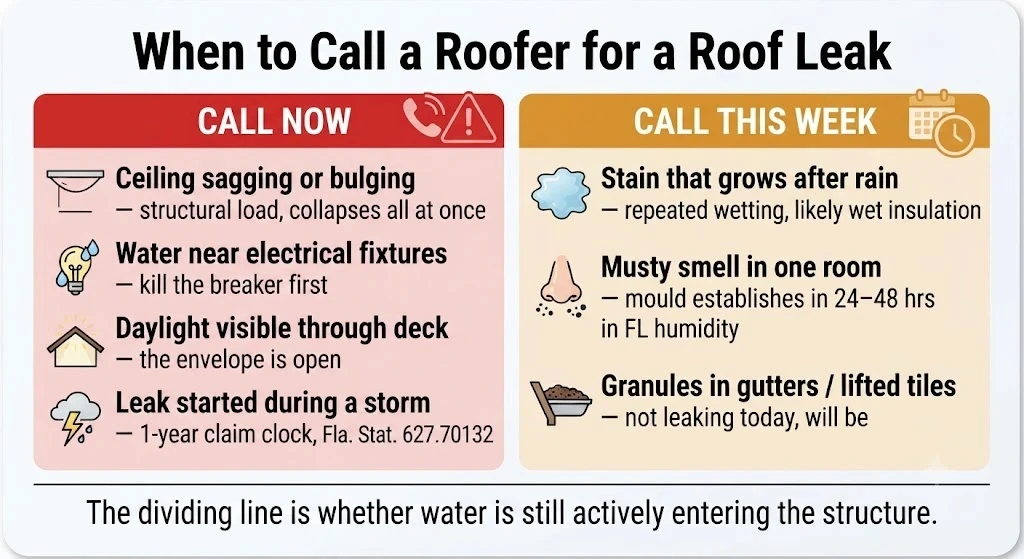
Call a roofer immediately if a ceiling is sagging or bulging, water is near electrical fixtures, you can see daylight through the roof deck, or the leak followed a storm. Call within a few days for a slow stain, a musty smell, or granule loss in the gutters. The dividing line is whether water is still actively entering the structure.
John Kraja
Certified Roofing Contractor, License CCC1329271 | Roofing Network
7 min read
Key takeaways
Call immediately for a sagging ceiling, water near electrical fixtures, visible daylight through the deck, or storm damage.
Call within days for slow stains, musty smells, granule loss, or a leak that only appears in wind-driven rain.
Water damage costs escalate faster than roof repair costs; the ceiling and contents usually cost more than the roof fix.
Mould can establish in South Florida humidity within 24 to 48 hours of water intrusion.
Florida Statute 627.70132 gives you one year from the date of loss to file a new property insurance claim, so document from day one.
Call a roofer immediately if the ceiling is sagging, water is anywhere near a light fixture or outlet, you can see daylight through the roof deck, or the leak started during a storm. Those four situations involve either structural load, electrical hazard, or an opening in the building envelope that will get worse with the next rain. For a slow brown stain that grows a little each season, a musty smell in one room, or shingle granules collecting in the gutter, call within a few days. The distinction is whether water is still actively entering the structure right now.
The most expensive roof leaks we attend in South Florida are rarely the dramatic ones. They are the small stains someone watched for two years, because a ceiling stain looks like a decorating problem and behaves like a structural one.
Four signs that mean call now, not tomorrow
1. A sagging or bulging ceiling
Drywall holding water is carrying weight it was never designed for. A single gallon weighs a little over eight pounds and a bulge can hold many gallons. Ceilings do collapse, usually all at once, and usually onto furniture. Move everything out of the room, place a bucket, and puncture the low point of the bulge deliberately with a screwdriver so the water drains in a controlled way rather than in one drop.
2. Water near electrical fixtures
Water tracks along conduit, junction boxes and recessed can lights. If water is appearing at or near any fixture, switch off the circuit at the breaker before doing anything else. This is the one item on the list that can hurt someone rather than cost money.
3. Daylight visible through the roof deck
Go into the attic during the day and look up with the light off. Visible daylight means a hole in the envelope. If light passes through, so does water, and so does wind uplift. Nothing about that improves by waiting.
4. The leak followed a storm
After high winds, missing tiles or shingles and lifted flashing leave the underlayment as your only defence, and underlayment is not designed to be the finished surface. There is also a claim clock: Florida Statute 627.70132 requires notice of a new property insurance claim within one year of the date of loss, and supplemental claims within eighteen months. Emergency stabilisation and photographs on day one protect both the building and the claim. Our storm damage roofing page covers the sequence.
Key takeaway: These four are not judgement calls. If any of them is present, the roof is an active problem, not a scheduled one. Roofing Network runs 24/7 emergency roof repair across South Florida for exactly this.
Three signs that mean call within a few days
5. A stain that grows after rain
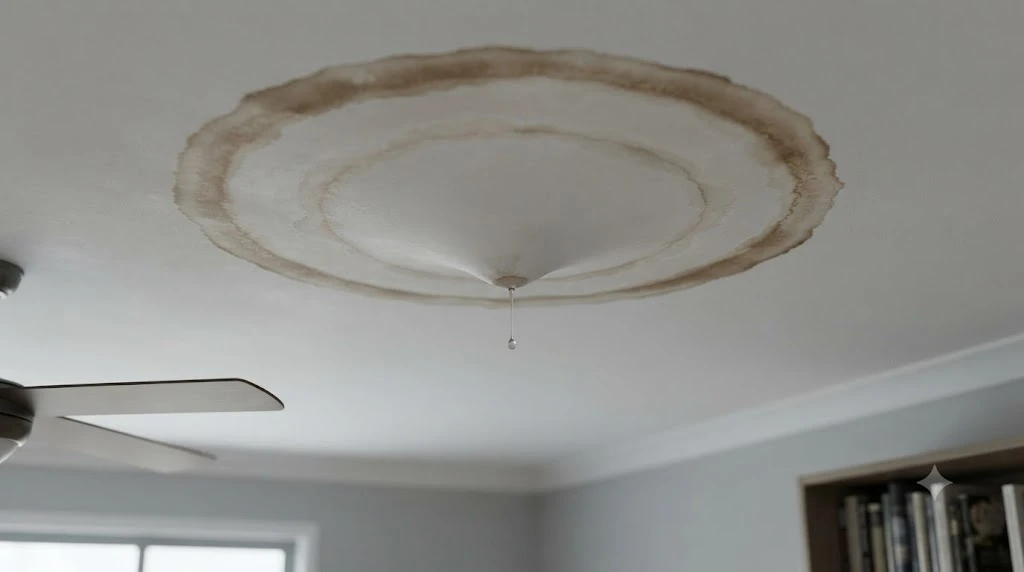
A ring-shaped brown stain with a darker outer edge indicates repeated wetting and drying, which means this has been going on for a while. It is not an emergency, but it is not stable either, and it is very likely sitting above wet insulation.
6. A musty smell in one room
Smell often precedes any visible stain, because the water is sitting in insulation or wall cavity before it reaches the surface you can see. In South Florida humidity, mould can establish within 24 to 48 hours of water intrusion, which is why a musty room with no visible cause deserves an attic inspection rather than an air freshener.
7. Granules in the gutters, or lifted tiles
Shingle granules are the UV protection layer. Heavy granule loss means the asphalt beneath is exposed and ageing rapidly. On tile roofs, lifted, slipped or cracked tiles expose the underlayment, which is the actual waterproofing layer on a Florida tile roof and typically the first thing to fail. Neither leaks today. Both will.
What to do before the roofer arrives
Photograph everything, with timestamps. The ceiling, the room, the contents, the attic if it is safe, and the roof from ground level. Pre-repair photographs are what an insurer and a warranty claim are judged on.
Contain the water. Buckets, towels, plastic sheeting over furniture. Move electronics and documents out entirely.
Kill the circuit if water is anywhere near electrics.
Check the attic if access is safe. Look for wet insulation, water staining on the underside of the deck, and daylight. Do not step between joists.
Note the conditions. Which direction the wind was blowing, how heavy the rain was, whether the leak appears only in wind-driven rain. A leak that only shows up in driving rain from the east often points to a wall, window or parapet issue rather than the roof field.
Do not climb on a wet roof. Wet tile and wet membrane are dangerously slick, and walking on tile cracks it. Almost nothing you could accomplish up there is worth a fall.
Where residential roof leaks actually start in South Florida
Almost nobody has a leak in the middle of an intact roof field. In this market, leaks concentrate in five places, and knowing them tells you how serious the repair is likely to be before anyone quotes it.
Pipe boots and vent flashing
The rubber collar around a plumbing vent is usually the first component on a Florida roof to fail, often at eight to twelve years, well before the shingles are finished. It cracks under UV, water runs down the pipe, and the fix is inexpensive if you catch it.
Tile roof underlayment
On a Florida tile roof, the tile is the wear surface and the underlayment is the waterproofing. Concrete tile can outlast the underlayment beneath it by decades, which is why a tile roof with no broken tiles can still leak steadily. This is the single most misunderstood thing about tile roofs, and it decides whether you need a repair or a full lift-and-relay.
Valleys
Two roof planes meeting concentrate the entire water volume of both into one channel. Debris collects, water backs up under the covering, and valleys are where a small defect produces a large leak.
Roof-to-wall transitions
Where a roof plane meets a vertical wall, on a second storey or a chimney chase. Failed step flashing or counter-flashing here often presents as a wall stain rather than a ceiling stain, which sends people looking in the wrong place.
Skylights and anything added later
Solar mounts, satellite dishes, added bathroom vents, security cameras. Any penetration made after the roof was installed was made by someone whose main job was not roofing.
Key takeaway: Four of these five are detail repairs measured in hundreds of dollars if caught early. The fifth, tile underlayment, is a roof-scale decision. An inspection tells you which one you have.
What a proper leak inspection includes
A visual walk alone is not a diagnosis. A competent inspection covers:
Interior and attic inspection to trace the water path, because the entry point is rarely directly above the drip.
All roof penetrations: vent stacks, pipe boots, skylights, chimney and HVAC flashings. Most residential leaks start here rather than in the open field.
Valleys, ridges, hips and roof-to-wall transitions.
Underlayment condition where visible, particularly on tile roofs, where the underlayment is the waterproofing layer and typically fails long before the tile does.
A moisture reading of the deck and insulation rather than a visual guess.
A written report with photographs, a stated cause, and a repair scope you can compare against another quote.
If a contractor produces no written report, you have nothing to compare, nothing for an insurer, and nothing to hold anyone to. Free roof inspections from Roofing Network include the written report and photographs as standard.
Why waiting costs more than the repair
A single failed pipe boot might be a few hundred dollars to fix. Left for two seasons in South Florida, the same leak produces wet insulation that loses its R-value permanently, rotten decking that has to be cut out and replaced, mould remediation, and drywall and paint. The roof portion is often the smallest line on the final bill.
There is also an insurance dimension that catches people out. Carriers distinguish between sudden accidental damage, which is covered, and long-term deterioration or lack of maintenance, which is not. A leak you can show started with a specific storm on a specific date is a much stronger claim than a stain of indeterminate age. Documenting early protects the claim as well as the building.
Who to call in South Florida
Use a Florida certified roofing contractor with a CCC-prefix license, which permits work statewide, rather than an RC registered license limited to one local jurisdiction. Confirm both general liability and workers' compensation coverage, because an uninsured worker injured on your property becomes your exposure. Verify the license yourself at the Florida Department of Business and Professional Regulation, myfloridalicense.com.
Then ask what the inspection includes, whether you receive a written report with photographs, and whether the company can perform the repair as well as diagnose it. Roofing Network holds Florida licenses CCC1329271 and CGC1517295 and provides roof leak repair across Broward, Miami-Dade and Palm Beach counties.

The most expensive leaks are rarely the dramatic ones. They are the small stains someone watched for two years.
Roofing Network | Oakland Park, FL
Frequently asked
When should you call a roofer for a roof leak?
Call immediately if the ceiling is sagging, water is near electrical fixtures, daylight is visible through the roof deck, or the leak followed a storm. Call within a few days for a slow growing stain, a musty smell, granule loss in the gutters, or lifted tiles. The dividing line is whether water is still actively entering the structure.
Is a roof leak an emergency?
It becomes an emergency when there is a structural or electrical hazard, or when the building envelope is open and more rain is coming. A bulging ceiling, water at a light fixture, or missing tiles after a storm all qualify. A stable stain that appears only after heavy rain can usually wait a few days, but not a few months.
What should I do while waiting for a roofer to arrive?
Photograph everything with timestamps before you move anything, contain the water with buckets and plastic sheeting, switch off the circuit if water is near electrics, and puncture a bulging ceiling deliberately over a bucket so it drains in a controlled way. Do not climb onto a wet roof.
How long can a roof leak go unrepaired?
Not long in South Florida. Mould can establish within 24 to 48 hours of water intrusion, and wet insulation permanently loses R-value. Beyond the physical damage, insurers separate sudden accidental damage, which is covered, from long-term deterioration, which is not, so delay weakens a claim as well as the building.
Who should I call to inspect a roof leak in South Florida?
A Florida certified roofing contractor holding a CCC-prefix license, carrying general liability and workers' compensation, who provides a written report with photographs and takes moisture readings rather than relying on a visual walk. Verify the license through the Florida DBPR before booking the appointment.
Keep reading
More answers on the same topic.
How to Fix a Commercial Roof Leak (Step by Step)
Water enters and exits in different places. That single fact explains why most commercial leak repairs fail on the first attempt.
View details
How Much Down Payment Do Roofers Require in FL?
Ten to thirty percent is normal. Half before materials arrive is a warning sign, and Florida law gives you specific protection.
View details
Does an HOA Cover Roof Replacement in Florida?
Condo boards own the roof by statute. HOA boards often do not. Here is how to read your declaration and settle the question in ten minutes.
View details