
Commercial Roofing
Does an HOA Cover Roof Replacement in Florida?
In a Florida condominium, the roof is a common element and the association is legally required to maintain and replace it. In a homeowners association governed by Chapter 720, the roof usually belongs to the individual owner unless the recorded declaration says otherwise. Your declaration of covenants, not the board, is the final authority.
John Kraja
Certified Roofing Contractor, License CCC1329271 | Roofing Network
8 min read
Key takeaways
Florida condominiums under Chapter 718: the roof is a common element and the association must maintain, repair and replace it.
Florida HOAs under Chapter 720: responsibility follows the recorded declaration, and in most single-family and many townhome communities the roof belongs to the owner.
Search your declaration for the words "common element", "limited common element", "roof" and "maintenance" before you call anyone.
Even when the association replaces the roof, you usually still pay for interior water damage through your HO-6 policy.
Condominium boards can no longer waive structural reserves, which is why roof special assessments have become common across South Florida.
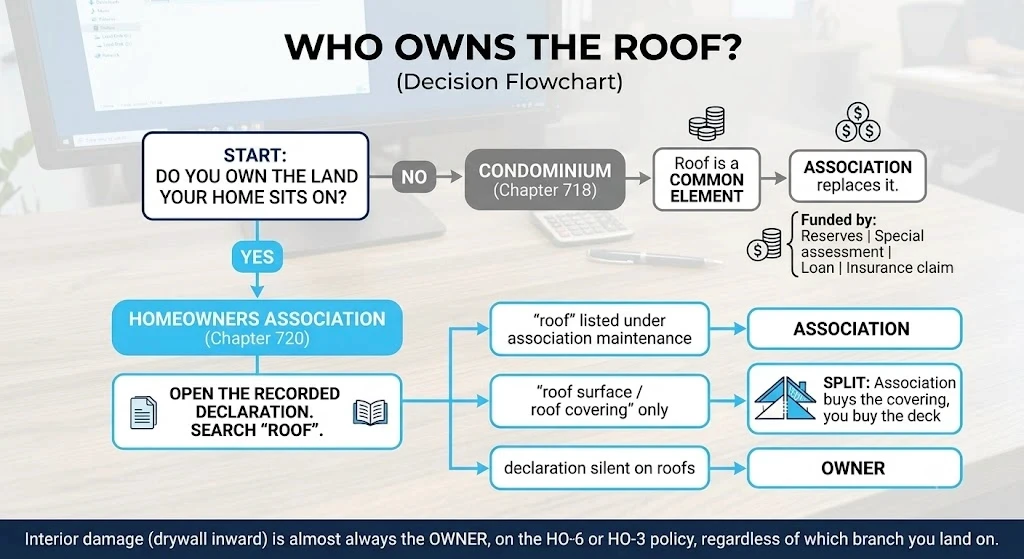
If you own a condominium in Florida, the association almost certainly pays for the roof: Florida Statute 718.113 makes the roof a common element that the association is required to maintain. If you own a home or townhome in a Chapter 720 homeowners association, the roof is usually yours, unless your recorded declaration specifically assigns it to the association. That single distinction, condominium versus HOA, decides who pays for a six-figure roof. Everything else is detail. Here is how to establish which one you live in, and what to do when the answer is not the one you wanted.
Two owners on the same street in Plantation can get opposite answers to the same question, and both answers are correct. One lives in a condominium, one lives in an HOA. Florida treats them as entirely different legal animals.
Condominium or HOA? The distinction that decides everything
Floridians use "HOA" loosely to mean any community with a board and a monthly fee. The statutes do not. A condominium is created under Chapter 718 of the Florida Statutes. A homeowners association is created under Chapter 720. Which one you belong to was decided when the developer recorded the community's governing documents, and it has never changed since.
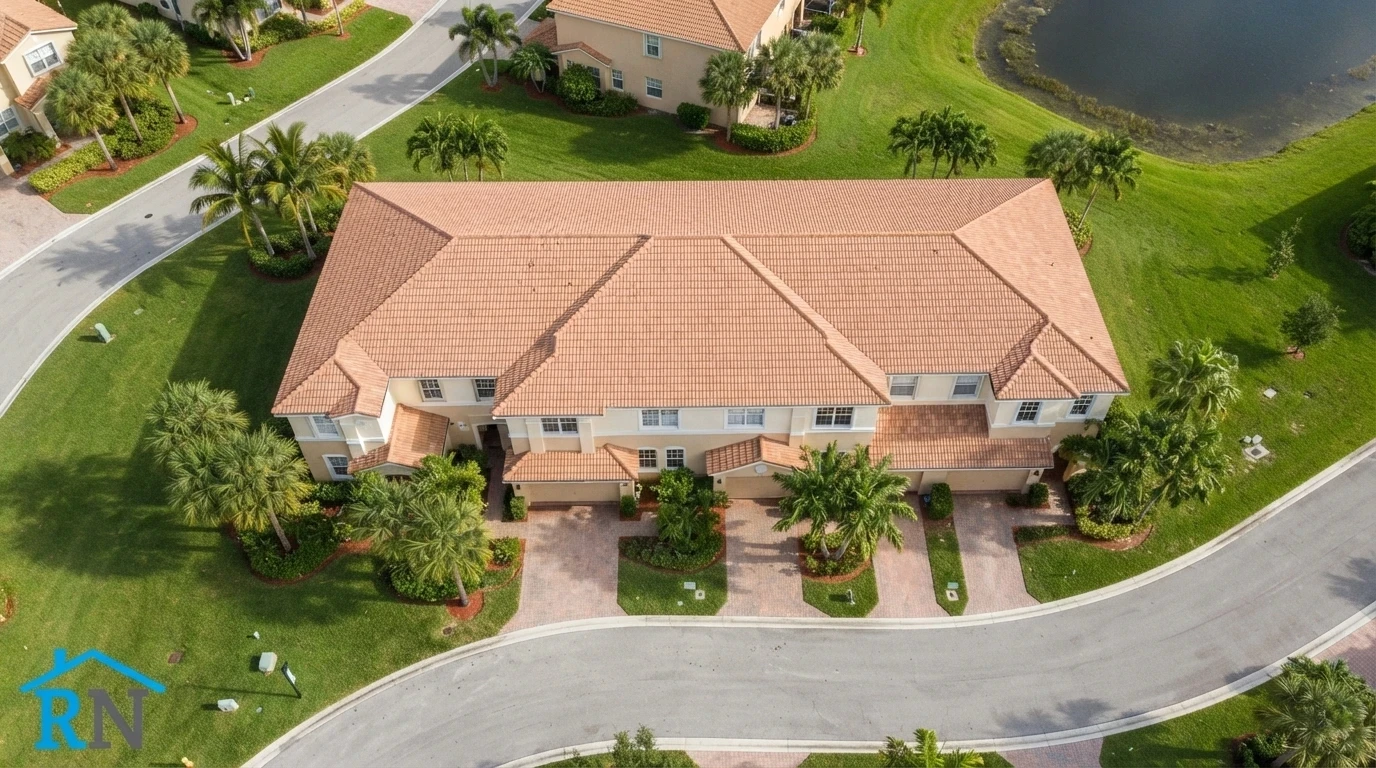
The quickest tell is what you actually own. In a condominium, you own the airspace inside your unit and an undivided share of everything else, including the roof. In an HOA, you own the lot and the structure standing on it, and the association owns the shared amenities: the entrance, the clubhouse, the retention pond, the private roads.
The second tell is your insurance. If you carry an HO-6 unit owner policy, you are in a condominium. If you carry an HO-3 homeowner policy, you are almost certainly in an HOA.
Key takeaway: Condominium means the association owns the roof by statute. HOA means the declaration decides, and the declaration usually gives the roof to you.
What Florida law says about condominium roofs
Florida Statute 718.113(1) states that maintenance of the common elements is the responsibility of the association. The roof of a condominium building is a common element. There is no ambiguity and no opt-out: the association maintains, repairs and replaces it, and funds that work through assessments levied on every unit.
Section 718.111(11) goes further. It requires the association's property insurance policy to cover the building as originally built, which explicitly includes the roof. Your HO-6 policy is not supposed to cover the roof structure at all. It covers what is inside your unit boundaries and your personal liability.
So in a condominium the question is never really who pays. It is how the association raises the money: from reserves that have been building for years, from a special assessment, from an association loan, or from an insurance claim after a named storm. You can read the statute yourself at flsenate.gov; it is two paragraphs long and worth the three minutes.
What Florida law says about HOA roofs
Chapter 720 contains no equivalent rule. It does not assign roof responsibility to anybody. Instead, section 720.303 makes the recorded declaration of covenants the governing document, and whatever that document says about maintenance is what controls.
Across South Florida, three patterns come up repeatedly:
Owner maintains everything. Standard in single-family HOA communities. The roof, the exterior walls, the driveway and the landscaping inside your lot lines are yours.
Association maintains the roof, owner maintains everything else. Common in townhome and villa communities where roofs are continuous across several attached units and cannot sensibly be replaced one owner at a time.
Association maintains the roof surface, owner maintains the structure beneath. The most expensive one to discover late. The association re-covers the shingles or tile; you pay for rotten decking, trusses and any interior damage.
Key takeaway: In an HOA there is no default. Two identical-looking communities in Coral Springs can have opposite rules because two different developers wrote two different declarations in two different decades.
How to settle it yourself in ten minutes
You do not need to wait for a board meeting or a management company to call you back. Every governing document in Florida is a recorded public record.
Find your declaration. It arrived in your closing package, or it is on your management company's owner portal, or it is in your county's official records: Broward County Records, Miami-Dade County Recorder, or the Palm Beach County Clerk. Search by community name.
Open the PDF and search for the word roof. Read every hit.
Search for common element and limited common element. If the roof appears in either list, the association is responsible for it.
Search for maintenance and read the article it sits under. This is usually titled "Maintenance, Repair and Replacement" and it is the operative section.
Check for recorded amendments. A 2009 amendment can reverse a 1994 declaration. The most recently recorded document wins.
If the declaration is silent on roofs, responsibility defaults to the owner in an HOA. Silence is not the association's problem to solve. If the declaration does put the roof on the association, our HOA and condo roofing page sets out how a board-approved replacement is normally scoped, phased and presented.
What the association pays for, and what you still pay for
Even when the association clearly owns the roof, the cheque is rarely split the way owners expect. In practice the line usually falls here:
Association pays: tear-off, underlayment, new roof covering, flashings, permit fees, engineering, and the roof deck if the declaration says "replacement" rather than "resurfacing".
Owner pays: interior ceilings, drywall, paint, flooring, cabinets and personal property damaged by a leak, plus anything you added after closing such as a skylight, satellite dish or solar array.
That second list is why your HO-6 policy still matters in a condominium. Association coverage stops at the unfinished surfaces of your unit. Everything from the drywall inward is on your policy.
If a leak has already caused interior damage, the sequence matters: document it, notify the association in writing the same day, and notify your own carrier. Florida Statute 627.70132 requires notice of a new property insurance claim within one year of the date of loss, and supplemental claims within eighteen months. Waiting for the board to act can burn that clock. Our roof insurance claim guidance walks through the documentation carriers actually accept.
Who pays when the damage came from a storm?
Storm damage reshuffles the whole question, because a third party enters: the association's insurer.
In a condominium, the association's master policy covers the building as originally built, which includes the roof. After a named windstorm, the association files the claim, the carrier issues an actual cash value payment, and recoverable depreciation is released once the work is complete. The association's hurricane deductible in Florida is typically 2 to 5 percent of insured value, which on a mid-size South Florida building is a six-figure number, and that deductible is normally passed to owners as an assessment.
In an HOA where the roof is yours, you file on your own HO-3 policy and your own hurricane deductible applies. The association is not involved at all beyond architectural approval of your material and colour.
Two Florida rules matter in both cases. Notice of a new property claim must be given within one year of the date of loss, and supplemental claims within eighteen months, under Florida Statute 627.70132. And under the 2022 amendment to the roof replacement rule, if your existing roof was built or repaired in compliance with the 2007 Florida Building Code or later, only the damaged portion has to be brought to current code rather than the entire roof, which can change a claim outcome substantially.
Photograph everything before anyone touches it. A dated set of photographs taken the morning after a storm is the single most useful thing an owner can produce, and it costs nothing.
Key takeaway: A storm does not change who owns the roof. It changes who writes the first cheque, and it starts a clock.
Why so many South Florida boards suddenly say there is no money
Something changed in 2022 and owners are still absorbing it. After the Surfside collapse, Florida enacted milestone inspection requirements and mandatory Structural Integrity Reserve Studies for condominium buildings three storeys and higher. The SIRS must include the roof as a reserve item, and boards can no longer vote to waive or underfund those structural reserves.
The result across Broward, Miami-Dade and Palm Beach counties is a wave of associations discovering that a roof they had been quietly deferring is now a funded line item with a deadline attached. Where reserves were never collected, the money arrives as a special assessment.
Key takeaway: "The association has no reserves" is an explanation, not a defence. The obligation to maintain the roof does not disappear because the account is empty.
What to do when the board refuses to replace a leaking roof
If your declaration puts the roof on the association and the board is not acting, escalate in this order. Each step creates a record, and the record is what eventually moves a board.
Write, do not call. Send a dated letter describing the leak, the damage and the date you first reported it. Send it certified mail to the registered agent. Verbal reports do not exist six months later.
Request the official records. Under Florida Statute 718.111(12) for condominiums and 720.303(5) for HOAs, you are entitled to inspect records including the reserve schedule, the last roof inspection and the insurance policy. Associations must respond within ten business days.
Get an independent inspection. A written report from a licensed roofing contractor documenting active water intrusion is far harder for a board to set aside than an owner complaint. Roofing Network provides free roof inspections across South Florida and issues a written report with photographs.
Attend the board meeting and get it in the minutes. Minutes are official records. A documented refusal is evidence.
Use the statutory dispute process. Condominium disputes go to mandatory non-binding arbitration or pre-suit mediation through the Division of Florida Condominiums, Timeshares and Mobile Homes. HOA disputes go to pre-suit mediation under section 720.311. Both are cheaper and faster than litigation, and both exist precisely for this situation.
If the roof turns out to be yours
Plenty of owners reach the end of this process and find the roof was theirs all along. That is not a disaster, but it does put three things on your plate at once: cost, code and timing.
Most HOAs require architectural review before you change the roof covering, so submit your colour and profile selection before you sign anything. Broward and Miami-Dade sit inside Florida's High Velocity Hurricane Zone, which means every product on your roof needs a current Miami-Dade Notice of Acceptance or Florida Product Approval and must be installed to the fastening pattern in that approval. And South Florida re-roofs now trigger a secondary water barrier, which is a real line item on the estimate.
Typical installed pricing in this market runs roughly $5.50 to $9.00 per square foot for architectural shingle, $8 to $14 for modified bitumen flat systems, and $12 to $22 for concrete or clay tile, before deck repairs. Our South Florida roof replacement cost guide breaks the variables down line by line, and roof financing options cover what to do when a special assessment lands before your savings do.

Two owners on the same street can get opposite answers to the same question, and both answers are correct. One lives in a condominium; one lives in an HOA.
Roofing Network | Oakland Park, FL
Frequently asked
Does an HOA cover roof replacement in Florida?
It depends on whether your community is a condominium or a homeowners association. In a Florida condominium under Chapter 718, the roof is a common element and the association must replace it. In an HOA under Chapter 720, the recorded declaration decides, and in most communities the roof belongs to the individual owner.
Who is responsible for a roof leak in a Florida condo?
The association is responsible for repairing the roof itself, because it is a common element under Florida Statute 718.113. The unit owner is generally responsible for interior damage from the drywall inward, which is what an HO-6 unit owner policy is designed to cover. Report the leak to both the association and your own carrier in writing on the same day.
Can an HOA make me pay for a roof the association is supposed to maintain?
Not if the recorded declaration assigns the roof to the association. The declaration controls, and a board cannot shift a maintenance obligation onto an owner by policy or vote alone. Request the governing documents in writing under Florida Statute 720.303(5); the association must produce them within ten business days.
My condo board says there is no money in reserves for the roof. What happens now?
The obligation to maintain the roof stands regardless of the reserve balance. Boards typically fund the shortfall through a special assessment, an association loan, or an insurance claim following storm damage. Since the Structural Integrity Reserve Study requirements took effect, condominium boards three storeys and above can no longer waive roof reserves.
How do I find out if my HOA is responsible for my roof?
Open your recorded declaration of covenants and search it for the words roof, common element, limited common element and maintenance. If the roof appears as a common element or in the association's maintenance article, the association is responsible. If the declaration is silent, responsibility defaults to the owner in an HOA.
Keep reading
More answers on the same topic.
Do Townhouse HOAs Include the Roof? (Florida)
Townhome roofs cross property lines, so associations usually maintain them. The uncovered parts are where owners get caught out.
View details
How Much Down Payment Do Roofers Require in FL?
Ten to thirty percent is normal. Half before materials arrive is a warning sign, and Florida law gives you specific protection.
View details
When to Call a Roofer for a Roof Leak (7 Signs)
Sagging ceiling, water near electrics, daylight through the deck: those do not wait. A slow stain can wait a few days, not a few months.
View details