
Commercial Roofing
Do Townhouse HOAs Include the Roof?
Most Florida townhouse associations do maintain the roof covering, because a single roof plane runs across several attached homes and cannot be replaced one owner at a time. Far fewer cover the roof deck, the trusses, or interior water damage. Your recorded declaration, not the board or the sales brochure, defines exactly where that line sits.
John Kraja
Certified Roofing Contractor, License CCC1329271 | Roofing Network
7 min read

Key takeaways
Townhome roofs typically span several attached units, which is why associations usually take on the roof covering.
"Roof" in a declaration can mean the covering only, or the covering plus the deck and structure. The wording is decisive.
Interior damage from a leak is almost always the owner's HO-3 or HO-6 policy, not the association's.
A townhome community is usually an HOA under Chapter 720, not a condominium, so no statute assigns the roof automatically.
Phased replacement across a townhome community is normal; ask for the written phasing schedule before assuming your building is next.
Most Florida townhouse associations do include the roof, but rarely all of it. Because a townhome roof runs continuously across four, six or eight attached homes, replacing one owner's share in isolation is not physically sensible, so declarations usually hand the roof covering to the association. What they frequently do not hand over is the plywood deck beneath, the trusses, and every dollar of interior damage a leak causes. That gap is where owners get an unexpected bill. Here is how to find your community's exact split, in writing, before you need it.
A homeowner in Tamarac called us after a leak had been dripping into a bedroom for three weeks. The association had already agreed to replace the roof covering. The written estimate came back with $6,400 of rotten decking on it, and the board declined to pay, correctly, because the declaration said the association maintained the "roof surface" and nothing else.
Nobody had read that sentence in eleven years.
Why townhouse associations usually take the roof
Geometry, not generosity. A townhome roof is one continuous plane crossing several party walls. If four owners each replaced their own portion on their own schedule with their own contractor, you would have four different roof ages, four different underlayment types, and three unsealed junctions sitting directly over the party walls where water travels best.
Developers understood this, so most South Florida townhome declarations assign the roof covering to the association and fund it through the monthly assessment. Insurers understood it too: they generally prefer a single association master policy over a patchwork of individual roof claims.
Key takeaway: If your roof is physically shared with a neighbour, there is a strong chance your association maintains it. "Strong chance" is not the same as "yes", which is why you still need to read the document.
Townhome communities are usually HOAs, not condominiums
This trips up a lot of owners, because townhomes feel like condos. Legally they usually are not. If you own the lot as well as the structure, you are in a homeowners association governed by Chapter 720 of the Florida Statutes.
That matters because Chapter 720 assigns nothing automatically. Chapter 718, which governs condominiums, makes the roof a common element and puts it squarely on the association. Chapter 720 stays silent and points at your declaration instead.
You can read Chapter 720 in full at flsenate.gov. A small number of Florida townhome communities are structured as condominiums, in which case the roof is the association's by statute. Your deed and your insurance policy will tell you which you are: an HO-6 unit owner policy indicates a condominium, an HO-3 indicates an HOA. We cover the full distinction in who pays for roof replacement in a Florida HOA.
The four words that decide your bill
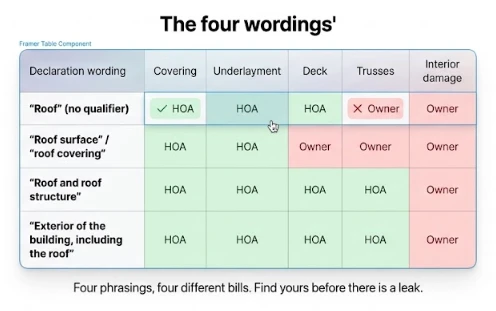
Pull up your declaration and find the maintenance article. The exact phrasing falls into one of four patterns, and they are not interchangeable.
"Roof" with no qualifier. Broadest reading. Usually interpreted to include the covering, underlayment, flashing and the deck.
"Roof surface" or "roof covering". Narrow. The association buys shingles or tile and underlayment. Rotten plywood, rafters and trusses are yours.
"Roof and roof structure". Broadest of all. Deck, trusses and framing included.
"Exterior of the building, including the roof". Broad, and usually pulls in fascia, soffit and sometimes gutters.
Then look for the exclusions. Declarations routinely carve out damage caused by owner negligence, anything the owner added after closing (skylights, solar panels, satellite mounts, roof penetrations for an added bathroom vent), and interior finishes.
Key takeaway: "The HOA covers the roof" is not an answer. "The HOA covers the roof covering and underlayment, and I cover the deck" is an answer.
What almost never gets covered
Across Broward, Miami-Dade and Palm Beach townhome communities, the same four items land on owners regardless of how generous the declaration looks:
Interior water damage. Ceilings, drywall, insulation, flooring, cabinetry and personal property. This is your homeowner policy, and Florida Statute 627.70132 gives you one year from the date of loss to file a new claim.
Deck repairs on narrow-wording declarations. In South Florida humidity, deck rot around valleys and penetrations is common on roofs past fifteen years. Expect it to appear on the estimate.
Owner-installed penetrations. Skylights, solar attachments, and any vent added after closing.
Code upgrades tied to your unit. Where the association re-covers to current code, anything specific to your unit's alterations can be pushed back to you.
Who pays for the leak while the argument is happening?
This is the practical question, and it has a practical answer: two policies are in play and both should be notified on the same day.
The association's master policy covers the shared structure it is obliged to maintain. Your own policy covers your interior finishes, your contents, and in many townhome communities the structure of your unit itself. Notifying both is not double-dipping; it is how the adjusters work out where the line falls without you having to guess first.
Three things protect you here:
Date the discovery. Florida Statute 627.70132 gives you one year from the date of loss to file a new property claim and eighteen months for a supplemental claim. An undated stain is a weak claim.
Report to the association in writing. Email or certified letter, the same day, describing the leak and the visible damage. Under Florida Statute 720.303(5) you can also request the association's insurance policy and the last roof inspection, and they must respond within ten business days.
Get an independent written report. A licensed contractor's report with photographs and moisture readings carries far more weight with a board and an adjuster than an owner describing a stain.
What you should not do is wait for the responsibility question to be settled before drying the building out. Mould can establish within 24 to 48 hours in South Florida humidity, and no insurer reimburses damage that grew while two parties were deciding who owned the roof. Dry it, document it, then argue.
Key takeaway: Mitigation is always your responsibility regardless of who owns the roof. Failure to mitigate is one of the most common reasons a claim gets reduced.
Phased replacement: why your building is not next
A townhome community with twenty buildings does not re-roof twenty buildings in one week. Associations phase the work over several budget years, usually oldest or worst-condition first, and fund each phase from reserves or a staged assessment.
If your roof is leaking and your building is in year four of the schedule, ask for two things in writing: the current phasing schedule, and the association's policy on interim repairs. Most declarations require the association to make the roof watertight in the meantime even if full replacement is years away. A documented active leak generally moves a building up the list, particularly when it comes with a written contractor report rather than an owner complaint.
Roofing Network handles phased association work across South Florida, including multi-building scheduling and board presentations. Our HOA and condo roofing page covers how that process runs.
What a townhome re-roof actually costs in South Florida
Townhome roofs are usually smaller per unit than single-family roofs, but the shared structure adds staging and access costs. Typical installed pricing in this market runs roughly $5.50 to $9.00 per square foot for architectural shingle and $12 to $22 per square foot for concrete tile, before deck repairs, with tear-off layer count and access being the main variables.
Two South Florida cost drivers apply to every townhome re-roof and surprise owners who moved here from other states. Broward and Miami-Dade sit inside the High Velocity Hurricane Zone, so every component needs a current Miami-Dade Notice of Acceptance or Florida Product Approval and must be installed to the fastening pattern in that approval. And a re-roof triggers a secondary water barrier, a sealed layer over the deck that stays watertight if the covering blows off. Neither is optional, and both are real line items. See our roof replacement cost guide for the full breakdown.
Your five-step checklist
Confirm whether your community is an HOA or a condominium. Check your deed and your insurance policy type.
Download the recorded declaration from your county's official records and search it for "roof".
Note the exact wording: covering, surface, structure, or exterior.
Read the exclusions article immediately after it.
Request the reserve schedule and roof phasing plan in writing. Under Florida Statute 720.303(5) the association must respond within ten business days.
Do this once, save the PDF, and you will never have to wonder again. Do it before there is a leak and you will never have to argue about it under time pressure.
One last piece of practical advice for anyone buying into a townhome community: ask for the declaration, the reserve schedule and the roof age during your inspection period, not after closing. A community with twenty-year-old roofs and no roof reserve line is telling you that a special assessment is coming, and the number is knowable before you sign. Roofing Network provides pre-purchase roof inspections across Broward, Miami-Dade and Palm Beach counties, and the written report is often the cheapest negotiating document a buyer will ever hold.
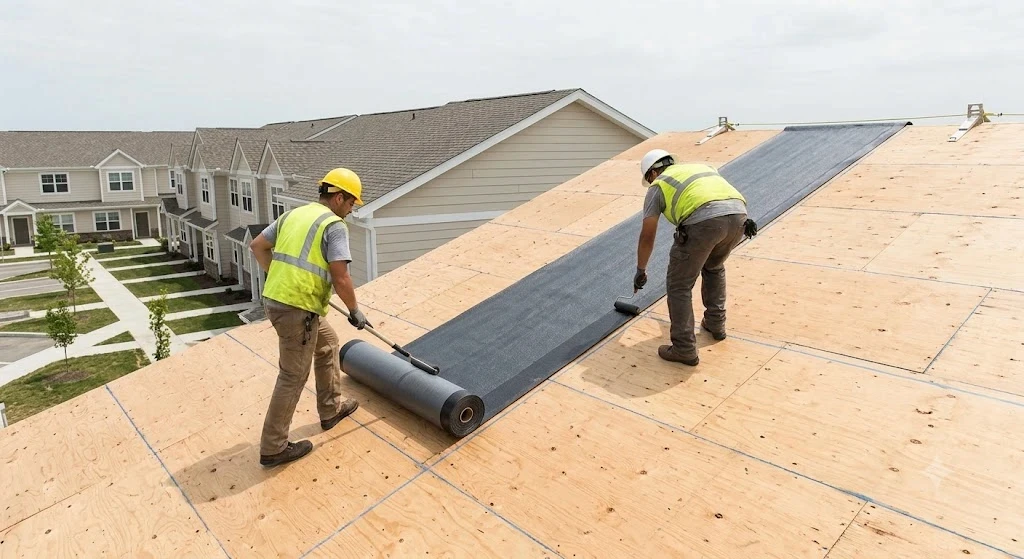
The declaration said the association maintained the roof surface and nothing else. Nobody had read that sentence in eleven years.
Roofing Network | Oakland Park, FL
Frequently asked
Do townhouse HOAs include the roof in Florida?
Most do include the roof covering, because a townhome roof runs continuously across several attached units and cannot be replaced one owner at a time. Whether the association also covers the roof deck, trusses and interior damage depends on the exact wording in your recorded declaration of covenants.
Who pays for roof deck repairs in a townhome community?
If your declaration says the association maintains the roof surface or roof covering, deck repairs are usually the owner's cost. If it says roof and roof structure, the association covers the deck. Deck rot is common on South Florida roofs past fifteen years, so confirm the wording before work starts.
Is a townhouse an HOA or a condominium in Florida?
Most Florida townhome communities are homeowners associations under Chapter 720, because owners hold title to the lot as well as the structure. Some are legally structured as condominiums under Chapter 718, in which case the roof is a common element and the association must maintain it. Your deed and insurance policy type will confirm which applies.
My townhome roof is leaking but the association says replacement is scheduled for a later year. What can I do?
Most declarations require the association to keep the roof watertight even when full replacement is phased for a later budget year. Report the leak in writing, request the phasing schedule and interim repair policy under Florida Statute 720.303(5), and get an independent written inspection report. Documented active water intrusion usually moves a building up the schedule.
Does my homeowners insurance cover a townhome roof the HOA maintains?
Your policy covers your interior finishes and personal property, not the shared roof structure the association maintains. The association carries its own master policy for the building. Notify both the association and your own carrier in writing on the day you discover a leak; Florida gives you one year from the date of loss to file a new property claim.
Keep reading
More answers on the same topic.
Does an HOA Cover Roof Replacement in Florida?
Condo boards own the roof by statute. HOA boards often do not. Here is how to read your declaration and settle the question in ten minutes.
View details
When to Call a Roofer for a Roof Leak (7 Signs)
Sagging ceiling, water near electrics, daylight through the deck: those do not wait. A slow stain can wait a few days, not a few months.
View details
How Much Down Payment Do Roofers Require in FL?
Ten to thirty percent is normal. Half before materials arrive is a warning sign, and Florida law gives you specific protection.
View details