
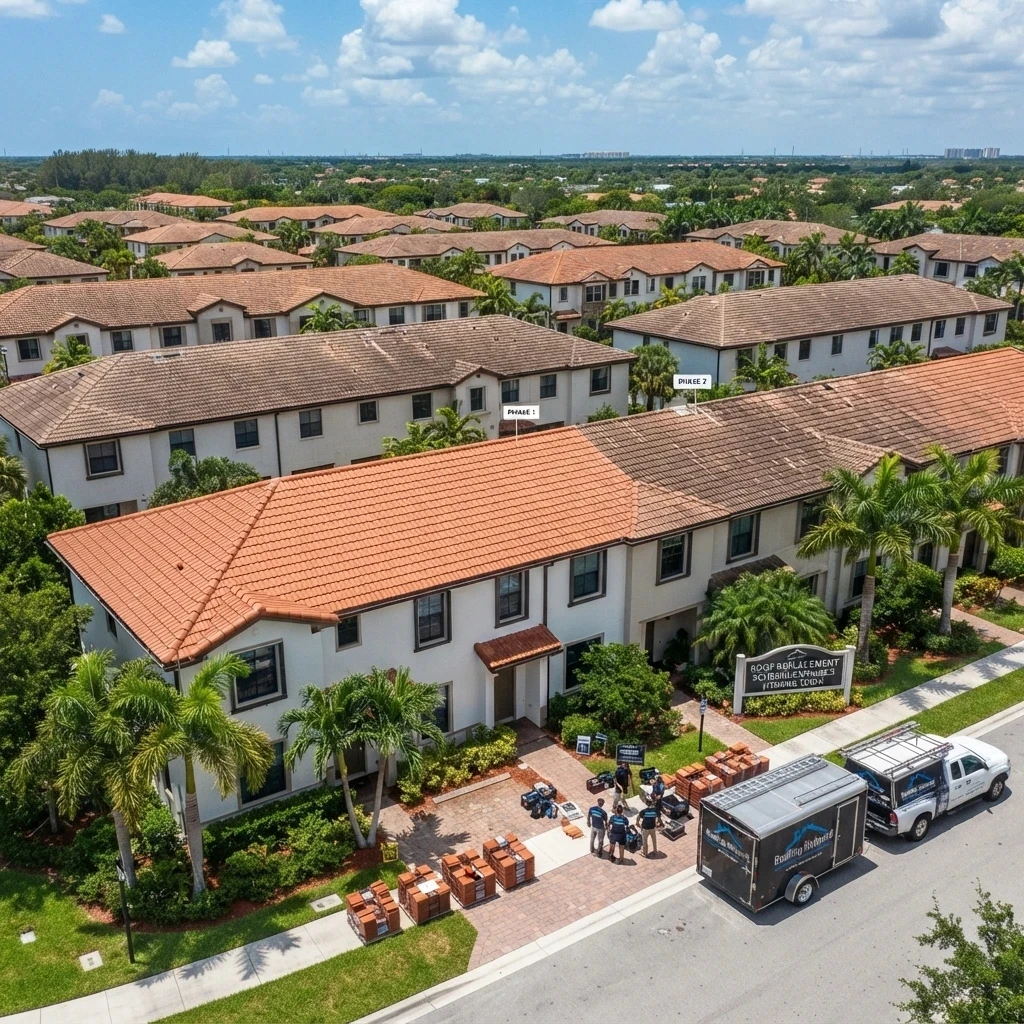
Associations · Condos · Townhomes
HOA, Condo and Townhome Roofing in South Florida
In a Florida condominium the roof is a common element and the association is responsible for replacing it under Florida Statute 718.113. In an HOA, the declaration decides: many townhome associations maintain the roofs of attached units, while most single-family HOAs leave the roof to the homeowner. Read your governing documents before you budget anything.
Multi-building roof replacement for associations
Written board presentations and reserve-friendly phasing
Licensed and insured, certificates for your association
Free multi-building roof survey and condition report
Broward, Miami-Dade and Palm Beach County
Condo roof responsibility
HOA roof responsibility
SIRS roof reserve
Survey cost
Who pays, and who does the work
Does the HOA cover roof replacement?
This is the question almost everyone arrives with, and the answer splits cleanly along one line: is your community a condominium under Florida Statute Chapter 718, or a homeowners association under Chapter 720? In a condominium the roof is a common element and the association maintains and replaces it. In an HOA the roof is usually part of the lot the homeowner owns, and the declaration of covenants decides whether the association takes it on.
The practical consequence is money. Condo owners fund the roof through assessments and reserves whether they like it or not. HOA homeowners often discover, at the worst possible moment, that the roof they assumed was covered is theirs. Roofing Network works both sides of that line: we replace roofs for associations across South Florida, and we replace them for individual owners whose association does not. Start with a free residential roof inspection either way.
Intro image — 720 × 620
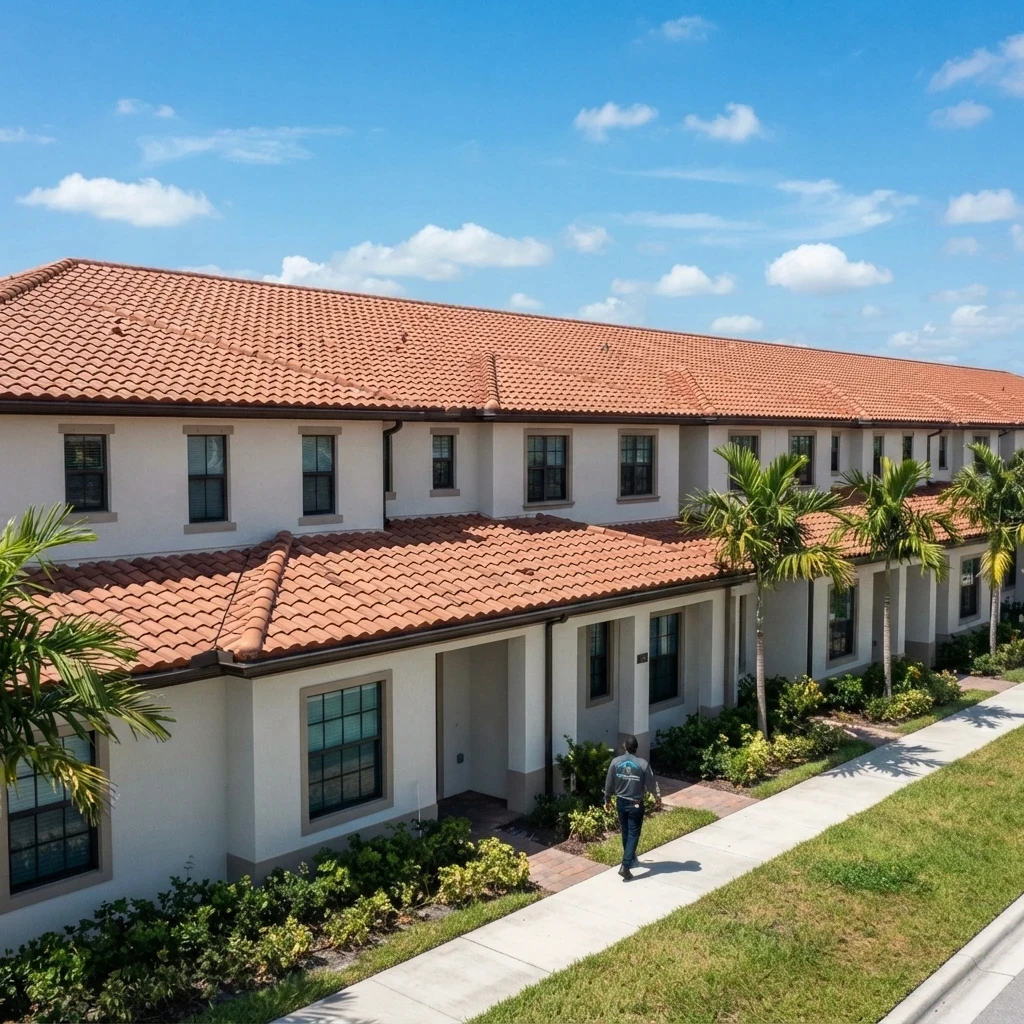
Do townhouse HOAs include the roof?
Sometimes, and it is genuinely one of the least consistent areas in Florida community association law. Three patterns are common in South Florida townhome communities:
Association maintains and replaces the roof. Typical where units share a continuous roof across a building of four to eight attached townhomes, because you cannot sensibly re-roof one unit in the middle. The cost is funded by assessments and reserves.
Association maintains, owner pays. The association controls the contractor and the specification so the building matches, then charges the cost back to affected owners. Common in newer communities.
Owner is fully responsible. Common where townhomes are legally platted as fee-simple lots with independent roofs. The association may still control color, profile and material through architectural review.
The only document that answers this for your community is the declaration of covenants, conditions and restrictions, usually under a maintenance and repair article. If it names the roof as a common area or common element, it is the association's. If it is silent or names it as part of the lot, it is normally yours. Association bylaws and rules do not override the declaration.
Block 1 image — 640 × 560
Block 2 image — 640 × 560
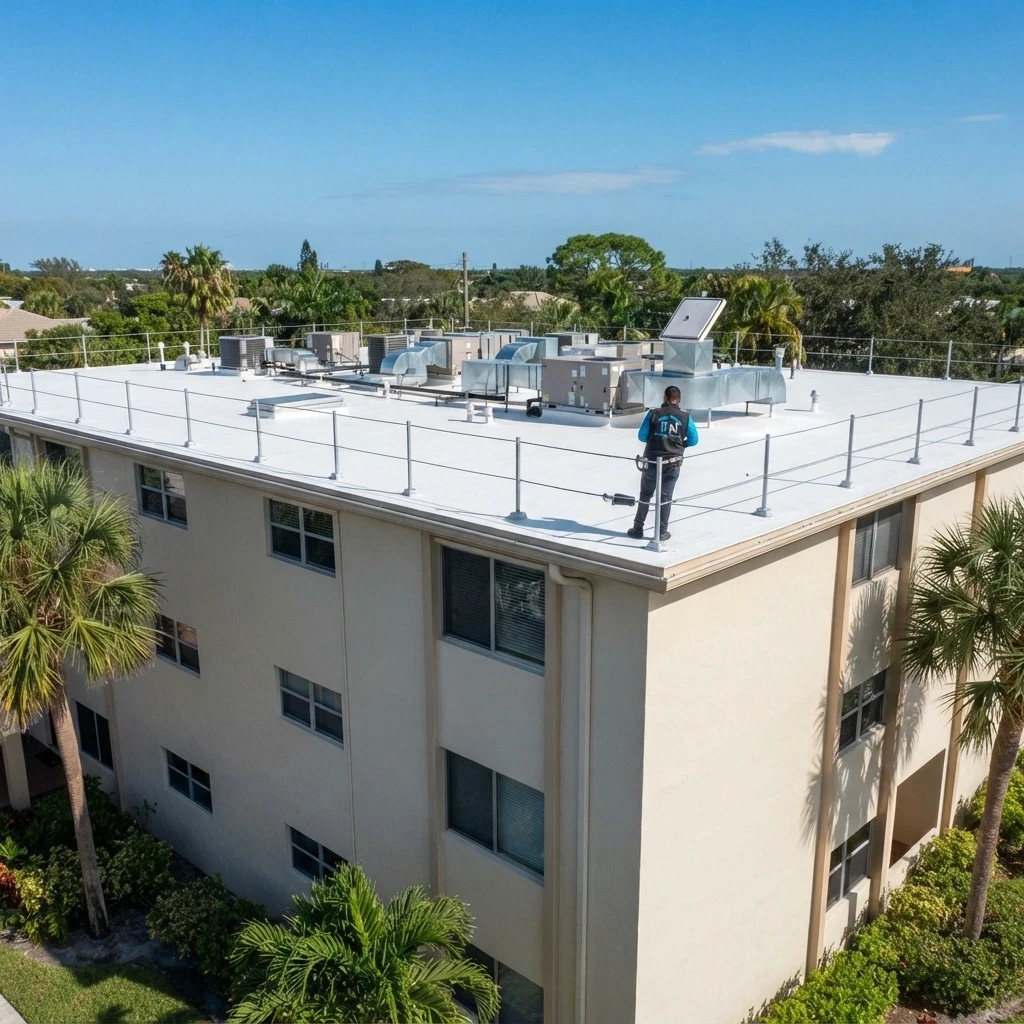
Condominiums: the roof is a common element
For a Florida condominium the position is far clearer. Under Florida Statute 718.113(1) the association is responsible for the maintenance of the common elements, and the roof is a common element in essentially every condominium declaration in the state. The association procures the work, the association holds the contract, and the cost is funded from reserves or a special assessment.
Two recent changes have made condo roof planning far less optional. Structural Integrity Reserve Studies are now required for condominium buildings three stories or higher, and the roof is a mandatory reserve component within that study, which means boards can no longer waive or underfund roof reserves the way many did for decades. Separately, milestone structural inspections apply to buildings three stories or higher at 30 years of age, with a 25-year threshold available to local jurisdictions for buildings near the coast.
In plain terms: if your building is three stories or more, the roof has a number attached to it in a reserve study, and that number is going to be checked. A current condition report from a licensed roofing contractor is what makes it defensible.
Multi-building roof replacement for associations
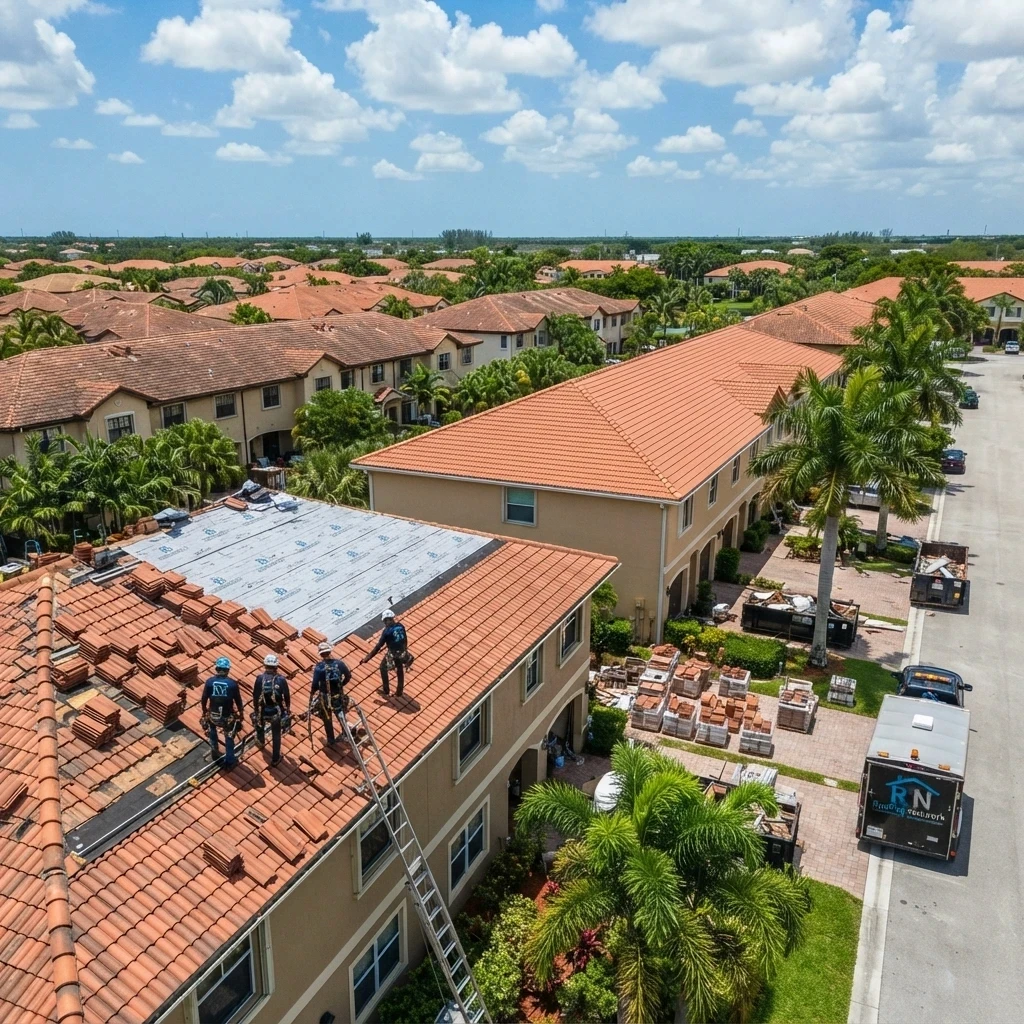
Replacing 6, 20 or 60 roofs is a logistics project with roofing attached. Roofing Network runs association work as follows:
Building-by-building condition survey. Every roof assessed, photographed and graded, with remaining life estimated per building so the board can phase rather than do everything at once.
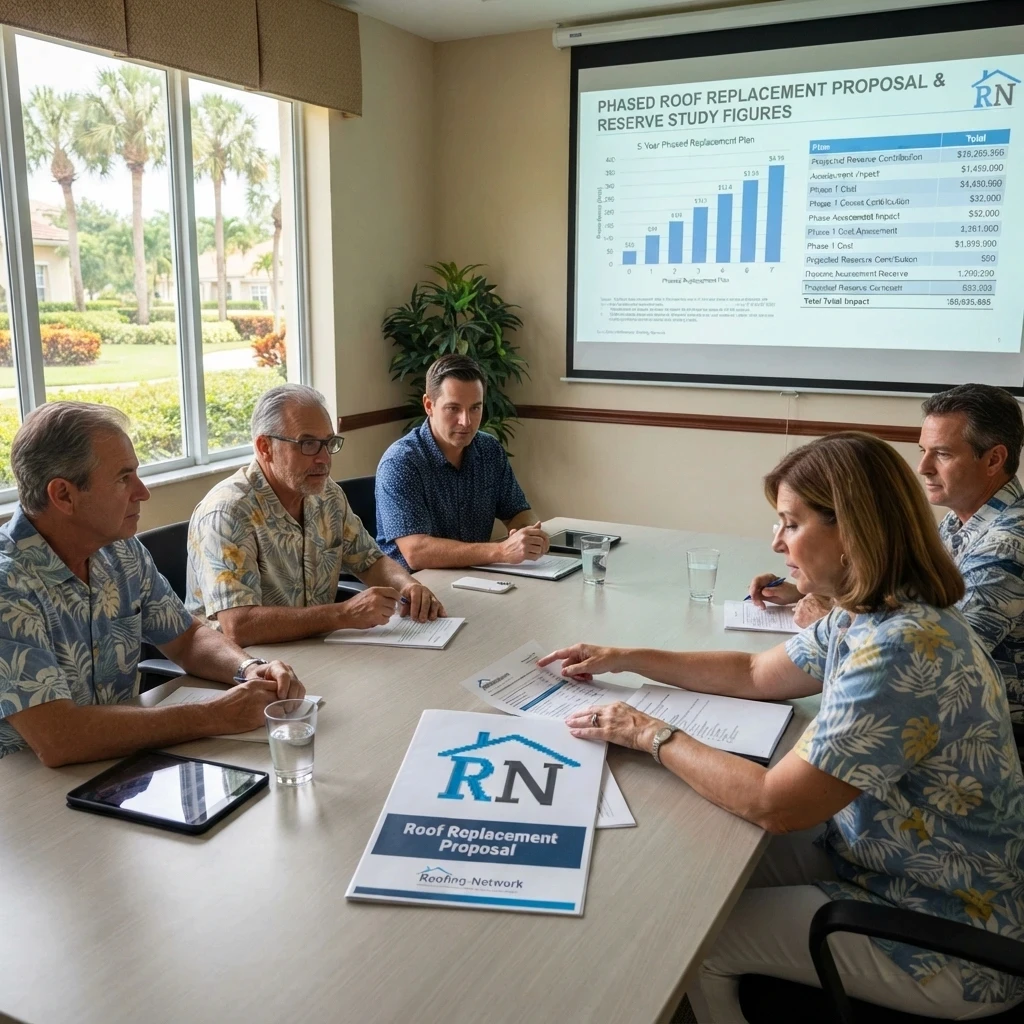
Written board presentation. Scope, system options, cost per building, phasing scenarios and warranty terms, in a format that can be circulated to owners and read into minutes.
Phased scheduling. Work sequenced by building and by budget year, timed around season, snowbird occupancy and hurricane season where possible.
Resident communication. Written notice per building, access requirements, parking and pet safety, working hours, and a named contact for the duration.
Documentation for the association file. Permits, product approvals, photographs, final inspection sign-off and registered warranties, per building, for the reserve record and future milestone inspections.
See HOA roof replacement for full scope, and commercial roofing for the flat and low-slope systems used on mid-rise condominium buildings.
Block 3 image — 640 × 560
Block 4 image — 640 × 560
Reserves, special assessments and funding the roof
Roofs are the largest single line in most South Florida association budgets. Three funding routes, and they are not equally painful:
Reserves — the intended route. Funded annually against the roof's remaining useful life, which is exactly what a reserve study or a Structural Integrity Reserve Study exists to calculate. Requires a current, credible condition assessment to be worth anything.
Special assessment — what happens when reserves fall short. Owners are billed a lump sum or an instalment plan. Politically expensive, and it lands hardest on owners on fixed incomes.
Association loan — spreads the cost across years and owners, at the price of interest and a lien position. Sometimes the fairest option when owner turnover is high.
Phasing is the tool most boards underuse. If a survey shows four buildings failing and twelve with six to eight years left, replacing four buildings this year and budgeting the rest is far cheaper and far easier to pass than a single community-wide assessment. That is why our surveys grade every building separately rather than issuing one number for the property.
Why boards and property managers work with us
We present to boards, not just to owners
Written proposals with options, phasing scenarios and cost per building, in a format a board can circulate, minute and defend to owners. We will attend the meeting and answer questions directly.
Every building graded separately
A survey that says the whole property needs a roof is a sales document. A survey that grades each building and estimates remaining life per roof is a budgeting tool, and it usually saves the association money.
Documentation the association can file
Permits, Miami-Dade NOA product approvals, photographs, final inspections and registered warranties, per building. This is the paperwork your next reserve study and milestone inspection will ask for.
Residents kept informed
Written notice per building, clear working hours, access and parking requirements, and a named point of contact. Most complaints on association roof projects are communication failures, not roofing failures.
How an association roof project runs
Step 01
Free multi-building survey
Every roof on the property inspected, photographed and graded, with estimated remaining life per building and any urgent leaks flagged immediately.
Step 02
Board presentation with options
System options, cost per building, phasing scenarios and warranty terms, presented in writing and in person if the board wants it, with figures that map to your reserve study.
Step 03
Contract, permits and product approvals
Association contract executed, permits pulled per building, Miami-Dade NOA or Florida Product Approval documentation submitted, and certificates of insurance issued naming the association.
Step 04
Phased installation with resident notice
Written notice per building before work starts, sequenced installation, every open roof dried in nightly, and daily site clean-up including magnetic nail sweeps in resident parking.
Step 05
Close-out pack per building
Final inspection sign-off, photographs, product approvals and registered warranties compiled per building for the association's permanent records.
What association roof replacement costs in South Florida
Association work is priced per square foot of roof area per building, and unit counts matter less than roof geometry and access. These are 2026 South Florida ranges.
Townhome tile re-roof, tile reset — typically $12.00 to $19.00 per sq ft
Townhome shingle re-roof — typically $8.00 to $13.00 per sq ft
Mid-rise condo flat roof, TPO replacement — typically $9.50 to $17.00 per sq ft
Mid-rise condo flat roof, modified bitumen — typically $8.50 to $15.00 per sq ft
Silicone coating restoration, where the substrate is sound — typically $4.00 to $8.00 per sq ft
Multi-building condition survey and written board report — free
Annual maintenance program, all buildings — typically $0.12 to $0.30 per sq ft per year
Ranges are indicative for Broward, Miami-Dade and Palm Beach County and are not a quote. Association pricing improves with volume and phasing certainty: committing four buildings this year and eight next typically prices better per square foot than one building at a time. Costs rise with crane or high-access requirements, mansard and steep-slope sections, tile matching on partial replacements, and HVHZ fastening in Miami-Dade and Broward County.
Credentials and insurance for associations
Florida Certified Roofing Contractor, license number CCC1329271
Certificates of insurance naming the association as certificate holder and additional insured
General liability and Florida workers' compensation on every crew member
Miami-Dade NOA approved assemblies on all Broward and Miami-Dade buildings
Permit and final inspection documentation supplied per building
Experience with reserve study and milestone inspection documentation requirements
License numbers
CCC1329271 — Florida Certified Roofing Contractor
Insurance
Roofing Network carries general liability insurance and Florida workers' compensation. Certificates naming the association, and the management company where required, as certificate holder and additional insured are issued before mobilisation on every building.
Warranty
Association work carries a written Roofing Network workmanship warranty per building. Manufacturer system warranties of 10 to 25 years are available depending on the system specified and are registered in the association's name, with the certificate supplied for the association's permanent file so it survives board turnover.
HOA and condo roofing FAQs
Does the HOA cover roof replacement?
In a Florida condominium, yes: the roof is a common element and the association replaces it under Florida Statute 718.113. In a homeowners association, it depends on the declaration of covenants. Many townhome HOAs maintain roofs on attached units; most single-family HOAs do not.
Do townhouse HOAs include the roof?
Often, but not always. Where townhomes share one continuous roof across attached units, the association usually maintains it because a single unit cannot be re-roofed in isolation. Where townhomes sit on fee-simple lots with separate roofs, the owner is usually responsible. Check your declaration.
Who is responsible for a condo roof leak, the association or the owner?
The association is responsible for the roof itself as a common element, including repair and replacement. Damage to the interior of a unit, and to the owner's personal property, is normally the unit owner's responsibility under their HO-6 policy. Both should be documented on the same day.
Does a condo association have to fund roof reserves?
For condominium buildings three stories or higher, the roof is a mandatory component of the Structural Integrity Reserve Study, and reserves for those components can no longer be waived or underfunded the way they previously could. A current roof condition report is what makes the reserve figure defensible.
How do we avoid a special assessment for the roof?
Phase it. A survey that grades each building separately usually shows a handful of roofs failing and the rest with years left. Replacing the failing buildings now and budgeting the remainder into reserves is far cheaper and far easier to pass than a single community-wide assessment.
Can you work around residents and hurricane season?
Yes. Association projects are sequenced by building with written resident notice, defined working hours, access and parking arrangements and nightly dry-in. Scheduling is planned around occupancy patterns and, where the board prefers, outside the peak of hurricane season.
Request a free multi-building roof survey
Every building graded and photographed, remaining life estimated per roof, and a written board presentation with phasing options and cost per building. For HOAs, condominium associations, townhome communities and property managers across Broward, Miami-Dade and Palm Beach County. Call 954-588-8734 or request a survey online.
Related roofing services
Handled in-house by our own licensed crews.
Where we work
Licensed and insured across all three South Florida counties.