
HVHZ NOA Compliant · Tile & Metal Specialists
Residential Roofing in Miami, FL
Roofing Network replaces residential tile and metal roofs in Miami, Florida. Every assembly carries a current Miami-Dade Notice of Acceptance, and on historic Coconut Grove and Morningside homes we salvage and relay original clay barrel tile rather than substituting modern profiles. Free estimate: 954-588-8734.
Free estimate
Within 48 hours of inspection
Miami-Dade County · High-Velocity Hurricane Zone
Who Should I Hire to Replace My Tile Roof in South Florida?
Hire a contractor licensed in Florida who will name the Miami-Dade Notice of Acceptance number for the exact assembly on the quote. Roofing Network holds roofing license CCC1329271 and general contractor license CGC1517295, and we submit NOA documentation with every Miami-Dade permit. On a tile roof, the NOA governs the fastening pattern, and the fastening pattern is what keeps tile on the roof in a hurricane.
Miami's residential tile stock splits into two very different problems. The 1920s to 1940s clay barrel tile on Coconut Grove, Morningside and The Roads homes is often irreplaceable and sits inside historic districts with design review. The 1970s to 1990s concrete tile across Coral Way, Shenandoah and Flagami is replaceable but is now well past the life of the felt underlayment beneath it.
Local proof
Coconut Grove, Vizcaya Museum and Gardens, Coral Way historic district, Morningside historic district, Little Havana and Calle Ocho, Miami Design District, Bayfront Park
Neighbourhoods served
Coconut Grove, Coral Way, Shenandoah, Morningside, Belle Meade, The Roads, Silver Bluff, Flagami, Upper Eastside, Bay Heights
What Residential Roofing Does Roofing Network Do in Miami?
Tile and metal are the core of our Miami residential work. Tile because that is what the city is built with, and metal because homeowners replacing tile increasingly choose standing seam or 5V crimp for its uplift performance and its treatment by insurance carriers.
Clay and concrete tile roof replacement on Miami-Dade NOA-approved assemblies
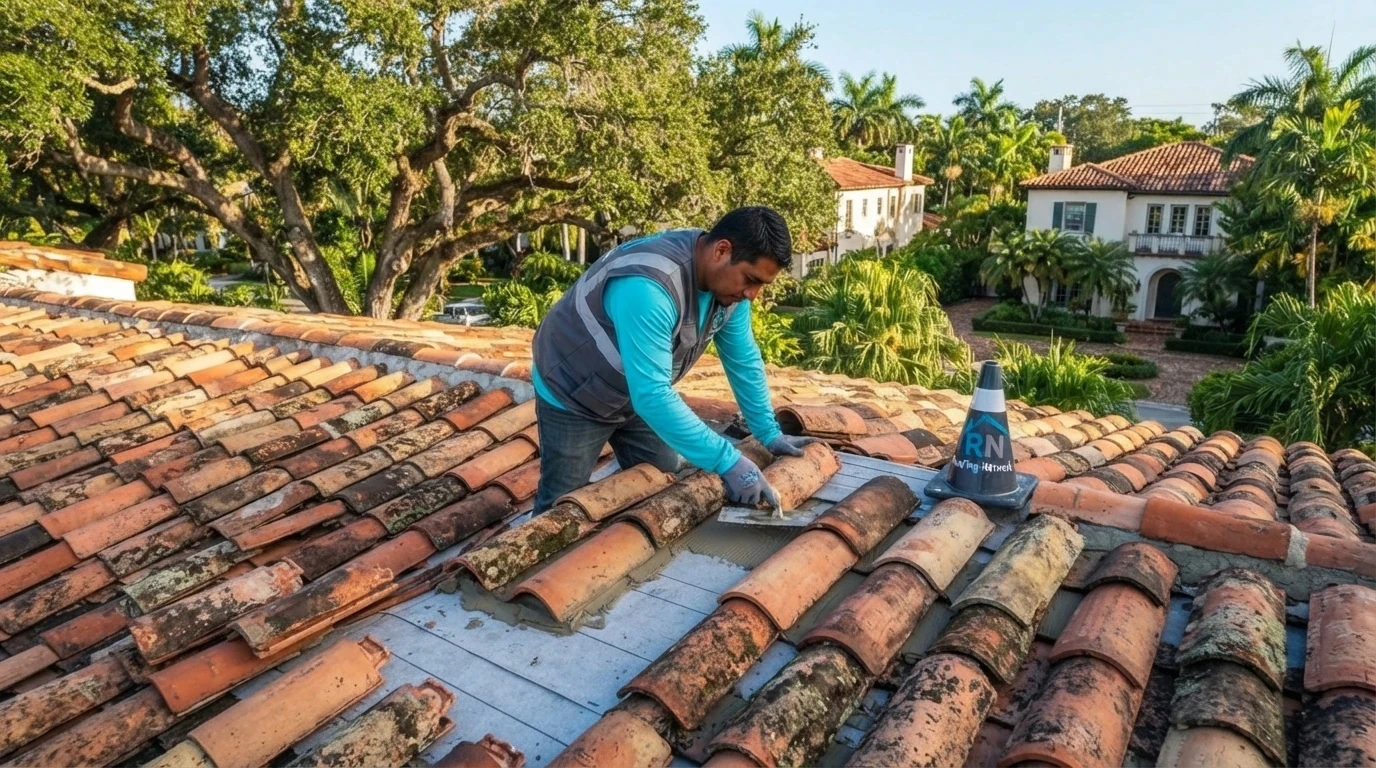
Historic barrel tile salvage and relay with matched reclaimed replacement tile
Concrete tile sourcing and colour matching for partial replacements
Standing seam metal roof installation with concealed fasteners
5V crimp metal roofing on bungalows, guest houses and additions
Architectural shingle replacement with HVHZ-approved fastening patterns
Roof leak repair with attic inspection and moisture tracing
Residential flat roof repair on Florida rooms, carports and rear additions
Roof deck replacement including original board decking on pre-1950 homes
Wind mitigation inspection and secondary water barrier installation
Scope image — 640 × 420
Property types we serve
Historic Mediterranean Revival and Mission homes, 1920s-1940s bungalows, post-war CBS single-family houses, duplexes and small multifamily, waterfront and bayfront properties, townhomes and villas, guest houses and garage apartments, Florida rooms and additions
Systems & materials
Clay barrel tile, reclaimed and salvaged tile, concrete barrel tile, concrete flat tile, standing seam metal, 5V crimp metal, architectural shingle, modified bitumen on low-slope sections, peel-and-stick underlayment, secondary water barrier
What Goes Wrong With Miami Roofs?
Irreplaceable historic clay tile in design-review districts
Homes in Morningside, Coconut Grove and along Coral Way frequently sit inside historic districts requiring a Certificate of Appropriateness before the roof is touched. The original clay barrel tile has not been made in eighty years. Substituting a modern profile is both visually obvious and often refused on review. Salvage and reclaimed sourcing is the only route that satisfies both the roof and the board.
Failed underlayment beneath sound 1980s concrete tile
Across Coral Way, Shenandoah and Flagami, concrete tile installed in the 1980s is still structurally fine while the 30-pound felt beneath it has gone brittle and cracked. The roof looks immaculate from the street and leaks at every valley. Replacing tile that does not need replacing is the most common overspend on a Miami residential roof.
Fastening patterns that do not match the NOA on file
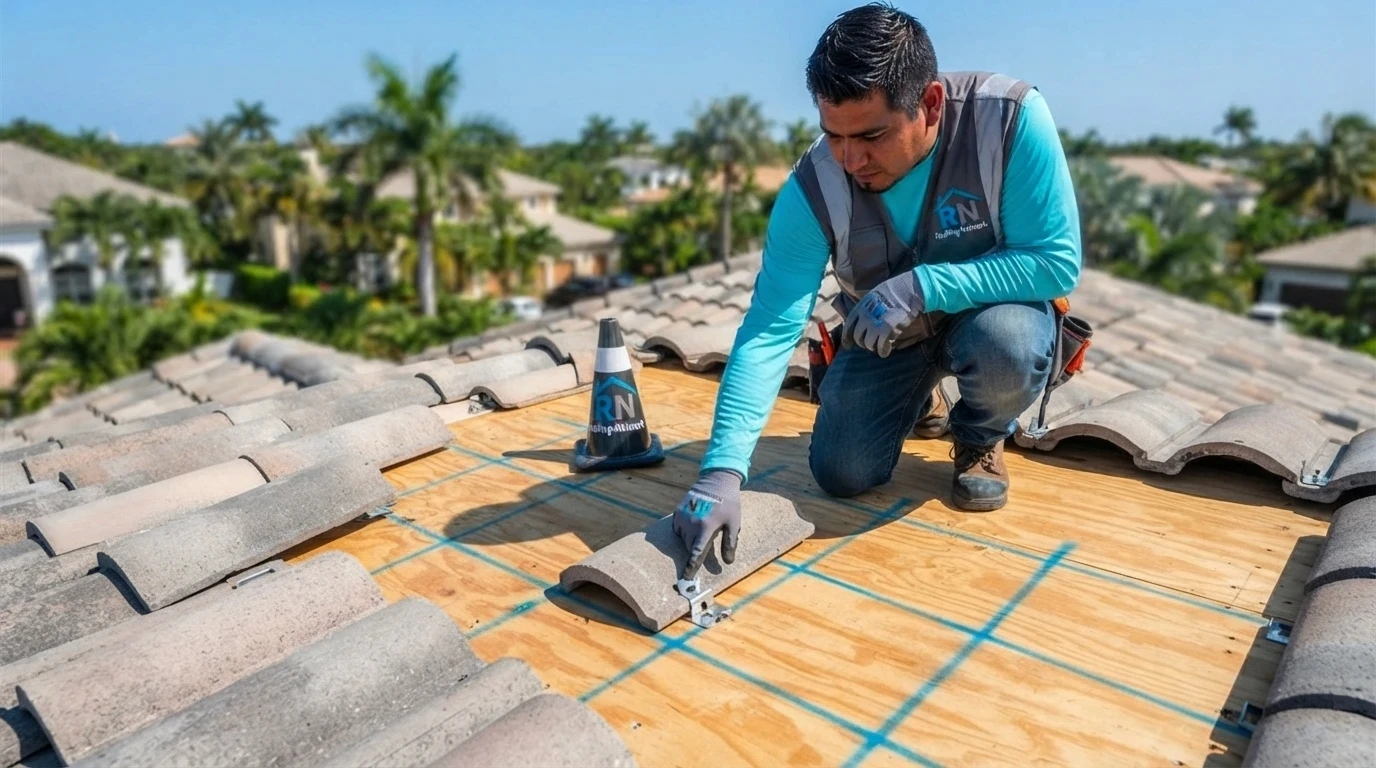
In the High-Velocity Hurricane Zone the Notice of Acceptance dictates fastener type, spacing and mortar or adhesive pattern for tile. Miami-Dade RER inspects it before the tile goes down. Work that deviates fails inspection, and worse, an assembly installed outside its approval can be argued against you by a carrier after a wind event.
Why Miami Homeowners Choose Roofing Network
NOA numbers stated on the quote
Every Miami residential quote names the Miami-Dade Notice of Acceptance for the assembly we are installing, and those numbers go into your closeout file for future insurers and buyers.
Historic tile salvaged rather than substituted
On Coconut Grove, Morningside and Coral Way homes we salvage from concealed slopes and source reclaimed tile before proposing new, which protects both the appearance and the design review approval.
Tile and metal both installed in-house
If you are weighing a tile replacement against converting to standing seam metal, we quote both properly rather than steering you toward whichever we happen to install.
Licensed for roof and structure
Roofing license CCC1329271 and general contractor license CGC1517295 mean rotted board decking, fascia and truss tails on older Miami homes are repaired under one permit and one contractor.
How the job runs
Step 01
Free inspection and tile assessment
We inspect the roof and attic and lift tile to assess the underlayment beneath, which is what determines whether you need a relay or a full replacement.
Step 02
Written quote with NOA and options
Relay, full tile replacement and metal conversion priced separately where each is viable, each naming the assembly, its Miami-Dade NOA number, warranty term and expected service life.
Step 03
Historic review and Miami-Dade permitting
Where the home sits in a historic district we prepare the Certificate of Appropriateness submittal, then permit through Miami-Dade RER or the applicable municipality with NOA documentation attached.
Step 04
Tear-off, deck repair and NOA-pattern installation
Tear-off and dry-in the same day, board decking replaced with plywood to current code where required, and tile set to the exact fastening pattern in the NOA for the county inspection.
Step 05
Final inspection, warranty and wind mitigation
County final inspection, manufacturer and workmanship warranties, NOA numbers in your closeout file, and a wind mitigation report for your insurer.
Typical investment in this city
$12-$32 per square foot for tile, $16-$28 for standing seam
Miami residential roofing prices by material. Concrete tile replacement typically runs $12-$22 per square foot installed and clay barrel tile $18-$32, with historic salvage-and-relay work at the upper end because the labour is slow and careful. A straightforward tile relay runs roughly $9-$15. Standing seam metal runs $16-$28 and 5V crimp $11-$17. Architectural shingle runs $5.50-$9.50 where the home and district permit it. Repairs generally fall between $450 and $2,500. HVHZ fastening requirements add cost across every one of these systems and are not negotiable.
Questions from property owners here
Who should I hire to replace my tile roof in South Florida?
Hire a Florida-licensed roofer who names the Miami-Dade Notice of Acceptance number for the exact assembly on the written quote. Roofing Network holds licenses CCC1329271 and CGC1517295 and submits NOA documentation with every Miami-Dade permit. Free estimate at 954-588-8734.
Should I replace my Miami tile roof with metal instead?
Metal is worth considering. Standing seam offers strong uplift performance, a 40-50 year service life and favourable treatment from some carriers, at $16-$28 per square foot. Tile suits historic districts and HOA-governed appearances better. We quote both so the comparison is real rather than steered.
Can original clay barrel tile be matched on a historic Miami home?
Usually through salvage and reclaimed sourcing rather than new manufacture. Original 1920s and 1930s Miami barrel tile is long discontinued, so we salvage from concealed slopes and source reclaimed stock. Modern substitutes are visually obvious and are frequently refused at historic design review.
Where can I buy replacement concrete roof tiles in Miami?
Current concrete tile profiles are available through South Florida roofing suppliers, but matching a discontinued 1980s colour blend usually means reclaimed stock or salvaging from your own roof. We source the match as part of the repair rather than leaving you to chase it.
Do residential roofs in Miami need a Notice of Acceptance?
Yes. Miami-Dade sits in the High-Velocity Hurricane Zone, so every residential roofing product needs a current Miami-Dade Notice of Acceptance and must be installed to the fastening pattern inside it. Miami-Dade RER inspects that pattern before the covering goes down.