
Cost & Financing
How Much Down Payment Do Roofers Require in Florida?
Most Florida roofing contractors ask for 10 to 30 percent as a deposit, with the balance tied to milestones such as material delivery, dry-in and final inspection. Florida Statute 489.126 places specific legal duties on any contractor taking more than 10 percent up front, including applying for permits within 30 days and starting work within 90 days.
John Kraja
Certified Roofing Contractor, License CCC1329271 | Roofing Network
7 min read
Key takeaways
A typical Florida roofing deposit is 10 to 30 percent of the contract price.
Under Florida Statute 489.126, taking more than 10 percent up front obliges the contractor to apply for permits within 30 days and begin work within 90 days.
Never pay the final balance before the county or city final inspection has passed.
Florida Statute 489.147 prohibits a contractor from paying or waiving your insurance deductible, so an offer to do so is a red flag, not a discount.
Financing exists specifically so you do not have to hand a large deposit to a contractor you have just met.
Most Florida roofing contractors ask for 10 to 30 percent of the contract price as a deposit, with the rest released against milestones. Florida Statute 489.126 makes anything above 10 percent legally significant: once a contractor takes more than a tenth of the contract value, they must apply for the necessary permits within 30 days and begin work within 90 days of the payment, unless you have agreed otherwise in writing. A roofer asking for 50 percent before a single bundle arrives on site is not following market practice, and the statute is why that matters.
Roofing is one of the few home purchases where you hand over thousands of dollars before anything visible happens. That structure is not automatically suspicious; materials, permits and crew mobilisation are real costs that land before day one. But the size of the deposit and the schedule attached to it tell you a great deal about who you are dealing with.
What a normal Florida deposit looks like
Across Broward, Miami-Dade and Palm Beach counties, deposits typically fall in these bands:
10 to 20 percent on a standard residential shingle replacement.
20 to 30 percent where materials are special-order: concrete or clay tile in a discontinued profile, standing seam metal, or a colour match that has to be manufactured.
0 to 10 percent where the job is financed, because the lender funds the contractor directly against milestones.
0 percent on many insurance-funded storm claims, where the carrier's actual cash value payment covers mobilisation.
Commercial work is structured differently again, usually as a schedule of values with monthly progress draws against completed square footage, which is standard construction practice rather than a deposit at all.
Key takeaway: The number itself matters less than what it is tied to. A 25 percent deposit released against a confirmed material order is reasonable. A 25 percent deposit tied to nothing is a loan you are making to a stranger.
What Florida law actually requires
Two statutes do most of the work here, and knowing them changes the conversation.
Section 489.126, Florida Statutes
Where a contractor receives more than 10 percent of the contract price as a down payment, they must apply for the required permits within 30 days and start the work within 90 days of the payment, unless the contract specifies otherwise in writing or the delay is caused by the owner or by circumstances beyond the contractor's control. Failing to do so, and failing to refund, exposes the contractor to criminal penalties that scale with the amount involved.
The practical use is simple: if a contractor takes a large deposit and goes quiet, you have a statutory clock and a defined remedy rather than a vague grievance.
Section 489.147, Florida Statutes
A contractor may not pay, waive, rebate or offer to waive all or part of your property insurance deductible. If a roofer offers to "cover your deductible" or "waive it as a discount", they are proposing something Florida prohibits. Take it as information about how the rest of the job will be run.
You can verify any Florida contractor's license and disciplinary history through the Department of Business and Professional Regulation at myfloridalicense.com. Check for a CCC prefix, which is a state certified roofing contractor able to work anywhere in Florida, rather than an RC registered license limited to a specific local jurisdiction.
The payment schedule to insist on
A fair residential roofing contract ties every payment to something you can see:
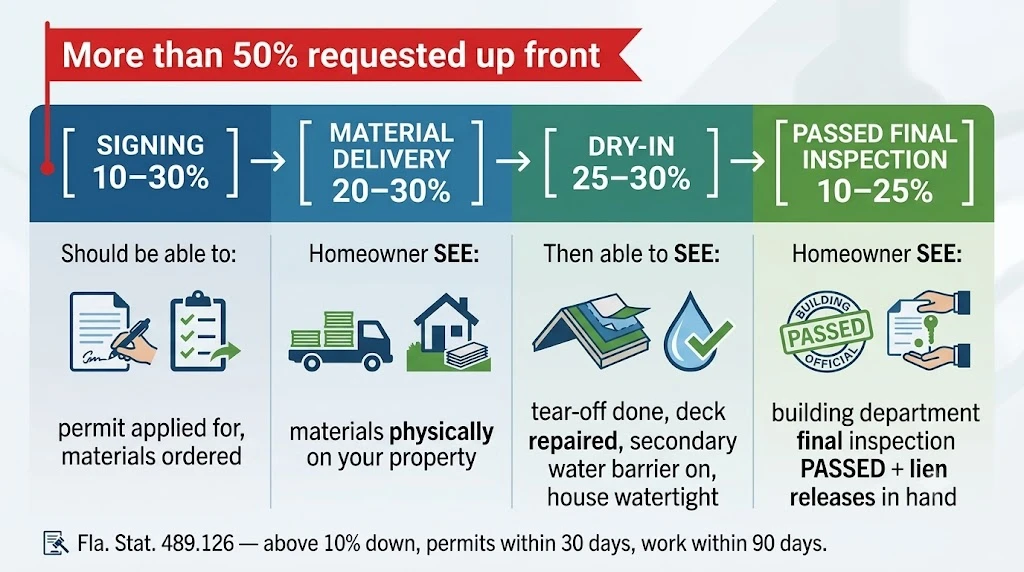
Deposit on signing: 10 to 30 percent. Covers permit fees and material ordering.
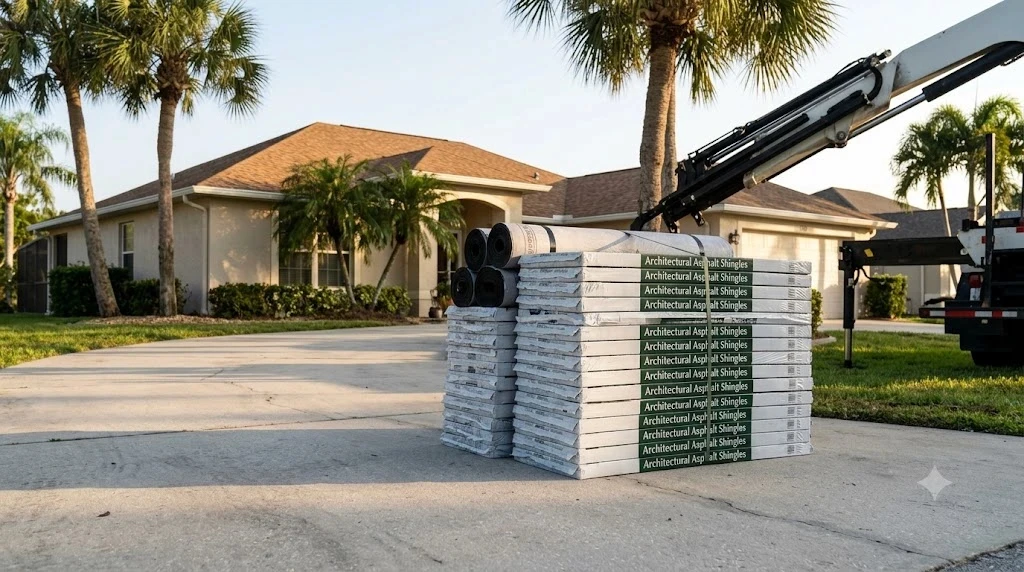
On material delivery: 20 to 30 percent. You are paying for something physically sitting on your property.
On dry-in: 25 to 30 percent. Tear-off complete, deck repaired, underlayment and secondary water barrier installed, house watertight. This is the single most important milestone on a South Florida roof.
On completion and passed final inspection: the remaining 10 to 25 percent.
That last line is non-negotiable. In Broward and Miami-Dade, the county or municipal building department performs an in-progress inspection and a final inspection. Until the final has passed, the work is not accepted, and any payment made before then is negotiating power handed away for free.
Key takeaway: Hold the final payment until the permit shows a passed final inspection. Not a photo of a finished roof. The inspection record.
Six deposit red flags
More than 50 percent requested up front. Outside of highly specialised custom material orders, there is no legitimate reason for it.
Cash only, or payment to a personal account. Pay the licensed business entity, ideally by card or check, so you have a record and a dispute path.
No written contract before payment. The contract should name the licensed entity, the license number, the scope, the materials by manufacturer and product, the payment schedule and the warranty terms.
Pressure to sign today. Storm-chasing operations work on urgency because urgency prevents comparison.
An offer to cover your deductible. Prohibited under Florida Statute 489.147.
No permit pulled. Roof replacement requires a permit everywhere in South Florida. Unpermitted work creates an open code issue that surfaces at resale and is not covered by insurance.
What belongs in the contract before you pay a cent
A deposit is only as safe as the document it is attached to. Before any money moves, the written contract should contain all nine of these. Anything missing is a question to ask, not a detail to overlook.
The licensed entity name and license number. Not a DBA on a truck. The name that appears on the DBPR record.
The full scope. Tear-off versus overlay, layer count, deck repair allowance with a stated per-sheet price, and what happens if more rot is found than allowed for.
Materials named by manufacturer and product. "Architectural shingle" is not a specification. Manufacturer, product line, colour and underlayment type is.
The secondary water barrier method. Required on South Florida re-roofs and a real cost line. It should be named, not assumed.
Permit responsibility. Who pulls it, which jurisdiction, and whether the fee is included or billed at cost.
The payment schedule, with each stage tied to an observable milestone.
Start and substantial completion dates, with weather-delay language.
Warranty terms, split in two. The manufacturer warranty on materials and the contractor warranty on workmanship are different products with different durations. Get both in writing.
Clean-up and disposal, including magnetic nail sweep and dumpster placement.
One more clause worth asking for: a stated remedy if work does not start by an agreed date. Florida Statute 489.126 already gives you a 90-day statutory backstop on deposits over 10 percent, but a contractual date is faster to enforce than a statute and usually never needs to be used at all.
Key takeaway: The deposit percentage is the least interesting number on the contract. The material specification, the deck repair allowance and the dry-in milestone decide whether the job goes well.
Protecting yourself with a Notice of Commencement
For any job over $2,500, Florida Statute 713.13 requires a recorded Notice of Commencement before work begins. It is filed with the county clerk and posted at the property.
It exists to protect you. Under Florida's construction lien law, suppliers and subcontractors can place a lien on your property if the general contractor takes your money and does not pay them, even though you paid in full. Request lien releases from the contractor and from material suppliers at each payment stage, and get a final release with the last payment. It takes one email per stage and removes an entire category of risk.
What to do when you cannot fund a deposit
A South Florida roof replacement typically runs $5.50 to $9.00 per square foot for architectural shingle and $12 to $22 for tile, so a 2,000 square foot roof lands somewhere between roughly $12,000 and $45,000 depending on system. Not everyone has a deposit sitting ready, and a leaking roof does not wait for a savings plan.
The realistic routes:
Contractor-arranged financing. Most established Florida roofers work with lenders offering deferred-interest or fixed-term plans. The lender pays the contractor against milestones, so your out-of-pocket deposit is often zero. See our roof financing options.
Insurance claim funding. If the damage came from a covered event such as a named storm, the carrier's initial actual cash value payment typically covers mobilisation, with recoverable depreciation released after completion. Our insurance claim guidance covers documentation.
Home equity line of credit. Usually the lowest interest rate available for a roof, though it takes several weeks to arrange.
PACE assessment financing. Available in parts of Florida for wind-resistance and energy improvements, repaid through the property tax bill. Read the terms carefully, because the obligation attaches to the property and can complicate a sale or refinance.
My Safe Florida Home. A state programme offering free wind mitigation inspections and matching grants for qualifying hardening improvements when funding is open. Check current status at mysafeflhome.com.
One tactic that costs nothing: ask whether the roof can be stabilised now and replaced on a scheduled date. A properly executed temporary repair buys months, and months are usually enough to arrange funding on your terms rather than under pressure.
The one question to ask every estimator
"What exactly does each payment release, and what happens to my money if you do not start?"
A contractor who answers with milestones, permit numbers and statutory timelines is running a business. A contractor who answers with reassurance is running something else. Roofing Network works under Florida licenses CCC1329271 and CGC1517295, publishes a milestone payment schedule in every contract, and provides free roof inspections across Broward, Miami-Dade and Palm Beach counties before any money changes hands.
A 25 percent deposit released against a confirmed material order is reasonable. A 25 percent deposit tied to nothing is a loan you are making to a stranger.
Roofing Network | Oakland Park, FL
Frequently asked
How much down payment do roofers require in Florida?
Most Florida roofing contractors request 10 to 30 percent of the contract price as a deposit, rising toward 30 percent when materials are special-order such as tile or standing seam metal. Financed jobs often require nothing up front, because the lender pays the contractor against milestones instead.
Is it legal for a Florida roofer to ask for 50 percent up front?
It is not prohibited outright, but Florida Statute 489.126 imposes duties on any contractor taking more than 10 percent of the contract price: permits must be applied for within 30 days and work started within 90 days. A request for half before materials arrive is well outside normal market practice and worth questioning.
When should I make the final payment on a roof replacement?
Only after the building department's final inspection has passed and you hold the inspection record, along with lien releases from the contractor and material suppliers. Paying before final inspection removes your remaining influence over any punch list item or documentation you still need.
Can a roofing contractor waive my insurance deductible in Florida?
No. Florida Statute 489.147 prohibits a contractor from paying, waiving, rebating or offering to waive any part of a property insurance deductible. An offer to cover your deductible is not a discount; it indicates the contractor is willing to operate outside Florida law.
How can I pay for a new roof if I have no money for a deposit?
Contractor-arranged financing usually requires no deposit because the lender funds the work directly against milestones. Other routes include an insurance claim payment where the damage is from a covered event, a home equity line of credit, PACE assessment financing, or My Safe Florida Home grants when funding is open. A temporary stabilisation repair can buy time to arrange the best option.
Keep reading
More answers on the same topic.
Does an HOA Cover Roof Replacement in Florida?
Condo boards own the roof by statute. HOA boards often do not. Here is how to read your declaration and settle the question in ten minutes.
View details
When to Call a Roofer for a Roof Leak (7 Signs)
Sagging ceiling, water near electrics, daylight through the deck: those do not wait. A slow stain can wait a few days, not a few months.
View details
Do Townhouse HOAs Include the Roof? (Florida)
Townhome roofs cross property lines, so associations usually maintain them. The uncovered parts are where owners get caught out.
View details