
Commercial Roofing
SPF Spray Foam Roofing in Florida: Cost, Lifespan and Fit
Spray polyurethane foam roofing is a seamless, self-flashing system sprayed as a liquid directly over an existing roof, typically costing $5 to $9 per square foot installed in South Florida. It delivers roughly R-6.5 per inch of insulation, eliminates seams entirely, and lasts 25 years or more when recoated on schedule.
John Kraja
Certified Roofing Contractor, License CCC1329271 | Roofing Network
8 min read
Key takeaways
SPF costs roughly $5 to $9 per square foot installed in South Florida, usually less than a full tear-off and replacement.
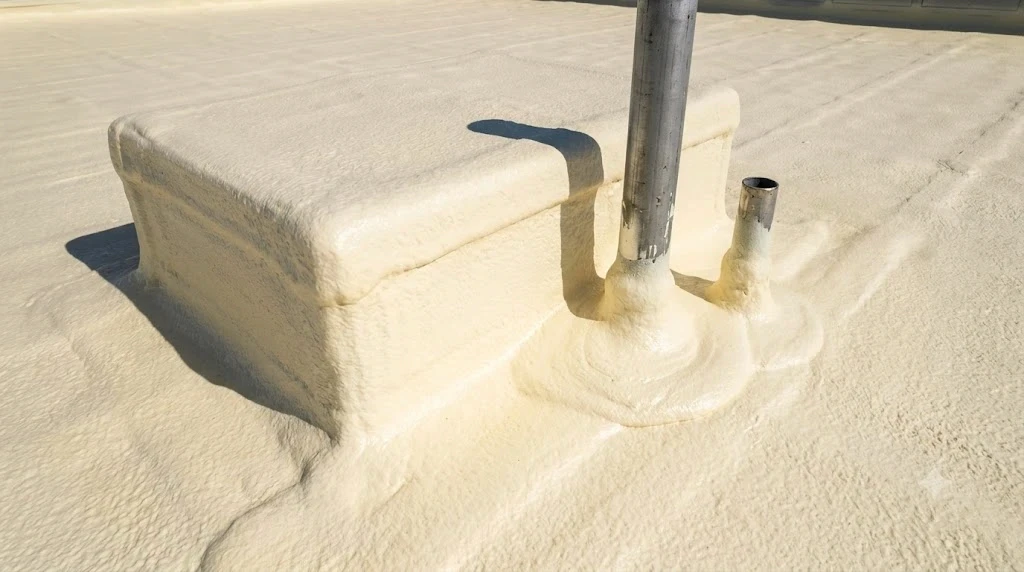
It is sprayed as a liquid, so it self-flashes around every curb, drain, pipe and HVAC penetration with no seams to fail.
Closed-cell foam delivers about R-6.5 per inch, which no single-ply membrane can match.
The coating, not the foam, is the wear layer. Recoat every 10 to 15 years and the system lasts indefinitely.
SPF is the wrong choice on ponding roofs with no drainage correction, on wet substrates, and where heavy foot traffic is unavoidable.
Spray polyurethane foam roofing costs roughly $5 to $9 per square foot installed in South Florida, delivers about R-6.5 of insulation per inch, and lasts 25 years or longer provided the protective coating is renewed every 10 to 15 years. It is applied as a liquid that expands in place, which means it seals around every drain, curb and pipe with no seams, laps or fasteners anywhere on the roof. That single property makes it the strongest option for penetration-heavy warehouse and industrial roofs, and a poor one for a few specific situations worth knowing before you get quotes.
Walk a 60,000 square foot distribution roof in Miami-Dade and count the penetrations. Exhaust fans, condenser curbs, gas lines, conduit runs, skylights, drains. On a mechanically fastened single-ply roof, every one of those is a flashing detail, and flashing details are where roofs leak. Not the field. Almost never the field.
Spray polyurethane foam removes the category. There are no flashing details, because there are no seams.
What SPF roofing actually is
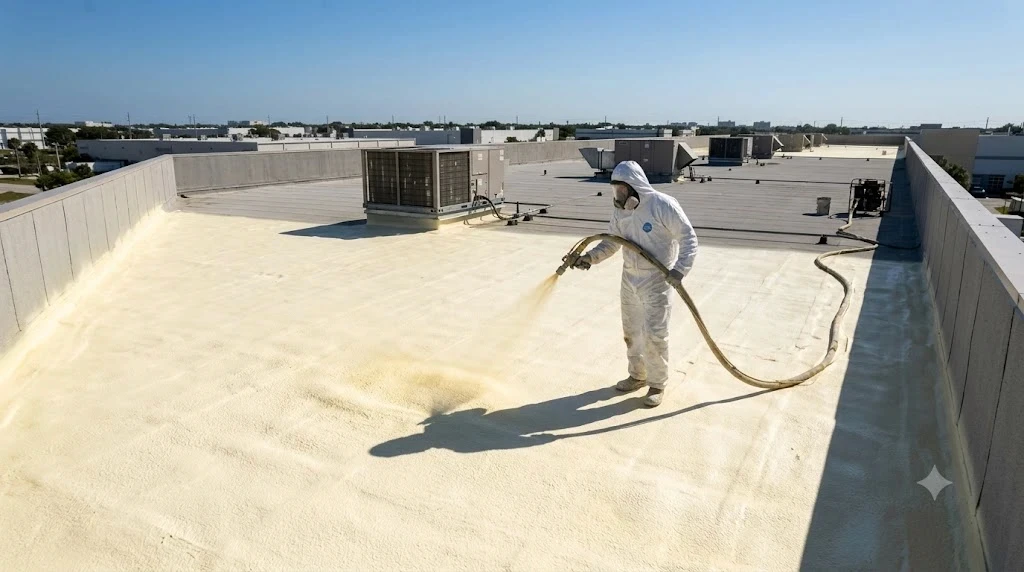
Two liquid components, an isocyanate and a polyol resin, are metered through a heated hose and combined at the spray gun. They react on contact with the roof deck and expand roughly thirty times in volume within seconds, curing into a rigid closed-cell foam.
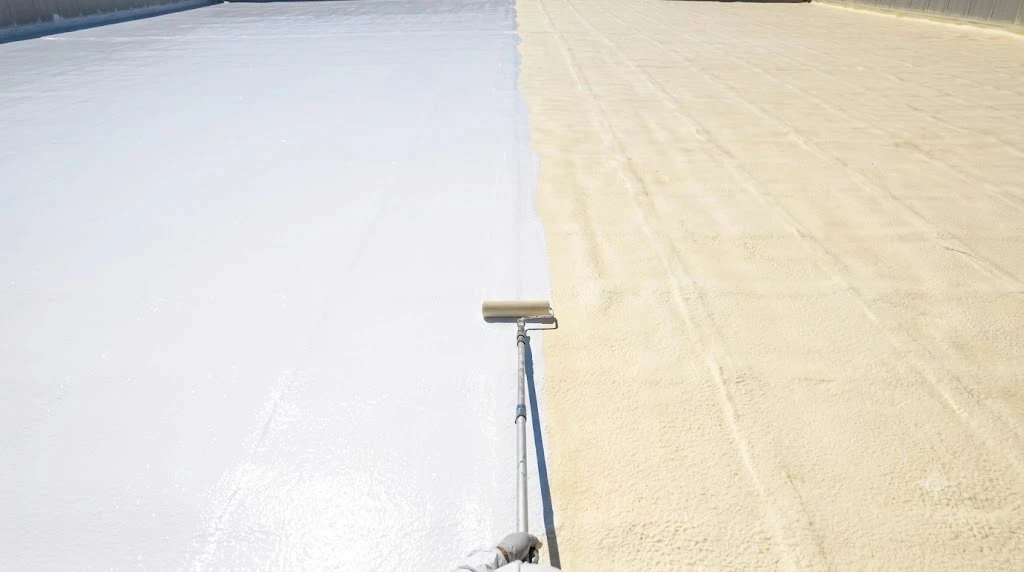
The foam is applied at a nominal one to one and a half inches on most commercial retrofits, tapered where drainage needs correcting, and finished with a protective elastomeric coating, usually silicone in Florida, at 20 to 30 mils dry film thickness. Granules are broadcast into the wet coating where foot traffic is expected.
The result is one monolithic layer bonded across the entire deck: no laps, no fasteners penetrating the substrate, no seams to open up as the building moves.
Key takeaway: The foam provides insulation and slope. The coating provides UV protection and waterproofing. They are two different products doing two different jobs, and confusing them leads to bad maintenance decisions.
What SPF roofing costs in South Florida
Installed pricing across Broward, Miami-Dade and Palm Beach counties typically lands in these ranges:
SPF over an existing sound roof, 1 inch plus silicone coating: approximately $5.00 to $7.00 per square foot.
SPF at 1.5 to 2 inches with tapered build-up for drainage correction: approximately $7.00 to $9.00 per square foot.
Recoat at 10 to 15 years: approximately $1.75 to $3.00 per square foot.
Full tear-off and new TPO or modified bitumen for comparison: approximately $6.00 to $12.00 per square foot.
On a 30,000 square foot warehouse roof, that puts an SPF retrofit at roughly $150,000 to $270,000 against $180,000 to $360,000 for a full replacement. The gap widens further once you count what you are not paying for: no tear-off, no landfill tipping fees, and in most cases no operational shutdown, because the building stays open throughout.
The recoat number is the one that decides lifecycle cost. A roof recoated at year twelve for $2.25 per square foot has effectively been renewed for a quarter of what a replacement would cost, and the clock resets.
Where SPF earns its money
Four building conditions make SPF clearly the better economic choice rather than merely a valid alternative.
Heavy penetration density
Warehouses, food processing plants, hospitals and any building with a crowded rooftop mechanical layout. Each curb on a single-ply roof is a detail installed by hand under time pressure. On SPF, the foam simply flows up and over it in one pass.
Ponding water and bad drainage
Florida flat roofs pond. SPF can be sprayed thicker in low areas to build positive slope toward drains without adding tapered insulation board and a new membrane on top. This is the single most useful thing SPF does that no membrane system can.
Cooling costs that matter
Closed-cell foam delivers roughly R-6.5 per inch. Two inches of foam is about R-13 added to a roof assembly that may currently have very little. Paired with a white silicone topcoat reflecting most incident solar radiation, the cooling load reduction on a conditioned South Florida building is measurable on the utility bill, not theoretical.
Operations that cannot stop
No tear-off means no exposed deck, no open building, and no interior protection programme. Work proceeds section by section and the building stays in production.
When SPF is the wrong choice
Any contractor who tells you SPF suits every roof is selling, not specifying. It is genuinely a poor fit in five situations.
A wet substrate. Foam bonds to the existing roof. If there is trapped moisture in the insulation below, you are sealing it in. Core cuts or an infrared moisture survey before quoting is not optional, and any contractor skipping that step should be removed from consideration.
Heavy or constant foot traffic. Foam dents under point loads. Walk pads and granulated coating help, but a roof crossed daily by maintenance staff is better served by a membrane with traffic protection.
Poor surface preparation. Foam bonds to what it touches. Dirt, loose gravel, silicone residue or ponded water at spray time means adhesion failure, and adhesion failure on SPF is not a repair, it is a redo.
Windy application conditions. Overspray drifts and lands on cars, neighbouring roofs and equipment. Reputable applicators shut down above roughly 12 to 15 mph and mask aggressively. It is a real scheduling constraint in coastal South Florida.
Neglected recoating. Once UV degrades the coating and reaches the foam, deterioration accelerates quickly. An SPF roof with no maintenance budget attached is a bad investment.
Key takeaway: SPF failures are almost never foam failures. They are preparation failures and maintenance failures.
How SPF compares to the alternatives
For a typical South Florida flat commercial roof, the practical comparison looks like this:
SPF: seamless, self-flashing, R-6.5 per inch, corrects slope, no tear-off, $5 to $9 per square foot, indefinite life with recoats every 10 to 15 years. Weak points: foot traffic, application weather, substrate prep.
TPO single-ply: reflective, well-proven, mechanically fastened or adhered, $6 to $10 per square foot, 20 to 25 year life. Weak points: seams and flashings, no meaningful R-value from the membrane itself, penetrations are labour-intensive.
Modified bitumen: tough and repairable, good for traffic, $7 to $12 per square foot, 15 to 20 year life. Weak points: heavier, seam-dependent, absorbs heat unless coated.
Silicone coating restoration over a sound existing roof: lowest cost at $2 to $4 per square foot, 10 to 15 year renewal. Weak points: adds no insulation, corrects no slope, and only works where the existing roof is genuinely sound.
If the existing roof is dry and structurally fine and you only need waterproofing, a coating restoration is the cheaper answer. If you need waterproofing plus insulation plus drainage correction in one operation, that is SPF's territory. If the deck is compromised or the insulation is saturated, neither works and you are looking at a full replacement.
How to compare SPF bids without getting fooled
SPF bids are unusually easy to make look cheap, because two of the three cost drivers are invisible once the job is finished. Three numbers decide whether you are comparing like with like.
Foam thickness
Quoted in inches, and it is the single biggest material cost. A bid at 1 inch and a bid at 1.5 inches are not competing bids; the second one has 50 percent more foam in it and roughly R-3 more insulation. Insist that thickness is stated in the contract, not described as "as required".
Coating dry film thickness
Quoted in mils. This is the wear layer, and it decides how long you go before the first recoat. Twenty mils and thirty mils look identical on the day of handover and differ by years in service life. Ask for wet mil gauge readings to be recorded during application, not estimated from gallons ordered.
Density and compressive strength
Roofing foam should be nominal 2.8 to 3.0 pound density with compressive strength around 40 to 50 psi. Lower-density wall foam is cheaper and will not take foot traffic. This belongs on the submittal.
Then check three process items: whether a moisture survey is included and priced, whether saturated insulation removal is a line item or a change order waiting to happen, and what the warranty actually covers. A manufacturer no-dollar-limit warranty on a certified applicator installation is a materially different product from a contractor workmanship warranty, and the price difference between two bids is often exactly that.
Key takeaway: Get thickness in inches, coating in mils, foam density in pounds, and the moisture survey in writing. Bids without those four numbers cannot be compared.
Florida code, HVHZ and product approval
Broward and Miami-Dade counties sit inside Florida's High Velocity Hurricane Zone. Every roofing product installed there needs a current Miami-Dade Notice of Acceptance or a Florida Product Approval, and the installed assembly must match the fastening, thickness and coating specification named in that approval.
For SPF this means three things on your submittal: the foam and the coating must be listed as an approved assembly together, not individually; the minimum coating thickness in the approval is a hard minimum, not a target; and the wind uplift rating must match your building's height, exposure category and roof zone. Perimeter and corner zones carry higher uplift demand than the field.
Ask for the NOA number before you sign. Any applicator who cannot produce it for the exact foam and coating combination they are proposing is not ready to pull a permit. You can verify approvals through the Florida Building Commission's product approval system at floridabuilding.org.
What a properly run SPF project looks like
Moisture survey. Infrared scan or core cuts to map wet insulation. Wet areas get cut out and replaced before anything is sprayed.
Substrate preparation. Power sweep, remove loose gravel or failed coating, prime where required, confirm the deck is dry.
Detail work first. Drains, scuppers, curbs and expansion joints addressed before the field pass.
Foam application. Multiple passes to nominal thickness, tapered into low areas to build slope to drains.
Coating. Base and top coat to the approval thickness, granules broadcast at traffic areas, thickness verified with a wet mil gauge as work proceeds.
Documentation. Thickness records, photos and warranty registration. Keep these; the manufacturer warranty depends on them.
Roofing Network installs SPF systems across Broward, Miami-Dade and Palm Beach counties under Florida roofing license CCC1329271. Details and specification support are on our SPF spray foam roofing page, and commercial roof maintenance programmes cover the recoat scheduling that keeps the system alive.
SPF failures are almost never foam failures. They are preparation failures and maintenance failures.
Roofing Network | Oakland Park, FL
Frequently asked
How much does spray foam roofing cost per square foot in Florida?
SPF roofing typically costs $5.00 to $7.00 per square foot installed over a sound existing roof, and $7.00 to $9.00 per square foot where tapered foam is used to correct drainage. Recoating at year 10 to 15 runs about $1.75 to $3.00 per square foot. For comparison, a full commercial tear-off and replacement runs $6.00 to $12.00 per square foot.
How long does an SPF roof last in Florida heat and humidity?
The foam itself does not have a fixed service life; the elastomeric coating over it is the wear layer. Recoat every 10 to 15 years and the system continues indefinitely, with 30-year-plus SPF roofs still in service. Skip the recoat and UV degradation reaches the foam, at which point deterioration accelerates quickly.
Which companies install spray foam roofing on commercial buildings in Florida?
Look for a Florida-certified roofing contractor with a manufacturer applicator certification for the specific foam and coating system, and a current Miami-Dade Notice of Acceptance or Florida Product Approval covering that assembly. Roofing Network installs SPF systems across Broward, Miami-Dade and Palm Beach counties under license CCC1329271.
Can spray foam be applied over an existing commercial roof?
Yes, and that is its most common use. SPF is sprayed directly over sound existing roofing, which avoids tear-off cost, landfill fees and operational shutdown. The prerequisite is a dry substrate, so an infrared moisture survey or core cuts must confirm there is no saturated insulation to seal in.
Is spray foam roofing good for a warehouse with a lot of rooftop equipment?
It is one of the strongest fits. Because the foam is sprayed as a liquid, it self-flashes around every curb, pipe and conduit with no seams or laps, removing the flashing details where penetration-heavy roofs usually leak. Add walk pads where maintenance staff cross the roof regularly.
Keep reading
More answers on the same topic.
How to Fix a Commercial Roof Leak (Step by Step)
Water enters and exits in different places. That single fact explains why most commercial leak repairs fail on the first attempt.
View details
Does an HOA Cover Roof Replacement in Florida?
Condo boards own the roof by statute. HOA boards often do not. Here is how to read your declaration and settle the question in ten minutes.
View details
When to Call a Roofer for a Roof Leak (7 Signs)
Sagging ceiling, water near electrics, daylight through the deck: those do not wait. A slow stain can wait a few days, not a few months.
View details