
Cost & Financing
How to Pay for a Roof When You Have No Money
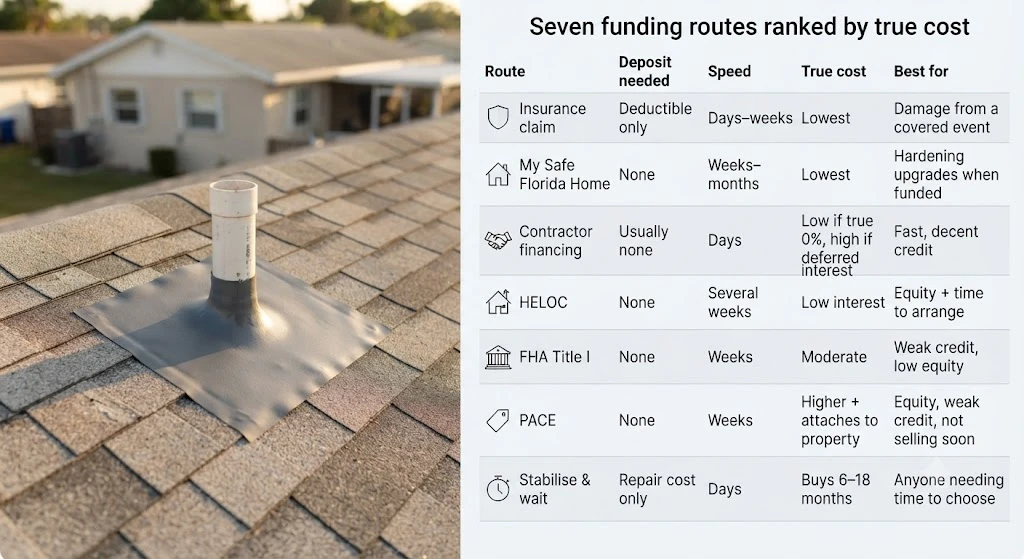
There are seven realistic ways to fund a Florida roof replacement without savings: an insurance claim, My Safe Florida Home grant money, contractor-arranged financing, a home equity line of credit, PACE assessment financing, an FHA Title I loan, or a staged repair-now-replace-later plan. They differ enormously in true cost, and two of them attach to the property rather than to you.
John Kraja
Certified Roofing Contractor, License CCC1329271 | Roofing Network
7 min read

Key takeaways
Check insurance first: if the damage came from a covered event, the carrier funds most of the work and you pay the deductible.
My Safe Florida Home offers free wind mitigation inspections and matching grants when the programme is funded.
Contractor-arranged financing usually needs no deposit, because the lender pays against milestones.
PACE financing repays through your property tax bill and stays attached to the property, which can complicate a sale or refinance.
A properly executed stabilisation repair buys months, and months let you choose the cheapest option instead of the fastest one.
If a Florida roof needs replacing and there is no money for it, work through the options in cost order rather than in urgency order. Start with an insurance claim, because a covered event shifts most of the cost to the carrier. Then check My Safe Florida Home grant funding. Then compare contractor-arranged financing against a home equity line of credit on total interest paid, not on monthly payment. PACE assessment financing comes last among the serious options, because the obligation attaches to the property title rather than to you. A temporary stabilisation repair buys the time to do all of this properly.
The worst roof decisions in South Florida are not made by people who chose badly. They are made by people who had four days of rain, one estimate, and no idea that five other funding routes existed.
So here they are, in the order a rational person should work through them.
1. Insurance, if the damage came from a covered event
This is first because it is the only option where somebody else pays the majority of the bill.
Florida homeowner policies cover sudden accidental damage: wind, hail, a tree limb, debris impact from a named storm. They do not cover wear, age or deferred maintenance. That distinction is the whole claim.
How the money actually arrives surprises people. Most Florida policies now pay on an actual cash value basis first, meaning the replacement cost minus depreciation for the age of the roof. That initial cheque funds mobilisation. The withheld portion, called recoverable depreciation, is released after the work is complete and documented. So the cash flow is: carrier pays some, you cover the deductible, contractor completes, carrier releases the rest.
Two Florida rules govern the timing. Notice of a new property claim must be given within one year of the date of loss, and a supplemental claim within eighteen months, under Florida Statute 627.70132. And no contractor may pay, waive or rebate your deductible; Florida Statute 489.147 prohibits it outright, so an offer to "cover the deductible" is a warning rather than a discount.
Our roof insurance claim guidance covers what documentation carriers actually accept.
Key takeaway: Before financing anything, establish whether this is a claim. A denied claim costs you nothing but time; an unfiled one costs you the whole roof.
2. My Safe Florida Home
A state programme offering free wind mitigation inspections and, when the legislature funds it, matching grants for qualifying hardening improvements: roof-to-wall connections, secondary water barriers, opening protection and roof-deck attachment upgrades.
Two things to understand. Funding opens and closes by legislative cycle, so availability changes year to year, and applications typically move fast when a window opens. And the grants target hardening improvements rather than roof replacement generally, so what qualifies is specific. Check current status at mysafeflhome.com before assuming either way.
Even when grant funding is closed, the free wind mitigation inspection is worth taking. It produces the OIR-B1-1802 form, which is what your insurer uses to apply premium discounts, and Florida law requires insurers to offer those discounts for qualifying construction features. Homeowners routinely discover they have been paying for discounts they already qualify for.
3. Contractor-arranged financing
Most established Florida roofers work with third-party lenders offering deferred-interest promotional periods or fixed-term instalment plans. The lender pays the contractor against milestones, which is why these usually require no deposit at all.
Three questions decide whether it is a good deal:
Is it deferred interest or zero interest? Deferred interest means that if any balance remains at the end of the promotional period, interest is charged retroactively on the original amount from day one. That is a very different product from true zero interest, and the difference is thousands of dollars.
Is there a dealer fee built into the price? Financing costs the contractor a percentage, and it is sometimes priced in. Ask for the cash price and the financed price side by side.
What is the rate after the promotional period? Often high teens or above.
Used properly, a genuine zero-interest twelve or eighteen month plan is the cheapest money available for a roof. Used carelessly, deferred interest is the most expensive.
4. Home equity line of credit
Usually the lowest interest rate available for a roof, because the loan is secured against the house. Interest may be deductible where funds are used to improve the property, which is a conversation for your accountant rather than your roofer.
The trade-off is time. A HELOC typically takes several weeks to arrange, including an appraisal, which makes it a poor fit for an active leak and a good fit for a roof you know is three years from failure. It also puts the house at risk in a way a personal loan does not.
5. PACE assessment financing
Property Assessed Clean Energy financing is available in parts of Florida for wind-resistance and energy improvements, including roofs. Approval is based largely on home equity rather than credit score, so it reaches people other products do not, and there is usually no money down.
Read this part carefully, because it is where people get caught. PACE is repaid as a non-ad-valorem assessment on your property tax bill, and the obligation attaches to the property, not to you. That means it can complicate a sale or refinance, because many mortgage lenders will not accept a PACE assessment sitting in a senior position to their lien, and buyers frequently ask for it to be paid off at closing. Effective rates and administrative fees are also typically higher than a HELOC.
PACE is a legitimate tool for someone with equity, weak credit and no intention of selling soon. It is a poor tool for anyone who might move within a few years.
Key takeaway: Ask one question of any PACE offer: what happens to this if I sell in three years? If the answer is vague, get it in writing before signing.
6. FHA Title I property improvement loan
A federally insured loan specifically for improvements that protect or improve the basic liveability of a home, which a roof plainly does. Available through approved lenders, and smaller loan amounts can be unsecured. Credit requirements are more forgiving than conventional home improvement lending, and the rates are usually well below a credit card.
It is slower than contractor financing and the lender list is limited, but for a homeowner with weak credit and little equity it is often the best genuine option on this page.
7. Stabilise now, replace later
The most underused option, and the one no financing brochure mentions.
A properly executed temporary repair on a failing roof, replacing failed pipe boots, re-flashing a valley, sealing a section, tarping a compromised area, can buy six to eighteen months for a few hundred to a few thousand dollars. That is not a fix. It is time, and time is what turns a panic decision into a planned one.
Use the interval to get three quotes rather than one, arrange the cheapest funding rather than the fastest, and schedule the work outside hurricane season when contractor availability is better and prices are more competitive. Roofing Network provides free roof inspections that state plainly how much time a stabilisation repair would realistically buy on your specific roof.
Two more routes worth knowing about
Neither suits most people, but both solve a specific problem well enough to be worth naming.
County and municipal home repair assistance
Broward, Miami-Dade and Palm Beach counties each administer housing rehabilitation assistance funded through federal Community Development Block Grant and SHIP allocations. Roof replacement is a common qualifying repair, because a failed roof makes a home unsafe.
Eligibility is income-based and typically restricted to owner-occupied primary residences, waiting lists are long, and funding cycles open and close. It is the wrong route for an active leak and a reasonable route for a roof with a year or two left in it. Call your county housing department directly rather than relying on third-party sites, and expect the application to require proof of ownership, income documentation and a current homeowner insurance policy.
Reverse mortgage proceeds, for owners over 62
A home equity conversion mortgage can fund a roof from accumulated equity with no monthly repayment, which suits an older homeowner on a fixed income facing a five-figure repair. The trade-off is significant and permanent: the balance grows over time and reduces what passes to heirs, and there are ongoing obligations around taxes, insurance and occupancy.
This is a financial planning decision rather than a roofing decision. If somebody who is selling you a roof is also recommending a reverse mortgage, treat that as a conflict of interest and get independent advice.
Key takeaway: Slow money and fast money solve different problems. Assistance programmes and equity products are for roofs you can plan around; contractor financing and insurance are for roofs that are already failing.
What to avoid
Credit cards at standard rates. At typical rates, a $20,000 roof paid over five years costs far more in interest than any option above.
Any contractor offering to waive your deductible. Prohibited by Florida Statute 489.147.
Signing anything during a door-knock after a storm. Storm-chasing operations work on urgency because urgency prevents comparison.
Paying more than a normal deposit up front. Ten to thirty percent is standard; see what Florida law says about roofing deposits.
Get the number before you choose the method
Every route above is easier to evaluate once you know the actual figure. A South Florida roof replacement typically runs $5.50 to $9.00 per square foot for architectural shingle and $12 to $22 for tile, so the gap between a 1,600 and a 2,600 square foot roof is enormous, and so is the gap between shingle and tile on the same house.
Our South Florida roof replacement cost guide breaks the variables down, and roof financing options shows what each route looks like as a monthly figure on a real quote rather than a brochure example.

The worst roof decisions are made by people who had four days of rain, one estimate, and no idea that five other funding routes existed.
Roofing Network | Oakland Park, FL
Frequently asked
How can I pay for a new roof with no money in Florida?
Work through the options in cost order: an insurance claim if the damage came from a covered event, My Safe Florida Home grant funding, contractor-arranged financing which usually needs no deposit, a home equity line of credit, an FHA Title I improvement loan, or PACE assessment financing. A temporary stabilisation repair buys time to arrange the cheapest of these.
Can you get roof financing in Florida with bad credit?
Yes. PACE assessment financing is approved largely on home equity rather than credit score, and FHA Title I property improvement loans have more forgiving credit requirements than conventional lending. Both are slower than contractor financing, and PACE attaches the repayment obligation to the property rather than to you.
What is PACE financing for a roof, and what is the catch?
PACE funds wind-resistance and energy improvements with no money down, repaid as an assessment on your property tax bill. The obligation attaches to the property, not the owner, so it can complicate a sale or refinance because many mortgage lenders object to the assessment's lien position and buyers often require payoff at closing.
Will insurance pay for my whole roof replacement?
Only if the damage came from a covered event such as wind or debris impact, and typically not in one payment. Most Florida policies pay actual cash value first, then release the withheld recoverable depreciation once the work is completed and documented. You pay the deductible, which a contractor is prohibited by law from waiving.
Is zero percent roof financing really zero percent?
Sometimes, but many promotional offers are deferred interest rather than zero interest. With deferred interest, any balance remaining at the end of the promotional period triggers interest charged retroactively on the original amount from day one. Ask explicitly which product it is, and ask for the cash price alongside the financed price.
Keep reading
More answers on the same topic.
How Much Down Payment Do Roofers Require in FL?
Ten to thirty percent is normal. Half before materials arrive is a warning sign, and Florida law gives you specific protection.
View details
When to Call a Roofer for a Roof Leak (7 Signs)
Sagging ceiling, water near electrics, daylight through the deck: those do not wait. A slow stain can wait a few days, not a few months.
View details
Does an HOA Cover Roof Replacement in Florida?
Condo boards own the roof by statute. HOA boards often do not. Here is how to read your declaration and settle the question in ten minutes.
View details