
Commercial Roofing
What a Commercial Roof Maintenance Program Should Include
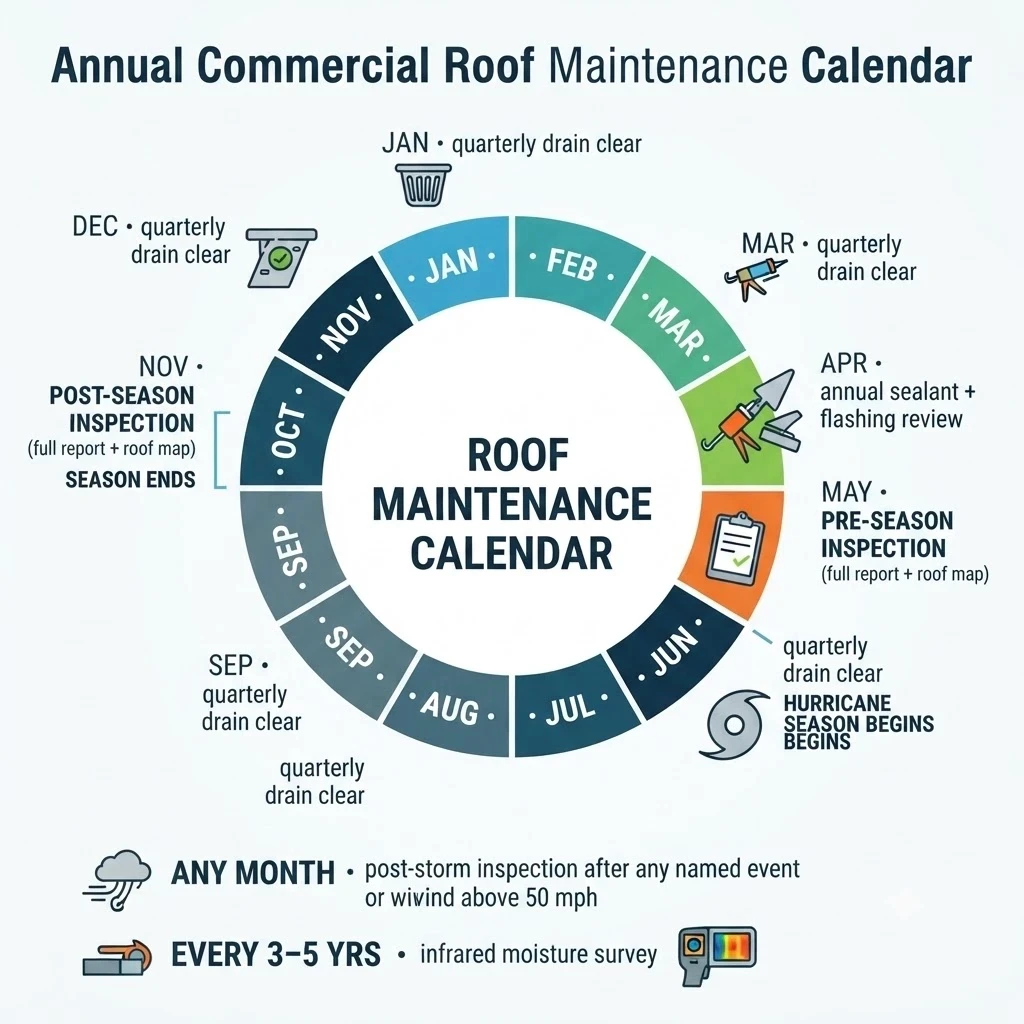
A commercial roof maintenance programme in Florida should include two documented inspections a year, quarterly drain and scupper clearing, post-storm inspections after any named event, an annual sealant and flashing review, a roof access log, and a written report with photographs each visit. Typical cost runs $0.05 to $0.20 per square foot per year.
John Kraja
Certified Roofing Contractor, License CCC1329271 | Roofing Network
7 min read
Key takeaways
Two inspections a year, timed late May and late November, catch most problems before they become claims.
Most manufacturer warranties require documented maintenance; missing records are a common reason a claim is declined.
Quarterly drain clearing is the cheapest single line item and prevents the most expensive failure mode.
A roof access log matters: every trade that goes up is a potential new penetration.
Budget $0.05 to $0.20 per square foot per year, against $6 to $12 per square foot to replace the roof early.
A commercial roof maintenance programme should contain six things: two scheduled inspections a year with written photographic reports, quarterly drain and scupper clearing, a post-storm inspection after any named event, an annual sealant and flashing review, a roof access log recording every trade that goes on the roof, and a periodic infrared moisture survey. Typical Florida pricing runs $0.05 to $0.20 per square foot per year depending on what repairs are bundled in. Anything less than that list is an inspection service, not a maintenance programme.
Ask a facility manager when the roof was last inspected and you get one of two answers. Either a date, or a pause. The pause is expensive.
Roofs in South Florida do not fail gradually and visibly. They fail at four or five specific details, quietly, for two or three years, and then present as a ceiling collapse over a server room in September.
The six things a real programme contains
1. Two scheduled inspections a year
Timed deliberately: late May, before hurricane season, so anything marginal gets addressed before it is tested. And late November, after the season, to catch damage that has not yet produced a leak.
Each visit should produce a written report with dated photographs, a plan-view roof map marking each observation, a severity rating, and a recommended action with a price. A report without a roof map is difficult to act on and impossible to compare year over year.
2. Quarterly drain and scupper clearing
The cheapest line item on the contract and the one that prevents the most expensive failure. A blocked drain produces ponding; ponding accelerates membrane degradation, adds structural load, and finds every weakness beneath it. In South Florida, debris accumulation after summer storms is constant.
Four visits a year is the minimum. On roofs with heavy tree cover, monthly during summer is not excessive.
3. Post-storm inspection
After any named storm, or any wind event above roughly 50 mph, regardless of whether anything is leaking inside. Wind damage frequently presents as lifted flashing, displaced coping and opened seams that leak weeks later during ordinary rain.
There is a claim dimension too. Florida requires notice of a new property insurance claim within one year of the date of loss. A post-storm inspection report dated within days of the event is the difference between a documented storm claim and an argument about deterioration.
4. Annual sealant and flashing review
Sealant is a consumable, not a permanent detail. Pitch pans, counter-flashing, termination bars and pipe boots typically need attention every three to five years under Florida UV. Reviewing them annually and renewing on a rolling basis is a fraction of the cost of the leak they prevent.
5. A roof access log
Underrated and nearly free. Every trade that goes on the roof, HVAC, telecoms, electrical, solar, window cleaning, is a potential new penetration or a dropped tool through a membrane. A log recording who went up and when explains most mystery leaks in one line.
Pair it with a simple rule: nobody accesses the roof without notifying the facility manager, and any new penetration is flashed by the roofing contractor, not by the trade that made it.
6. A periodic infrared moisture survey
Every three to five years, or immediately before any capital decision. An infrared scan after sunset shows wet insulation as warm areas, because saturated material releases stored heat more slowly than dry material.
This is the survey that tells you whether the roof can be restored or must be replaced, and it is the only honest basis for that decision. Opinion is not a substitute. Our commercial roof inspection service covers how the survey is run and reported.
Key takeaway: Inspections tell you what the roof looks like. A moisture survey tells you what it is worth.
What it costs, and what it saves
Florida commercial maintenance programmes typically price in these bands:
Inspection-only programme: roughly $0.05 to $0.08 per square foot per year. Two inspections, written reports, repairs quoted separately.
Standard programme: roughly $0.10 to $0.15 per square foot per year. Inspections, drain clearing, minor repairs up to an agreed value included.
Comprehensive programme: roughly $0.15 to $0.30 per square foot per year. Adds priority emergency response, higher included repair allowance and periodic infrared scanning.
On a 40,000 square foot roof, a standard programme is roughly $4,000 to $6,000 a year. Replacing that roof runs $6 to $12 per square foot, so $240,000 to $480,000. The programme does not need to extend the roof's life by much to pay for itself several times over; a maintained commercial roof reaching the top of its expected service range rather than the bottom is the whole economic argument.
The warranty reason, which is usually the decisive one
Most manufacturer warranties on commercial roof systems, particularly no-dollar-limit warranties, require documented maintenance and reserve the right to inspect. Two failure modes recur:
No records. A claim is submitted, the manufacturer requests the maintenance history, and there is none. The warranty is not honoured.
Unauthorised work. An unrelated contractor made a repair with non-approved materials, and the warranty is void from that point.
If you hold an NDL warranty, the maintenance programme is not an optional operating cost. It is the condition on which a six-figure asset guarantee depends. Ask your provider to hold and produce the records in the format the manufacturer requires, and confirm they are certified for your specific system.
What the reports should tell you over time
A single inspection report is worth having. A run of them is worth considerably more, because the value is in the trend rather than the snapshot.
After two years of consistent reporting you should be able to answer four questions from the file alone, without anyone going on the roof:
Which details keep coming back? The same pitch pan appearing in four consecutive reports is not a maintenance item. It is a design or workmanship defect that needs a different fix.
Is the rate of new findings rising? Three observations a visit rising to eleven over two years is a roof entering decline, and that is a capital planning signal well before it is a leak.
Where is the money going? If most of the repair spend clusters in one roof section, that section may warrant sectional replacement while the rest continues on maintenance.
What is the remaining service life estimate, and has it moved? A good provider revises this annually rather than repeating last year's number.
Ask for reports in a consistent format with the same roof map orientation each time. Providers who change format annually make trend analysis impossible, which is sometimes the point.
The National Roofing Contractors Association publishes guidance on inspection and documentation practice at nrca.net if you want a neutral reference for what to expect.
Key takeaway: You are not buying inspections. You are buying a documented history that tells you when to spend capital, and that history is only useful if the format stays constant.
What to look for in the contract
Six clauses separate a real programme from a photo album:
Emergency response time, stated in hours, with an out-of-hours contact route. "Prompt" is not a service level.
Included repair allowance, with a stated dollar or hour value per visit and a clear list of what falls outside it.
Report format and delivery time. Photographs, roof map, severity ratings, delivered within a defined number of business days.
Who owns the data. You should receive and keep every report, not view them on a portal you lose access to when the contract ends.
Manufacturer certification for your specific roof system, named in the contract.
Escalation path for anything found that exceeds the included allowance, so a $900 repair does not sit unactioned for a month waiting for approval.
What maintenance cannot fix
Honesty matters here, because maintenance is sometimes sold as a way to avoid a decision that has already been made.
If a moisture survey shows more than roughly a quarter of the insulation is wet, if leaks appear in new locations each season, or if annual repair spend exceeds a quarter of replacement cost, maintenance is subsidising a roof that has finished. At that point the options are a coating restoration where the substrate is genuinely dry, an SPF overlay, or a full commercial roof replacement. Our guide to diagnosing commercial roof leaks sets out the thresholds in detail.
A good maintenance provider will tell you when you have crossed that line. One who keeps selling annual visits on a roof with 40 percent wet insulation is charging you to watch it fail.
Starting from nothing
If there is no history at all on your roof, the sequence is: a baseline inspection with an infrared moisture survey, a roof map with a condition rating, an estimate of remaining service life, and a capital plan with a replacement year in it. Then the programme starts.
Our commercial roofing hub covers the full range of systems and services those plans usually draw on. The capital plan is the part finance directors care about. A roof with a documented remaining service life of seven years is a budget line. A roof with no assessment is an unplanned emergency waiting for a quarter you cannot afford it in. Roofing Network provides commercial roof maintenance programmes across Broward, Miami-Dade and Palm Beach counties under Florida license CCC1329271, with reporting formats that work for both facilities and finance.

Ask a facility manager when the roof was last inspected and you get a date or a pause. The pause is expensive.
Roofing Network | Oakland Park, FL
Frequently asked
What should a commercial roof maintenance program include?
Two documented inspections a year with photographic reports and a roof map, quarterly drain and scupper clearing, a post-storm inspection after any named event, an annual sealant and flashing review, a roof access log, and an infrared moisture survey every three to five years. Anything less is an inspection service rather than a maintenance programme.
How much does a commercial roof maintenance contract cost in Florida?
Inspection-only programmes run roughly $0.05 to $0.08 per square foot per year, standard programmes with drain clearing and minor repairs included run $0.10 to $0.15, and comprehensive programmes with priority emergency response and infrared scanning run $0.15 to $0.30. On a 40,000 square foot roof that is roughly $2,000 to $12,000 a year.
Does roof maintenance affect my manufacturer warranty?
Usually yes. Most commercial system warranties, particularly no-dollar-limit warranties, require documented maintenance and restrict who may work on the roof. Claims are commonly declined for two reasons: no maintenance records exist, or an uncertified contractor made a repair with non-approved materials.
How often should a commercial roof be inspected in South Florida?
Twice a year as a minimum, ideally late May before hurricane season and late November after it, plus a post-storm inspection following any named event or wind above roughly 50 mph. Drains and scuppers need clearing quarterly, or monthly through summer on roofs with heavy tree cover.
When does maintenance stop being worth it on a commercial roof?
When an infrared survey shows more than roughly a quarter of the insulation is wet, when leaks appear in new locations each season, or when annual repair spend exceeds a quarter of replacement cost. At that point the honest options are a coating restoration on a dry substrate, an SPF overlay, or full replacement.
Keep reading
More answers on the same topic.
How to Fix a Commercial Roof Leak (Step by Step)
Water enters and exits in different places. That single fact explains why most commercial leak repairs fail on the first attempt.
View details
SPF Spray Foam Roofing in Florida: Cost & Lifespan
SPF is the only commercial roof system that is seamless, self-flashing and insulating at once. It is also the least forgiving of poor prep.
View details
Flat Roof Repair or Replacement: How to Decide
Wet insulation percentage, repair spend ratio, remaining service life, deck condition. Get those four and the decision makes itself.
View details