
Commercial Roofing
TPO vs EPDM vs Modified Bitumen in Florida
For most South Florida commercial buildings, TPO is the default because its reflective white surface cuts cooling load in a climate where cooling is the dominant energy cost. EPDM is the most durable membrane chemically but is usually black, which works against you here. Modified bitumen is the toughest underfoot and the best choice for high-traffic roofs.
John Kraja
Certified Roofing Contractor, License CCC1329271 | Roofing Network
8 min read
Key takeaways
TPO: white and reflective, heat-welded seams, roughly $6 to $10 per square foot, 20 to 25 year service life.
EPDM: outstanding UV and ozone resistance, adhesive or tape seams, but standard black membrane absorbs heat in a cooling-dominated climate.
Modified bitumen: two-ply and highly puncture resistant, best for rooftop foot traffic, roughly $7 to $12 per square foot.
Reflectivity is not a green talking point in South Florida; it is a direct operating cost line.
Whatever you choose, it needs a current Miami-Dade NOA or Florida Product Approval to be installed in Broward or Miami-Dade.
In South Florida, TPO suits most commercial buildings, modified bitumen suits roofs that get walked on regularly, and EPDM is usually the wrong pick unless you specify the white version or a ballasted assembly. The reason is climate rather than product quality: this is a cooling-dominated region, so a black membrane absorbing solar heat all day works directly against your largest operating expense. Beyond reflectivity, the three systems differ most in how their seams are made, and seams are where flat roofs fail.
Three membranes, three genuinely different products, and one Florida-specific factor that reshuffles the ranking you would get anywhere north of Orlando.
TPO: the South Florida default
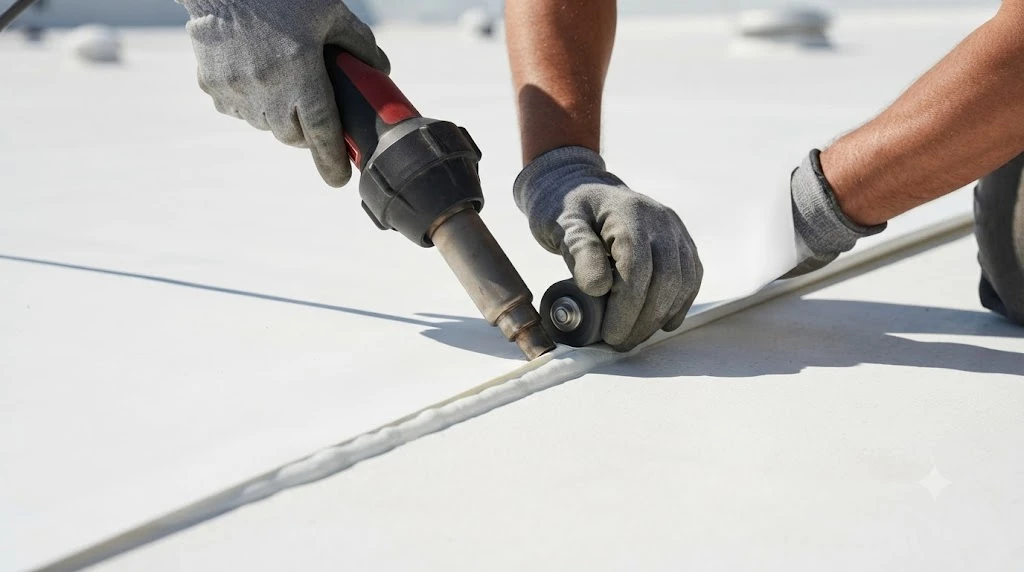
Thermoplastic polyolefin is a single-ply membrane, typically 45, 60 or 80 mil, manufactured white and installed mechanically fastened, fully adhered or induction welded. Seams are made with hot air, fusing the sheets into a single homogeneous material rather than gluing them together.
Why it dominates here. A white TPO surface reflects the large majority of incident solar radiation. On a conditioned building in Broward or Miami-Dade, where cooling runs most of the year, that shows up on the utility bill rather than in a brochure. Reflective roofing products are listed by the Cool Roof Rating Council and many qualify under Energy Star, which matters for some tenants and lenders.
Where it is weaker. The welded seam is only as good as the weld, so installer skill and weld testing matter enormously; a cold weld looks identical to a good one until it opens. TPO formulations have also changed repeatedly since the material was introduced, so early-generation performance data is not a guide to current products. And the membrane itself adds essentially no insulation value, so R-value has to come from the insulation board below.
Typical cost: $6 to $10 per square foot installed in South Florida. Service life: 20 to 25 years. Choose 60 mil over 45 mil on anything you intend to keep.
Key takeaway: TPO wins on reflectivity and on seam integrity when welded properly. Ask how seams are probe-tested, and ask for the test log.
EPDM: the most durable membrane in the wrong colour
Ethylene propylene diene monomer is a synthetic rubber single-ply, usually 45, 60 or 90 mil. It has the longest field track record of the three and outstanding resistance to UV, ozone and thermal cycling. It stays flexible in cold, which is why it dominates in northern climates.
The Florida problem. Standard EPDM is black. A black roof in Broward can reach very high surface temperatures under summer sun, and that heat load lands on your cooling system every day. White EPDM exists and solves this, but it costs more and is less commonly stocked. Ballasted assemblies also work but add significant structural load, which most existing South Florida buildings were not designed for.
Seams. EPDM seams are made with adhesive or seam tape rather than heat welding. Modern tape systems perform well, but the seam remains a bonded joint rather than a fused one, and seams are historically where EPDM roofs need attention first.
Typical cost: $5.50 to $9 per square foot installed for black, more for white. Service life: 20 to 30 years, genuinely the longest of the three when detailed well.
EPDM is a strong choice for an unconditioned warehouse where cooling load is not a factor, for a roof with heavy chemical or grease exposure where it outperforms TPO, or where the white version is specified and the budget allows. See our EPDM roof replacement page for where we specify it.
Modified bitumen: the one you can walk on
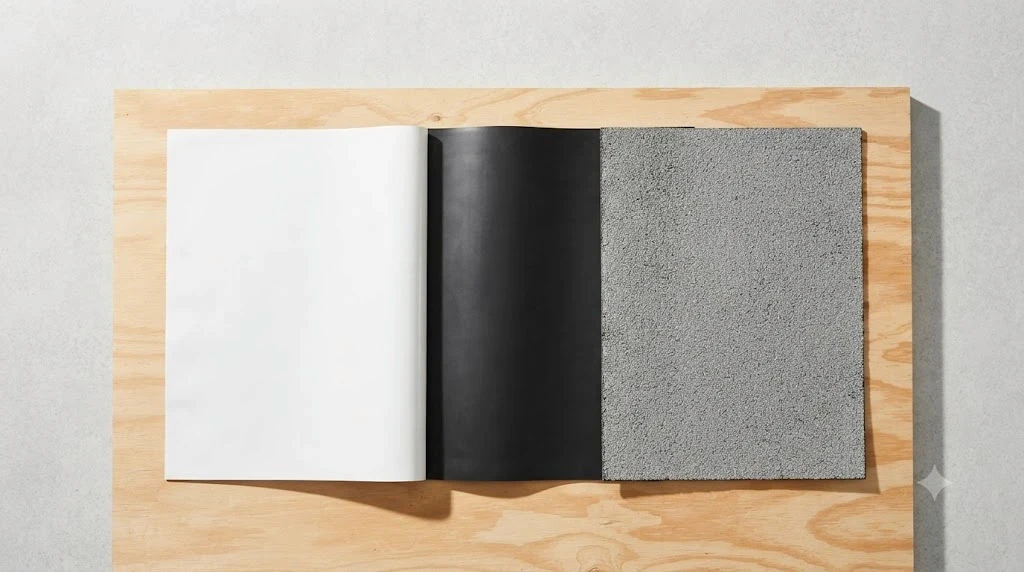
Modified bitumen is asphalt modified with polymers, either SBS for flexibility or APP for heat resistance, reinforced with polyester or fibreglass and installed in two plies. Application is by torch, hot asphalt, cold adhesive or self-adhered sheet.
Why it still wins jobs. Two plies mean redundancy: a puncture through the cap sheet does not automatically reach the deck. It is by a distance the most puncture and traffic resistant of the three, which matters on any roof crossed daily by maintenance staff, or crowded with equipment requiring regular service. It is also the easiest of the three to repair with commonly available materials, and repairs blend rather than patch.
Where it loses. A granulated cap sheet is usually dark and absorbs heat, though a white granulated cap or a reflective coating over the top solves that. It is heavier than single-ply, so structural capacity has to be confirmed on a recover. And torch application carries genuine fire risk, which is why self-adhered and cold-applied systems have become the norm on occupied buildings.
Typical cost: $7 to $12 per square foot installed. Service life: 15 to 20 years, longer if coated and maintained. Our modified bitumen replacement page covers the application methods we use on occupied buildings.
Side by side
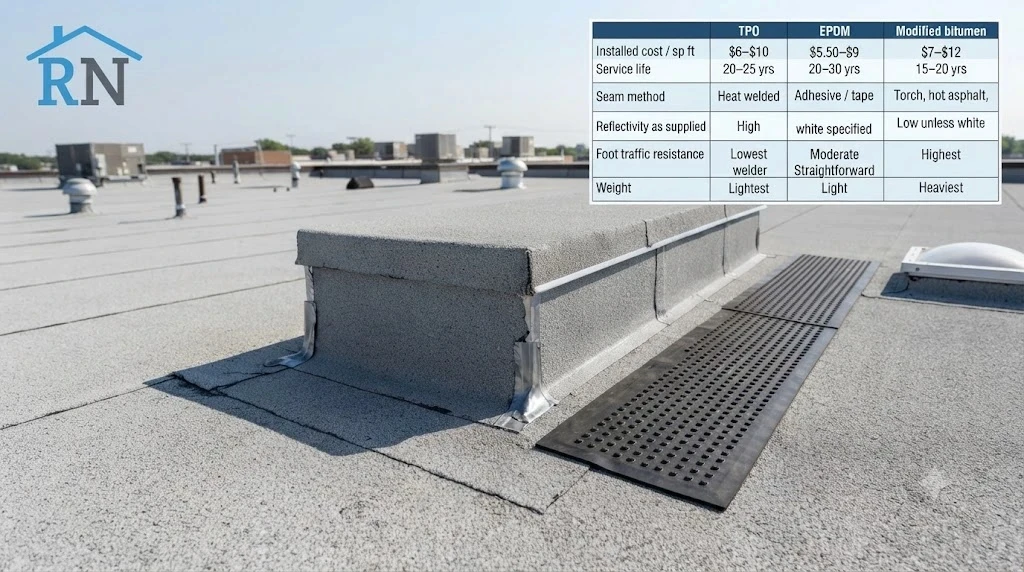
Installed cost per square foot: EPDM $5.50 to $9 · TPO $6 to $10 · Modified bitumen $7 to $12.
Service life: Modified bitumen 15 to 20 years · TPO 20 to 25 · EPDM 20 to 30.
Seam method: TPO heat welded (fused) · EPDM adhesive or tape (bonded) · Modified bitumen torch, hot asphalt, cold adhesive or self-adhered (fused or bonded by ply).
Reflectivity as supplied: TPO high · EPDM low unless white specified · Modified bitumen low unless white cap or coated.
Foot traffic resistance: Modified bitumen highest · EPDM moderate · TPO lowest of the three.
Repairability: Modified bitumen easiest · EPDM straightforward · TPO requires a hot air welder and matching membrane.
Weight: TPO lightest · EPDM light · Modified bitumen heaviest.
How to actually choose
Building use decides this more cleanly than product specifications do.
Air-conditioned building, low rooftop traffic. Retail, office, medical, cold storage. TPO at 60 mil. The reflectivity pays back continuously and the roof is not being walked on.
Heavy rooftop traffic or dense equipment. Restaurants, manufacturing, buildings with frequent HVAC service. Modified bitumen, or TPO with a comprehensive walkway pad system, but do not skip the pads.
Unconditioned warehouse. Reflectivity matters far less. EPDM becomes genuinely competitive, and its longer service life starts to win.
Grease or chemical exposure. Restaurant kitchen exhaust areas degrade some membranes quickly. EPDM handles it better, and localised protective mats around exhaust are worth specifying regardless.
Existing roof sound but leaking, and you want insulation too. None of these three. That is where SPF spray foam or a coating restoration outperforms a tear-off on cost.
Key takeaway: Match the membrane to how the roof gets used, not to the lowest number on the bid. The traffic question alone decides more of these than cost does.
The Florida code layer nobody mentions in a sales meeting
Broward and Miami-Dade counties sit inside the High Velocity Hurricane Zone. Whichever system you choose, three things must be true, and they are frequently glossed over:
The complete assembly needs approval, not the membrane alone. Deck, insulation, fastening pattern, membrane and edge metal are approved together as a system under a Miami-Dade Notice of Acceptance or Florida Product Approval. A membrane with an approval installed over an unapproved insulation attachment is not an approved assembly.
Wind uplift ratings vary by roof zone. Perimeters and corners carry substantially higher uplift demand than the field, and fastening density increases accordingly. A bid priced at field density across the whole roof is underpriced, and it will not pass inspection.
Edge metal matters more than people expect. Perimeter edge failure is one of the most common initiating causes of roof loss in high wind. It has its own approval and its own testing.
Ask for the NOA or Florida Product Approval number for the proposed assembly before signing, and verify it yourself at floridabuilding.org. Any contractor who cannot produce it is not ready to pull a permit.
The four things that decide the price of any of them
Bids on the same building for the same membrane routinely differ by 30 percent, and it is almost never margin. Four variables account for most of the gap, and none of them are visible once the roof is finished.
Membrane thickness. 45 mil against 60 mil against 80 mil is a material cost difference and a service life difference. A bid that does not state thickness in mils is not a bid you can compare.
Insulation thickness and type. The membrane provides almost no R-value; the polyiso board below it provides all of it. Two inches against four inches is a large cost difference and a large energy difference, and Florida energy code sets a minimum that some bids quietly sit at.
Attachment method. Mechanically fastened is cheapest and fastest. Fully adhered costs more, performs better in wind uplift, and eliminates the fastener-induced ridging that makes mechanically fastened roofs look wavy. Induction welded sits between the two.
Tear-off scope. Down to the deck, or recover over one existing layer? How many layers are actually up there? Core cuts answer this, and a bid written without them carries an assumption that becomes a change order.
Ask every bidder for the same four numbers in writing, then compare. Very often the cheap bid turns out to be 45 mil mechanically fastened over two inches of insulation, and the expensive one 60 mil adhered over four. Those are not competing prices for the same thing.
Key takeaway: Thickness in mils, insulation in inches, attachment method, tear-off scope. Without those four, you are comparing paragraphs rather than roofs.
The question that beats all of this
Before comparing membranes at all, establish whether you need a new membrane. If the existing roof is structurally sound and the insulation is dry, a coating restoration or an SPF overlay is often half the cost of a tear-off and buys 10 to 15 years. An infrared moisture survey answers that, and it should precede the material conversation rather than follow it.
Roofing Network installs TPO, EPDM and modified bitumen systems across Broward, Miami-Dade and Palm Beach counties under Florida license CCC1329271. Our TPO roof replacement page covers specification and warranty options, and commercial roof replacement covers the full tear-off process on occupied buildings.
Match the membrane to how the roof gets used, not to the lowest number on the bid. The traffic question alone decides more of these than cost does.
Roofing Network | Oakland Park, FL
Frequently asked
Is TPO or EPDM better for a Florida commercial roof?
TPO is usually better in South Florida because its white reflective surface reduces cooling load in a cooling-dominated climate, while standard EPDM is black and absorbs heat. EPDM has excellent durability and a longer service life, so it becomes competitive on unconditioned warehouses or where the white version is specified.
How much does TPO roofing cost per square foot in South Florida?
TPO typically runs $6 to $10 per square foot installed, depending on membrane thickness, attachment method, insulation thickness and tear-off complexity. EPDM runs roughly $5.50 to $9 for black membrane, and modified bitumen $7 to $12. Specify 60 mil rather than 45 mil on any roof you intend to keep long term.
Which flat roof system is best for a roof with heavy foot traffic?
Modified bitumen. Its two-ply construction gives redundancy, so a puncture through the cap sheet does not automatically reach the deck, and it is the most puncture resistant of the three systems. If TPO is used on a high-traffic roof, a comprehensive walkway pad system is essential rather than optional.
What is the difference between TPO welded seams and EPDM taped seams?
TPO seams are heat welded, fusing two sheets into one homogeneous material. EPDM seams are bonded with adhesive or seam tape, so the joint remains two materials held together. Welded seams are stronger when correctly executed, but a cold weld looks identical to a good one, which makes probe testing and a documented test log important.
Do commercial roof membranes need Miami-Dade approval in Broward County?
Yes. Broward and Miami-Dade are inside Florida's High Velocity Hurricane Zone, so the complete roof assembly, including deck, insulation attachment, membrane and edge metal, needs a current Miami-Dade Notice of Acceptance or Florida Product Approval, and must be installed to the fastening pattern specified in that approval.
Keep reading
More answers on the same topic.
SPF Spray Foam Roofing in Florida: Cost & Lifespan
SPF is the only commercial roof system that is seamless, self-flashing and insulating at once. It is also the least forgiving of poor prep.
View details
Flat Roof Repair or Replacement: How to Decide
Wet insulation percentage, repair spend ratio, remaining service life, deck condition. Get those four and the decision makes itself.
View details
What a Commercial Roof Maintenance Program Includes
Most maintenance contracts are an annual walk and a photo album. Here is what a programme that protects your warranty actually contains.
View details