
Commercial Roofing
Silicone Roof Coating Restoration: When It Works
A silicone roof coating restoration costs roughly $2 to $4 per square foot in South Florida and extends a sound commercial roof by 10 to 15 years, renewable indefinitely. It only works where an infrared moisture survey shows dry insulation, the substrate is structurally sound, and an adhesion test passes. Skip those three checks and the coating fails.
John Kraja
Certified Roofing Contractor, License CCC1329271 | Roofing Network
7 min read
Key takeaways
Silicone restoration runs roughly $2 to $4 per square foot against $6 to $12 for full replacement.
It is only valid where an infrared moisture survey shows the insulation is dry.
Silicone handles ponding water; acrylic does not, which matters on Florida flat roofs.
Preparation is most of the job: cleaning, priming, seam and penetration detailing before any field coat.
A restoration may be treated as maintenance rather than a capital improvement, which is a question for your accountant.
A silicone roof coating restoration is a fluid-applied membrane rolled or sprayed over an existing commercial roof, costing roughly $2 to $4 per square foot in South Florida and adding 10 to 15 years of service life, renewable at each interval. It is genuinely excellent value on the right roof and a waste of money on the wrong one. Three things decide which you have: whether the insulation is dry, whether the substrate is structurally sound, and whether the coating will actually bond to the existing surface.
Restoration coatings have a reputation problem in Florida, and it is deserved but misdirected. The failures are real. They are almost never the coating's fault.
They are the result of applying a waterproofing layer over insulation that was already saturated, on a surface nobody cleaned properly, at a thickness nobody measured.
What a silicone restoration actually is
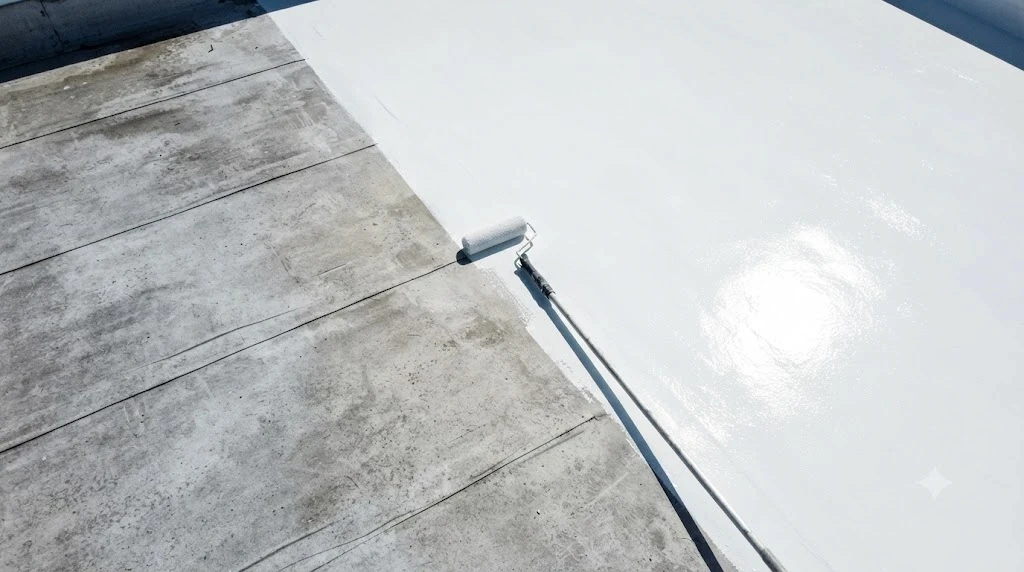
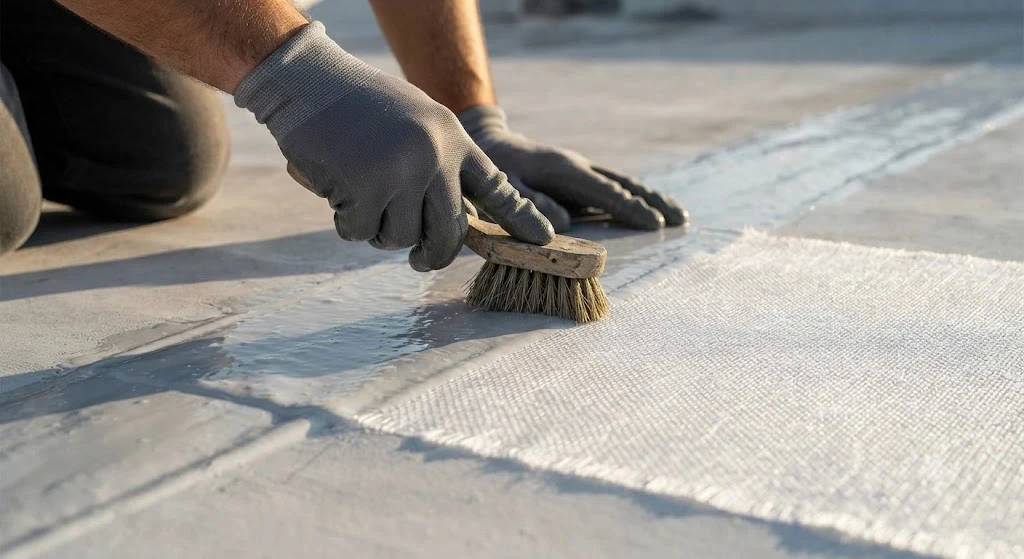
A high-solids silicone coating is applied over an existing roof, usually in two coats, at a total dry film thickness of around 20 to 30 mils. Before the field coats go on, seams, laps, penetrations, drains and terminations are detailed with reinforcing fabric embedded in coating.
The result is a monolithic, fully adhered waterproofing layer with no seams. Because it bonds to the existing roof rather than replacing it, there is no tear-off, no landfill, no exposed deck and no operational shutdown.
At the end of its service life it is recoated rather than removed, typically at a lower cost than the original application because the detail work is already done. That renewability is the real economic argument: a roof on a restoration cycle may never need another tear-off.
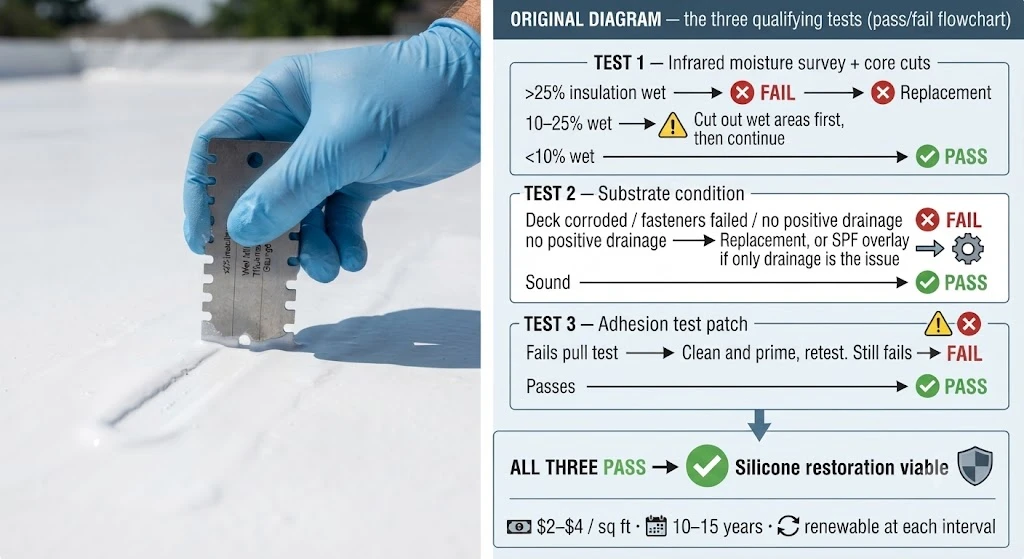
The three tests that decide whether it is viable
Test 1: infrared moisture survey
Non-negotiable. An infrared scan after sunset shows wet insulation as warm areas, because saturated material releases stored heat more slowly than dry material. Core cuts confirm the readings.
Coating over wet insulation seals the moisture in permanently. The insulation never dries, R-value is gone for good, steel decks corrode from above, and the coating blisters as trapped moisture vapour tries to escape under summer heat.
The rough rule: if more than about 25 percent of the insulation is wet, restoration is off the table and you are looking at replacement. Below that, wet areas are cut out and replaced before coating begins, and that removal is a line item that belongs on the quote rather than arriving later as a change order.
Test 2: substrate condition
A coating is a waterproofing layer, not a structural one. It cannot fix a deteriorated deck, failed fasteners, insulation that has lost compressive strength, or a roof that has no positive drainage at all. Ponding that never clears needs drainage correction first, either through additional drains, tapered insulation or an SPF overlay that can be sprayed thicker in low areas.
Test 3: adhesion test
Silicone bonds well to most surfaces, but not to all of them, and not to a dirty one. A previous silicone or asphalt-based coating, heavy grease near kitchen exhausts, chalking, or residual pond scale all affect adhesion. A test patch applied and pulled after cure takes a day and is the difference between a fifteen-year roof and a warranty argument.
Key takeaway: Any restoration quote produced without a moisture survey is a guess. Ask to see the scan images and the core cut photographs before you sign anything.
Silicone or acrylic?
Both are common in Florida, and the difference matters here more than in most states.
Ponding water. Silicone is essentially unaffected by standing water. Acrylic is water-based and re-emulsifies under prolonged ponding, softening and eventually failing. On a Florida flat roof with any ponding at all, this decides it.
Cost. Acrylic is cheaper per gallon, roughly $1.50 to $2.75 per square foot installed against $2 to $4 for silicone.
Dirt pickup. Silicone holds dirt and loses some reflectivity over time; acrylic stays cleaner and holds reflectivity better.
Cure. Silicone cures with humidity, which is an advantage in South Florida. Acrylic needs a dry window and a temperature floor, which can be awkward in summer.
Recoat. Silicone can generally only be recoated with silicone, which fixes your future path. Worth knowing rather than worth avoiding.
For most South Florida commercial flat roofs, silicone is the right answer because ponding is common and humidity is constant. Acrylic suits sloped metal roofs with genuinely positive drainage.
What the process should look like
Survey and core cuts. Map wet areas, confirm substrate and existing system.
Wet insulation removal. Cut out and replace saturated material with matching thickness.
Cleaning. Power wash, and where required a chemical cleaner to remove chalking, grease and biological growth. This is where corners get cut most often and where failures start.
Primer where required, based on the substrate and the adhesion test result.
Detail work. Seams, laps, penetrations, drains, terminations and any repairs, reinforced with fabric embedded in coating.
Field coats. Two coats to the specified dry film thickness, verified with a wet mil gauge as work proceeds rather than estimated from gallons ordered.
Documentation. Thickness records, photographs and warranty registration.
Manufacturer warranties on restoration systems typically run 10 to 20 years and depend entirely on that documentation, on a certified applicator, and on the specified thickness being achieved. Two bids at different prices are often two different thicknesses, which is not a like-for-like comparison.
The numbers, honestly
On a 40,000 square foot commercial roof in South Florida:
Silicone restoration at $2 to $4 per square foot: roughly $80,000 to $160,000, buying 10 to 15 years, renewable.
SPF overlay at $5 to $9 per square foot: roughly $200,000 to $360,000, adding insulation and drainage correction.
Full tear-off and replacement at $6 to $12 per square foot: roughly $240,000 to $480,000, plus disposal and disruption.
Where the roof qualifies, restoration is the clear economic winner. Where it does not, it is the most expensive option available, because you pay for it and then pay for the replacement anyway two years later.
There is also a tax dimension worth raising with your accountant rather than your roofer: a restoration is sometimes treated as a maintenance expense rather than a capitalised improvement, which changes when the deduction lands. Do not let anyone sell you a roof on tax treatment they are not qualified to advise on.
Where restorations fail, and why
Four failure modes account for nearly all of it, and recognising them in a quote is easier than recognising them on a roof.
Coating over wet insulation
The most common and the most expensive. Trapped moisture vapour expands under summer heat and lifts the coating in blisters, usually within the first two summers. There is no repair for this beyond removing the affected area entirely.
Inadequate cleaning
Silicone bonds to what it touches. Chalking, biological growth, grease near kitchen exhausts and pond scale all defeat adhesion. Power washing alone is often not enough, and a chemical cleaner plus rinse is frequently required. Cleaning is invisible in the finished job and is therefore the first thing cut on a competitive bid.
Under-thickness application
Coating is sold by the gallon and applied by the mil. A contractor working to a gallon budget rather than a thickness specification produces a roof that measures 14 mils where it should measure 25, and that difference is roughly half the service life. Wet mil gauge readings taken during application are the only defence.
Skipped detail work
Seams, laps, drains, penetrations and terminations need reinforcing fabric embedded in coating before the field coats. A field coat rolled straight over an untreated seam moves with the seam and splits along it.
All four are preparation and process failures, which is why the useful questions to a contractor are about method rather than product. Product approvals for coating systems used in the High Velocity Hurricane Zone can be verified at floridabuilding.org.
Key takeaway: Nobody can inspect a finished coating and tell you whether it was done properly. That is precisely why the documentation during application matters more here than on almost any other roofing work.
How to vet a restoration contractor
Four questions separate the serious from the rest:
Is an infrared moisture survey included, and will I see the images? If no, stop there.
What dry film thickness, in mils, and how is it verified during application? Wet mil gauge readings as work proceeds is the correct answer.
Are you a certified applicator for this manufacturer's system, and what warranty does that open up? A contractor workmanship warranty and a manufacturer system warranty are different products.
Is wet insulation removal a line item or a change order? Anything discovered later that was foreseeable earlier is a pricing tactic.
One further question is worth asking, and it separates a contractor who wants the job from one who wants the building: what happens at year twelve? A restoration is a cycle rather than an event, so the answer should describe an inspection schedule, a recoat trigger and a rough recoat cost, not a shrug. A provider who has thought about year twelve has priced year one honestly.
Roofing Network provides silicone roof coating restoration across Broward, Miami-Dade and Palm Beach counties under Florida license CCC1329271, starting with a commercial roof inspection and moisture survey, and we will tell you plainly when a roof does not qualify.
The failures are real, and they are almost never the coating's fault. They are the result of coating over insulation that was already wet.
Roofing Network | Oakland Park, FL
Frequently asked
How much does silicone roof coating cost per square foot in Florida?
Silicone restoration typically runs $2 to $4 per square foot installed in South Florida, against $6 to $12 per square foot for a full tear-off and replacement. Price varies with dry film thickness, the amount of detail work at seams and penetrations, and how much saturated insulation has to be removed first.
How long does a silicone roof coating last?
Ten to fifteen years, and it is renewable: at the end of that period the roof is recoated rather than replaced, usually at lower cost because the detail work is already done. That renewability means a roof kept on a restoration cycle may never need another tear-off.
Is silicone or acrylic better for a Florida roof coating?
Silicone, on almost any Florida flat roof. Acrylic is water-based and re-emulsifies under prolonged ponding water, which is common here, while silicone is essentially unaffected by standing water and cures with humidity. Acrylic suits sloped metal roofs with genuinely positive drainage.
Can you coat a roof that has wet insulation underneath?
No. Coating over saturated insulation seals the moisture in permanently, the insulation never dries, steel decks corrode from above, and the coating blisters as trapped vapour expands in summer heat. Wet areas must be cut out and replaced first, and if more than roughly a quarter of the insulation is wet, restoration is not viable.
How do I know if my commercial roof qualifies for restoration?
Three tests: an infrared moisture survey confirming the insulation is dry, a structural assessment confirming the deck, fasteners and drainage are sound, and an adhesion test patch confirming the coating will bond to the existing surface. Any restoration quote produced without a moisture survey is a guess.
Keep reading
More answers on the same topic.
SPF Spray Foam Roofing in Florida: Cost & Lifespan
SPF is the only commercial roof system that is seamless, self-flashing and insulating at once. It is also the least forgiving of poor prep.
View details
What a Commercial Roof Maintenance Program Includes
Most maintenance contracts are an annual walk and a photo album. Here is what a programme that protects your warranty actually contains.
View details
Flat Roof Repair or Replacement: How to Decide
Wet insulation percentage, repair spend ratio, remaining service life, deck condition. Get those four and the decision makes itself.
View details