
Commercial Roofing
Flat Roof Repair or Replacement: How to Decide
Four measurements decide whether a commercial flat roof should be repaired or replaced: the percentage of insulation that is wet, annual repair spend as a share of replacement cost, the roof's remaining service life, and the condition of the deck below. Once you have those four numbers, the decision usually makes itself without anyone needing an opinion.
John Kraja
Certified Roofing Contractor, License CCC1329271 | Roofing Network
7 min read
Key takeaways
More than roughly 25 percent wet insulation means replacement; below that, sectional repair or restoration is usually viable.
Annual repair spend above 25 to 30 percent of replacement cost means you are buying a roof without owning one.
A recover or overlay is only permitted where there is one existing roof covering; a second recover is not allowed.
Florida's 25 percent roof rule can force a full code upgrade, with a significant exception for roofs built to the 2007 code or later.
Get an infrared moisture survey before any bid. Without one, every number in every quote is a guess.
Repair a commercial flat roof when less than about a quarter of the insulation is wet, the deck is sound, annual repair spend is below a quarter of replacement cost, and the roof still has meaningful service life. Replace it when any two of those fail. The single most important step is an infrared moisture survey, because the wet insulation percentage drives every other decision and cannot be judged by walking the roof. Florida's 25 percent roof rule can also force the decision independently of condition.
Two contractors walk the same 40,000 square foot roof in Miami. One quotes $38,000 of repairs. One quotes $340,000 to replace it. Neither is lying, and the building owner has no way to tell which is right.
The way out is not a third opinion. It is four measurements.
Number 1: what percentage of the insulation is wet
The most important number, and the one almost nobody has.
An infrared survey conducted after sunset shows wet insulation as warm areas, because saturated material releases stored heat more slowly than dry material. Core cuts at sample points confirm the readings and reveal how many roof layers exist. Nuclear or capacitance moisture meters give a supporting reading.
How to read the result:
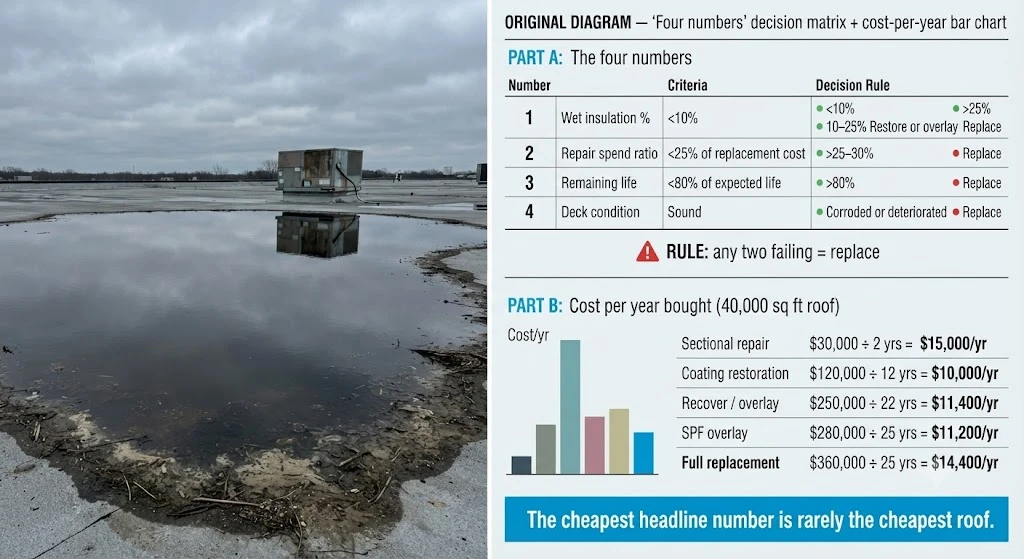
Under 10 percent wet: sectional repair. Cut out the wet areas, replace the insulation, patch the membrane properly.
10 to 25 percent wet: the grey zone. Sectional repair plus a coating restoration or an overlay is often the best value, provided the deck is sound.
Over 25 percent wet: replacement. Beyond this point you are paying to remove and replace so much of the roof that leaving the rest makes little sense, and the remaining wet area keeps damaging the deck.
Wet insulation does not dry out under a membrane. It permanently loses R-value, holds water against the deck, and corrodes steel from above. It is not a cosmetic issue.
Key takeaway: Any bid produced without a moisture survey, on either side of the argument, is a guess wearing a number.
Number 2: annual repair spend against replacement cost
Pull the last three years of roof repair invoices and add them up. Then divide by the cost to replace the roof.
Above roughly 25 to 30 percent a year, you are buying a new roof in instalments and receiving nothing durable for it. Three more years at that rate exceeds the replacement cost outright, and at the end of it you still own the old roof.
The signal is not just the total but the pattern. Repairs clustering at the same detail suggest a fixable problem. Leaks appearing in new locations each season suggest systemic membrane or fastener failure, which repair cannot address.
Number 3: remaining service life
Typical South Florida service lives, assuming reasonable maintenance:
Modified bitumen: 15 to 20 years
TPO: 20 to 25 years
EPDM: 20 to 30 years
Built-up roofing: 20 to 30 years
SPF with recoats: indefinite
Past about 80 percent of expected life, major repair investment rarely returns. Spending $60,000 repairing a roof with three years left is worse value than putting the same money toward the replacement you are going to make anyway.
Two Florida-specific factors compress these ranges: constant UV load, and salt air within a few miles of the coast, which is hard on fasteners and edge metal.
Number 4: deck condition
Core cuts show what is under the insulation. Steel deck corroded from years of trapped moisture, or a wood or lightweight concrete deck that has deteriorated, ends the repair conversation immediately. You cannot fasten a new roof to a deck that will not hold fasteners, and you cannot leave a compromised deck under a new membrane.
Deck replacement is expensive and disruptive, but discovering it mid-project as a change order is far worse. This is exactly what core cuts are for. Our roof deck replacement page covers how it is scoped and phased on occupied buildings.
The Florida code rule that can decide for you
Independently of condition, Florida's roofing code contains a rule that changes projects.
Where more than 25 percent of a roof area is repaired, replaced or recovered within any twelve month period, the entire roofing system generally has to be brought into compliance with the current code. That can pull in secondary water barriers, current fastening patterns, and edge metal to current approval, none of which were in your repair budget.
A significant exception was added in 2022: where the existing roof was built or repaired in compliance with the 2007 Florida Building Code or later, only the repaired, replaced or recovered portion must be brought to current code rather than the whole roof. Whether your roof qualifies depends on its permit history, which the building department holds.
The practical consequence: a large repair can quietly become a full replacement by operation of code, so ask the question before you scope the repair, not after. You can review the current code at floridabuilding.org, and any competent contractor should raise this unprompted.
The middle options most owners are never shown
Repair and replace are not the only two choices, and the middle ground is where most of the value sits.
Recover or overlay
A new membrane installed over the existing one, with wet areas cut out first. Cheaper and faster than tear-off, no landfill cost, and the building stays operational. The constraint: Florida code permits only one recover. If the roof already has two coverings, a recover is not available and tear-off is mandatory. Core cuts tell you how many layers exist. See TPO roof overlay for how this is specified.
Coating restoration
Roughly $2 to $4 per square foot on a sound, dry roof, buying 10 to 15 years and renewable at each interval. It corrects no slope and adds no insulation, so it suits roofs whose only real problem is waterproofing. Our guide to silicone restoration covers the three tests a roof must pass.
SPF overlay
Roughly $5 to $9 per square foot, and the only option that fixes drainage and adds insulation in the same operation, because the foam can be sprayed thicker in low areas to build slope to drains.
The numbers side by side
On a 40,000 square foot South Florida commercial roof:
Sectional repair: typically $5,000 to $40,000 depending on the extent. Buys 1 to 3 years on a roof near end of life.
Coating restoration: $80,000 to $160,000. Buys 10 to 15 years, renewable.
SPF overlay: $200,000 to $360,000. Buys 25 years plus with recoats, plus insulation and drainage correction.
Recover / overlay: $180,000 to $320,000. Buys a full new membrane service life.
Full tear-off and replacement: $240,000 to $480,000. Resets everything including deck and insulation.
Divide each by the years it buys and the ranking usually changes from what the headline numbers suggest. A restoration at $120,000 for 12 years is $10,000 a year. A repair at $30,000 for 2 years is $15,000 a year, and it leaves you with the same decision in 24 months.
Timing, disruption and the things owners forget to price
The bid covers the roof. It rarely covers everything the project costs your building, and three of those items are large enough to change which option wins.
Operational disruption
A full tear-off means an open deck. That means interior protection, noise, dust, restricted roof-adjacent areas, and on some buildings temporary relocation of staff or stock. A recover, restoration or SPF overlay leaves the building sealed throughout and the disruption is largely limited to noise and access. On a warehouse running three shifts or a medical facility, that difference is often worth more than the price gap between the two options.
Rooftop equipment
Every HVAC unit, satellite dish, solar array and conduit run on the roof has to be lifted, disconnected or worked around. Curb adaptation for a new insulation thickness is a real cost. Solar arrays in particular need removal and reinstallation by a qualified installer, and that is a separate contract most roofing bids exclude. Ask explicitly what is excluded rather than assuming it is included.
Season
South Florida hurricane season runs June through November. Tear-offs in that window carry genuine exposure risk, and contractors price nightly dry-in accordingly. Scheduling a large tear-off for December through April usually buys better pricing, better availability and far lower risk. A restoration or coating is less season-sensitive because the building stays sealed, though silicone needs a dry window to cure.
Key takeaway: Ask each bidder what is excluded, not just what is included. Equipment handling and interior protection are the two exclusions that most often turn a competitive bid into the expensive one.
How to run the decision properly
Commission an infrared moisture survey with core cuts. Independent of any bid, if the building is large enough to justify it.
Pull three years of repair invoices and calculate the ratio.
Establish the roof age and permit history from the building department, which also answers the 25 percent rule question.
Get the survey results in front of every bidder so all bids price the same known conditions rather than their own assumptions.
Ask each bidder to price repair, restoration and replacement, with the years each buys stated. A contractor who will only price one is answering a different question from the one you asked.
Divide cost by years bought. Then decide.
Roofing Network provides commercial flat roof repair and full replacement across Broward, Miami-Dade and Palm Beach counties under Florida license CCC1329271, and we quote the middle options alongside the replacement rather than instead of it.
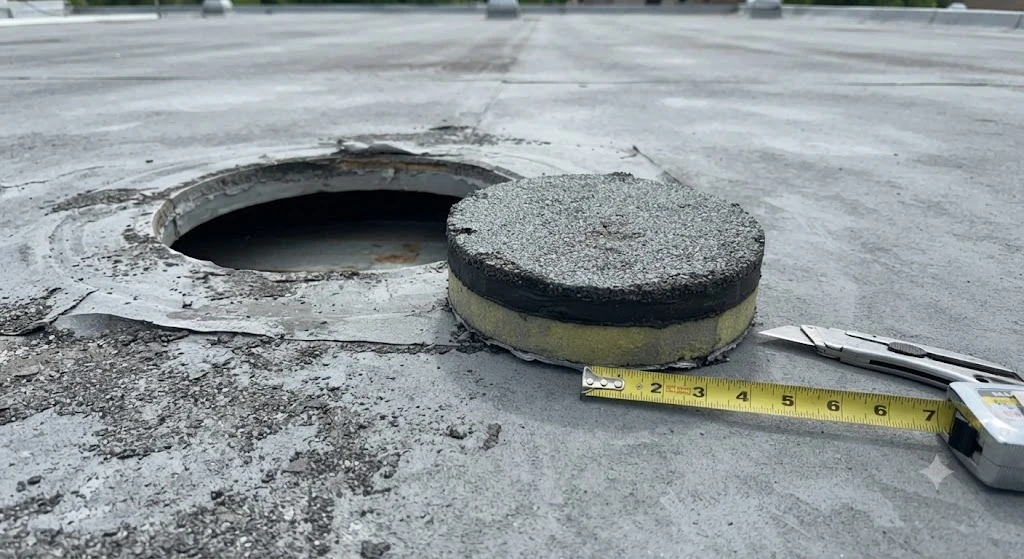
One quotes $38,000 of repairs. One quotes $340,000 to replace it. Neither is lying, and the owner has no way to tell which is right.
Roofing Network | Oakland Park, FL
Frequently asked
Should I repair or replace my commercial flat roof?
Repair when less than about a quarter of the insulation is wet, the deck is sound, annual repair spend is under a quarter of replacement cost, and meaningful service life remains. Replace when any two of those fail. An infrared moisture survey with core cuts is what turns this from an opinion into a decision.
What is the 25 percent roof rule in Florida?
Where more than 25 percent of a roof area is repaired, replaced or recovered within twelve months, the whole roofing system generally must be brought to current code. A 2022 exception applies where the existing roof was built or repaired to the 2007 Florida Building Code or later, in which case only the affected portion must comply.
Can you put a new flat roof over an existing one?
Yes, if there is only one existing roof covering. Florida code permits a single recover, so a roof that already carries two coverings must be torn off. Wet insulation has to be cut out and replaced before the new membrane goes on, and core cuts are how you establish how many layers exist.
How much does it cost to replace a 40,000 square foot commercial roof in South Florida?
Roughly $240,000 to $480,000 at typical rates of $6 to $12 per square foot installed. A recover or overlay runs about $180,000 to $320,000, an SPF overlay $200,000 to $360,000, and a silicone coating restoration $80,000 to $160,000 where the roof qualifies for one.
How do I know how much of my roof insulation is wet?
An infrared thermographic survey conducted after sunset shows saturated insulation as warm areas, because wet material releases stored heat more slowly than dry material. Core cuts at sample points confirm the scan and reveal how many roof layers exist. Neither can be substituted with a visual walk.
Keep reading
More answers on the same topic.
How to Fix a Commercial Roof Leak (Step by Step)
Water enters and exits in different places. That single fact explains why most commercial leak repairs fail on the first attempt.
View details
Silicone Roof Coating Restoration: When It Works
A third of the cost of a tear-off and ten to fifteen more years, on a roof that passes three tests. On a roof that does not, it is money burned.
View details
TPO vs EPDM vs Modified Bitumen in Florida
Florida is cooling-dominated, which rules one of these three out for most buildings before anything else is compared.
View details