
Commercial Roofing
HVHZ Roofing Requirements in South Florida
Broward and Miami-Dade counties make up Florida's High Velocity Hurricane Zone, where every roofing product needs a current Miami-Dade Notice of Acceptance or Florida Product Approval, every re-roof requires a secondary water barrier, fastening density increases at perimeters and corners, and a deck inspection must be passed before any covering goes on.
John Kraja
Certified Roofing Contractor, License CCC1329271 | Roofing Network
7 min read
Key takeaways
The High Velocity Hurricane Zone is Broward and Miami-Dade counties only. Palm Beach is not in it, though it has its own wind-borne debris requirements.
Every component needs a current Miami-Dade NOA or Florida Product Approval, and the assembly is approved as a system rather than part by part.
A secondary water barrier is required on re-roofs, and it is a real cost line, not an upsell.
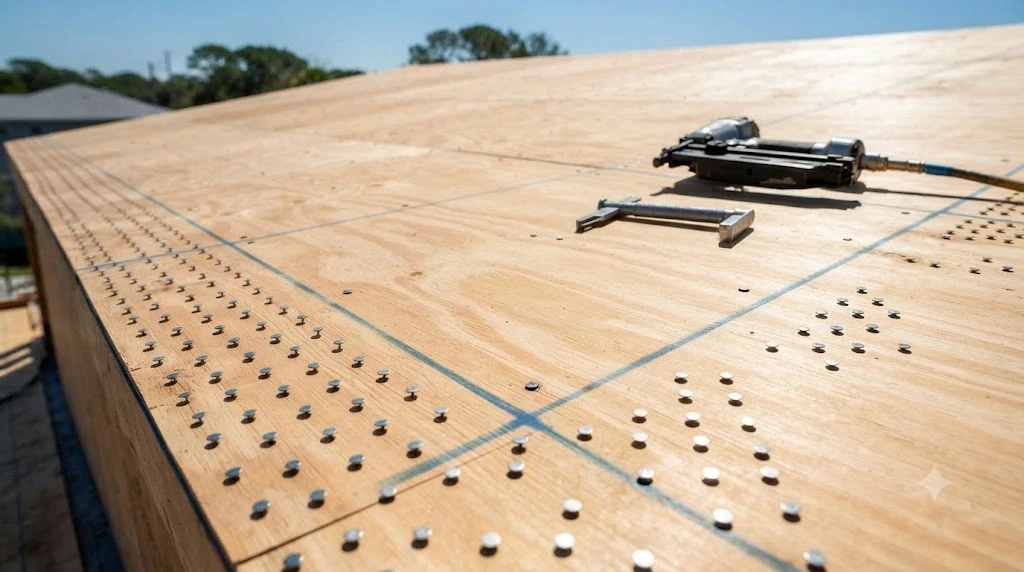
Fastening density rises at perimeters and corners; a bid priced at field density across the whole roof will not pass inspection.
An in-progress deck or dry-in inspection must be passed before the covering is installed.
The High Velocity Hurricane Zone covers Broward and Miami-Dade counties, and roofing there follows rules that do not apply elsewhere in Florida. Every product on the roof needs a current Miami-Dade Notice of Acceptance or Florida Product Approval, and the whole assembly, deck through to edge metal, is approved together rather than component by component. A secondary water barrier is required on re-roofs. Fastening density increases in perimeter and corner zones. And the building department must inspect the deck before any covering goes on.
A quote for the same roof can differ by twenty percent between Boca Raton and Fort Lauderdale, and it is not the labour rate. It is the code.
Boca sits in Palm Beach County. Fort Lauderdale sits in the High Velocity Hurricane Zone, and the HVHZ adds requirements that cost real money and are not negotiable.
What the HVHZ is, and where it stops
The High Velocity Hurricane Zone is defined in the Florida Building Code as Broward and Miami-Dade counties. That is the whole list. It exists because those two counties took the worst of Hurricane Andrew in 1992, and the code written afterwards became the strictest wind-resistance standard in the United States.
Palm Beach County is not in the HVHZ. It sits in a wind-borne debris region with high design wind speeds and its own requirements, but it does not use the HVHZ product approval and testing regime. So a contractor who works mainly in Palm Beach and quotes you a Fort Lauderdale roof from habit may produce a number that cannot legally be built.
Key takeaway: Ask any bidder which county's requirements they have priced. It is a fair question and the answer tells you a lot.
Product approval: the assembly, not the parts
Every roofing product installed in the HVHZ needs either a current Miami-Dade Notice of Acceptance or a Florida Product Approval. Products are tested against Testing Application Standards, which cover wind-driven rain resistance, uplift resistance and static uplift on the completed assembly.
The part people get wrong is that approval attaches to the system, not to the components. A membrane with a valid NOA installed over an insulation attachment method that is not part of that NOA is not an approved assembly, and it will fail inspection even though every individual product on site has paperwork.
So the submittal should name the deck type, the insulation and its attachment, the underlayment or base sheet, the covering, the fastener type and spacing, and the edge metal, all traced to one approval number. Ask for that number before signing and verify it yourself at floridabuilding.org. A contractor who cannot produce it is not ready to pull a permit.
The secondary water barrier
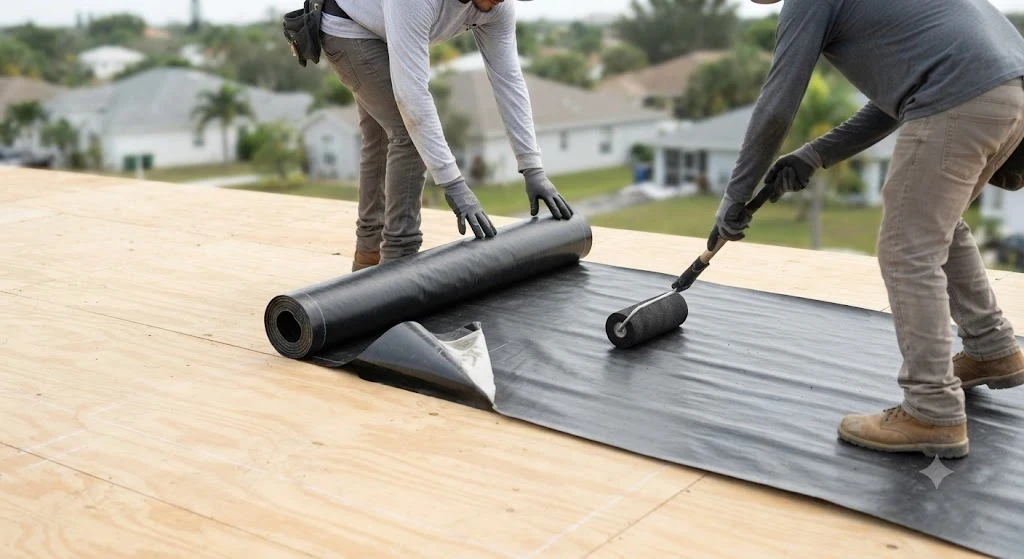
On a re-roof in the HVHZ, a secondary water barrier is required. This is a sealed layer bonded to the roof deck that keeps the building watertight if the primary covering is blown off.
Depending on the assembly it takes the form of a self-adhered membrane over the whole deck, or taped deck joints with an approved underlayment above. It is installed after the tear-off and before the new covering, and it is inspected.
Two practical consequences. It is a genuine line item, typically adding meaningfully to the square-foot price, so a quote that is conspicuously cheaper than the others may simply have left it out. And it is the single feature that most often keeps a South Florida building dry after a storm strips tiles or shingles, which is why it also earns an insurance discount on the wind mitigation form.
Enhanced fastening, and why corners cost more
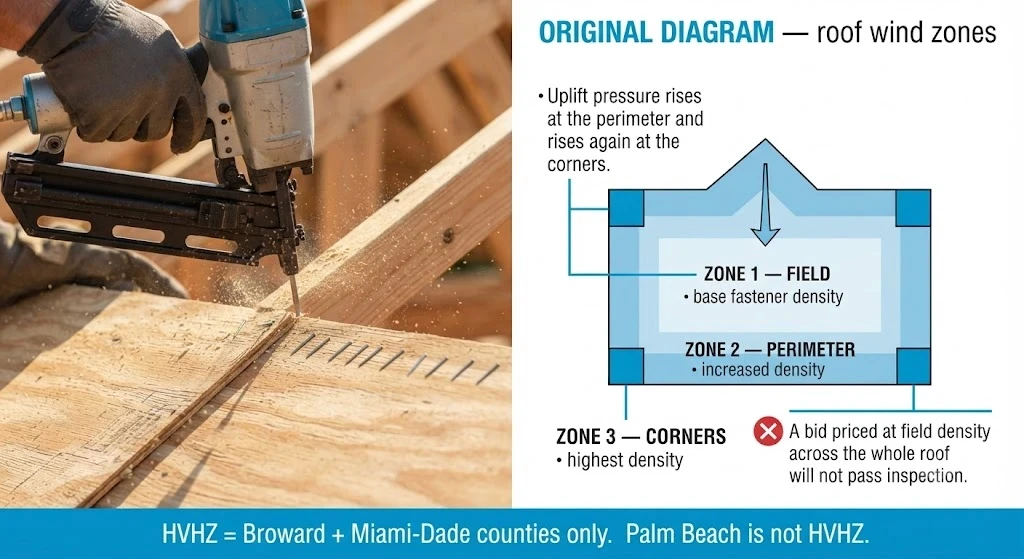
Wind uplift is not uniform across a roof. Pressure concentrates at the perimeter and rises sharply again at the corners, so the code divides a roof into zones and increases fastener density accordingly. Field, perimeter, corner: three different fastening patterns on one roof.
On decks, re-nailing at the required nail type and spacing is standard practice at re-roof, which typically means ring shank nails at a specified spacing rather than the staples used on many older South Florida homes. On tile, attachment method and the approved adhesive or mechanical fastening pattern come from the NOA rather than from habit. On low-slope commercial work, fastener density per board of insulation increases at the edges.
Key takeaway: A bid priced at field-zone density across the entire roof is underpriced, and the shortfall shows up at inspection rather than in the meeting.
Permits and the inspection you cannot skip
Every roof replacement in Broward and Miami-Dade requires a permit, and the process includes an in-progress inspection of the deck and dry-in before the covering is installed. That inspection is the whole point: once the tile or shingle is on, nobody can see whether the deck was re-nailed correctly or whether the secondary water barrier was actually installed.
A contractor who wants to load the roof before that inspection has passed is asking you to accept a roof nobody can verify. It also creates an open permit that surfaces years later at resale.
Two other requirements sit alongside the permit. A Notice of Commencement must be recorded for any job over $2,500 under Florida Statute 713.13. And the contractor must hold the right licence: a CCC prefix is a state certified roofing contractor able to work anywhere in Florida, while an RC registered licence is valid only in specific local jurisdictions. Our licensing and insurance page sets out what to verify and how.
The 25 percent rule
Separate from HVHZ but frequently colliding with it. Where more than 25 percent of a roof area is repaired, replaced or recovered within any twelve month period, the whole roofing system generally has to be brought to current code, which pulls in the secondary water barrier and current fastening across the entire roof rather than just the repaired portion.
A 2022 exception matters here: where the existing roof was built or repaired in compliance with the 2007 Florida Building Code or later, only the affected portion must comply. Whether your roof qualifies depends on its permit history, which your building department holds.
The practical effect is that a large repair can quietly become a full replacement by operation of code. Establish this before scoping a repair, not after. Our guide to deciding between flat roof repair and replacement covers how this reshapes commercial projects in particular.
What HVHZ compliance changes on your quote
Compared to a comparable roof in a non-HVHZ county, expect the following to appear:
Secondary water barrier across the full deck.
Deck re-nailing to the current nail type and spacing.
Zone-based fastening with higher density at perimeters and corners.
Approved edge metal, which carries its own approval and is a common initiating point of roof loss in high wind.
Approved assembly components, which sometimes means a specific underlayment or fastener rather than the cheapest equivalent.
Additional inspections, and the schedule time they consume.
None of that is optional and none of it is padding. It is also why South Florida roofs frequently outperform their design expectations: the assembly is engineered for the conditions rather than adapted to them.
How HVHZ changes each roof type
The requirements are universal but they land differently depending on what is going on the roof.
Shingle
Enhanced nailing pattern, typically six nails per shingle rather than four, with the approved nail type and placement. Starter courses at eaves and rakes matter more here than anywhere else, because that is where uplift begins. Deck re-nailing and the secondary water barrier apply as standard.
Tile
Attachment method comes entirely from the approval: mechanically fastened, foam adhesive set, or mortar set, each with its own pattern and each tested as a system with a specific underlayment. Mixing an approved tile with an unapproved attachment is the most common tile compliance failure in South Florida, and it is invisible once the roof is loaded.
Metal
Panel, fastener, underlayment and trim are approved together. Exposed fastener systems such as 5V crimp have prescribed screw spacing that increases at eaves, rakes and ridge, and it is checked. Our guide to how 5V crimp metal roofing is installed covers that pattern in detail.
Low-slope commercial
Fastener density per insulation board rises in perimeter and corner zones, and the insulation attachment is part of the approved assembly rather than an installer choice. Edge metal carries its own approval and its own uplift testing.
Key takeaway: Whatever the covering, the approval names the fastening. If a contractor describes their fastening pattern from experience rather than from a document, they are describing a different roof from the one the inspector will look at.
How to check a contractor is genuinely HVHZ-competent
Ask for the NOA or Florida Product Approval number for the exact assembly proposed, then verify it yourself.
Ask which zones they have priced and what the fastening pattern is at the corners.
Ask how the secondary water barrier is being achieved and which product.
Ask when the deck inspection is scheduled and confirm no covering goes on before it passes.
Verify the licence prefix. CCC works statewide; RC is jurisdiction-limited.
Roofing Network works throughout the High Velocity Hurricane Zone under Florida licenses CCC1329271 and CGC1517295, on both tile replacement and commercial systems. A free roof inspection includes a written note on which of these requirements your specific roof will trigger.
A quote for the same roof can differ by twenty percent between Boca Raton and Fort Lauderdale. It is not the labour rate. It is the code.
Roofing Network | Oakland Park, FL
Frequently asked
Which Florida counties are in the High Velocity Hurricane Zone?
Broward and Miami-Dade counties only. Palm Beach County is not in the HVHZ, though it sits in a wind-borne debris region with its own high wind design requirements. The distinction matters because HVHZ product approval and testing rules do not apply outside those two counties.
What is a Miami-Dade Notice of Acceptance and do I need one?
It is a document confirming a roofing assembly has passed the testing standards required in the High Velocity Hurricane Zone. Every product installed on a Broward or Miami-Dade roof needs a current NOA or Florida Product Approval, and the approval covers the complete assembly rather than individual components.
Is a secondary water barrier required on a Florida re-roof?
Yes, on re-roofs in the High Velocity Hurricane Zone. It is a sealed layer bonded to the deck that keeps the building watertight if the primary covering blows off, installed after tear-off and inspected before the new covering goes on. It also earns a credit on the wind mitigation insurance form.
Why do roof corners need more fasteners than the middle?
Wind uplift pressure is not uniform. It concentrates at the perimeter of a roof and rises sharply again at the corners, so the code divides the roof into field, perimeter and corner zones with increasing fastener density. A bid priced at field density across the whole roof will not pass inspection.
Can a roof be covered before the deck inspection in Broward County?
No. The building department inspects the deck and dry-in before any covering is installed, because once tile or shingle is on, nobody can verify the deck nailing or the secondary water barrier. A contractor pushing to load the roof beforehand is asking you to accept work that cannot be verified.
Keep reading
More answers on the same topic.
Flat Roof Repair or Replacement: How to Decide
Wet insulation percentage, repair spend ratio, remaining service life, deck condition. Get those four and the decision makes itself.
View details
Roofing Code Violations and How to Clear Them
Six common violations, and the sequence that clears each. Most do not require tearing the roof off, despite what people assume.
View details
Wind Mitigation Inspections and Insurance Discounts
Under $150, valid five years, and insurers are required by Florida law to discount for what it documents. Most owners never order one.
View details