
Commercial Roofing
Roofing Code Violations and How to Clear Them
The most common Florida roofing code violations are unpermitted roof work, permits left open without a final inspection, expired permits, work performed by an unlicensed contractor, missing secondary water barriers, and incorrect fastening. Most can be resolved through an after-the-fact permit and an inspection, without removing the roof.
John Kraja
Certified Roofing Contractor, License CCC1329271 | Roofing Network
7 min read
Key takeaways
An open permit is not the same as no permit, and the two are cleared differently.
Most violations are resolved with an after-the-fact permit plus inspection, often using exposure cuts rather than a tear-off.
Permits generally expire if no inspection is requested within 180 days of the last activity.
Unpermitted roof work can void insurance coverage and stops a sale during title search.
Start at the building department, not the contractor. You need the record before you need a quote.
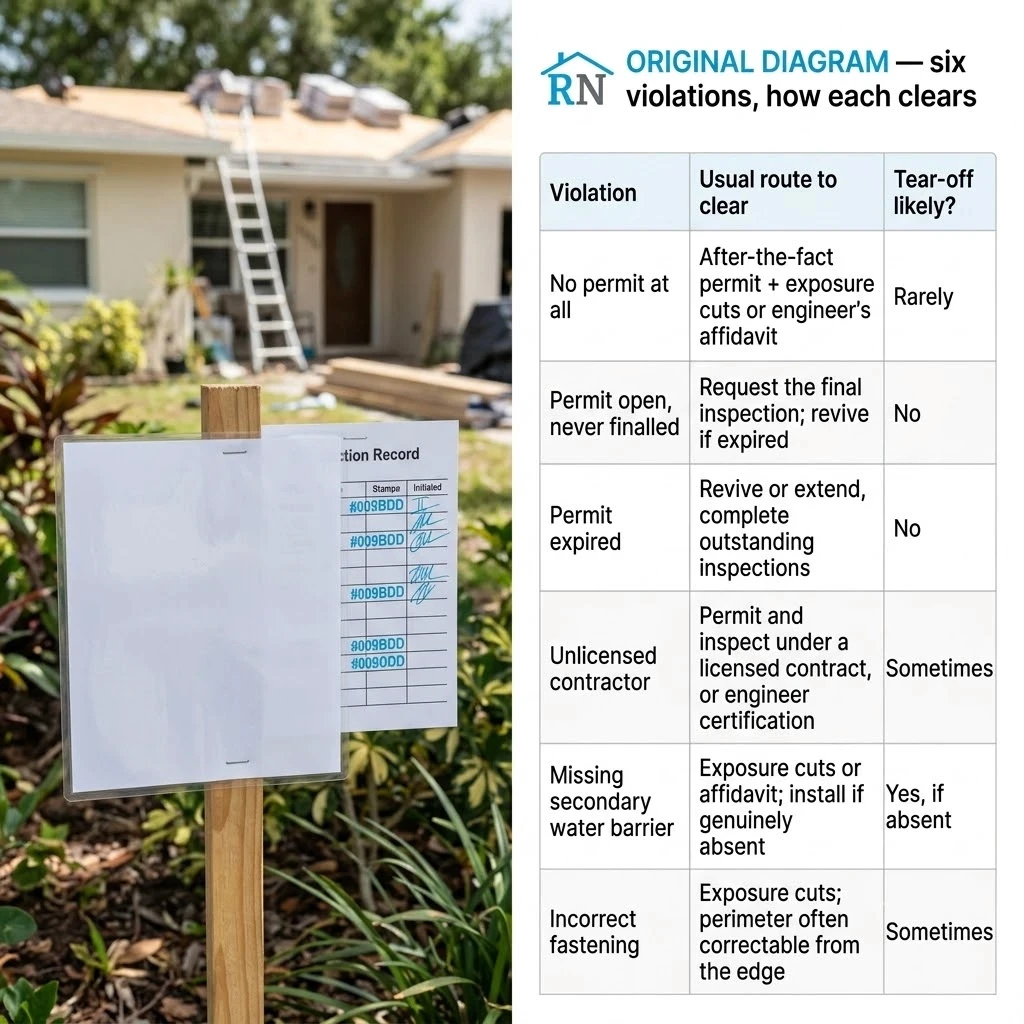
Florida roofing code violations fall into six recurring categories: roof work performed without a permit, a permit opened but never finalled, an expired permit, work performed by an unlicensed contractor, a missing secondary water barrier on a High Velocity Hurricane Zone re-roof, and fastening that does not meet current requirements. Most are cleared through an after-the-fact permit, an engineering affidavit or exposure inspection, and a final inspection, without removing the roof. The first step is always the building department record, not a contractor quote.
Almost nobody discovers a roofing violation because they went looking. They discover it because a title search flags an open permit two weeks before closing, or because an insurer asks for the permit number after a claim.
By that point it is urgent, and urgency is expensive. Here is how each of the six actually gets cleared.
1. Roof work with no permit at all
Every roof replacement in South Florida requires a permit. Repairs above a threshold set by the local jurisdiction do too. Work performed without one is unpermitted, regardless of quality.
How it is cleared: an after-the-fact permit. You apply as though the work were about to start, disclose that it is already complete, and the department requires evidence that what is up there meets code. Because the assembly is hidden, that evidence usually comes from one of two routes: exposure cuts, where small sections are opened so an inspector can see the deck attachment and underlayment, or a signed affidavit from a Florida-licensed engineer or architect attesting to compliance.
Expect higher fees. Many Florida jurisdictions charge a multiple of the standard permit fee for after-the-fact applications, and that penalty is a fixed policy rather than something to negotiate.
Worst case: if neither exposure cuts nor an affidavit can establish compliance, the department can require removal and reinstallation. This is uncommon, and it is almost always the result of work that genuinely does not meet code rather than paperwork alone.
2. A permit that was opened but never finalled
The most common of the six, and the one that ambushes home sales. The contractor pulled the permit, did the work, and never called for the final inspection. The permit sits open in the county record indefinitely.
How it is cleared: often just by requesting the final inspection, if the permit is still active and the work passes. If the original contractor is still licensed and reachable, they can request it, and many will because an open permit is a liability for them too.
Where the permit has since expired or the contractor is gone, it becomes a permit revival or an after-the-fact application, following the same path as item one.
Key takeaway: Check for open permits on your own property today rather than the month you list it. Every Florida county provides an online permit search, and it takes about five minutes.
3. An expired permit
Florida permits generally expire if work does not commence within a set period, or if no inspection is requested within 180 days of the last approved inspection. A roof that stalled between the dry-in inspection and the final can leave an expired permit with the covering already on.
How it is cleared: apply to revive or extend the permit if the jurisdiction allows it, which is usually cheaper and faster than starting again. Where revival is not available, a new after-the-fact permit is required. Either way the outstanding inspections must still be completed.
4. Work performed by an unlicensed contractor
Roofing in Florida requires a licensed contractor: a CCC prefix for a state certified roofing contractor able to work anywhere in Florida, or an RC registered licence valid only in specific local jurisdictions. Unlicensed contracting is a criminal offence under Florida Statute 489.127, and penalties escalate during a declared state of emergency, which is precisely when unlicensed operators appear.
How it is cleared: the work has to be permitted and inspected under a licensed contractor. In practice a licensed contractor must be willing to take responsibility for work they did not perform, which most will only do after opening the roof to verify it, or the assembly is certified by an engineer instead.
Verify any licence yourself at myfloridalicense.com, and the statute at flsenate.gov. Doing this before hiring costs nothing; doing it afterwards costs a great deal. Our licensing and insurance page sets out exactly what to check.
5. Missing secondary water barrier
Specific to Broward and Miami-Dade. A re-roof in the High Velocity Hurricane Zone requires a secondary water barrier bonded to the deck, and it is verified at the dry-in inspection. If the covering went on before that inspection, nobody knows whether it exists.
How it is cleared: exposure cuts to demonstrate it is present, or an engineer's affidavit. If it genuinely is not there, the resolution is removal of the covering in the affected areas and correct installation, which is the closest any of these six gets to a genuine tear-off.
This is the reason the dry-in inspection matters so much, and the reason a contractor pushing to load the roof before it passes should be refused. Our guide to HVHZ roofing requirements covers the inspection sequence.
6. Incorrect fastening or deck attachment
Staples where ring shank nails are required, field-zone fastener spacing carried into perimeter and corner zones, or tile attachment that does not match the approved pattern in the product approval.
How it is cleared: exposure cuts to establish what was actually done. Where the deck attachment is wrong, remediation is invasive because it is under everything. Where perimeter fastening is short, correction is often possible from the edge without full removal.
Buying or selling a home with a roofing violation
This is where most people meet the problem, so it is worth handling on its own terms.
If you are selling
Search your own permit record before you list, not after you have a contract. An open permit found during a title search becomes a closing condition on the buyer's timeline, which removes every ounce of negotiating room you had. Found three months early, it is a routine administrative task at your own pace and your own cost.
Florida also imposes disclosure obligations on sellers for known material defects affecting value. Known unpermitted roof work sits squarely in that territory, and concealing it is a considerably larger problem than disclosing it.
If you are buying
Add a permit search to your due diligence alongside the home inspection. A standard home inspection reports on the visible condition of the roof; it does not tell you whether the roof was permitted, whether the permit was closed, or who performed the work.
Three questions worth asking on any South Florida purchase: when was the roof last replaced, is there a closed permit for it, and is there a current wind mitigation form. Those three answers determine the roof's insurability, its remaining life and its premium impact, and all three are obtainable before you remove your inspection contingency.
If any of them comes back badly, that is a price conversation rather than a walk-away, provided you find it in time. A pre-purchase roof inspection is commonly used exactly this way, as a due diligence document rather than a repair diagnosis.
Key takeaway: A permit search costs nothing and takes five minutes. It is the cheapest piece of due diligence available on a Florida property and it is skipped constantly.
What a violation actually costs you
Beyond the fees, three consequences do the real damage:
Insurance. Carriers can decline claims on unpermitted work, and unpermitted roof work is one of the clearer grounds available to them. An unpermitted roof is effectively an uninsured roof.
Sale. Open and unpermitted work surfaces during title search and inspection. Buyers routinely require it resolved before closing, at the seller's cost and on the buyer's timetable.
Code enforcement. Local code enforcement can issue notices and, where unresolved, pursue fines that attach as a lien against the property.
Key takeaway: The permit fee is trivial. What it buys is an insurable, sellable roof, and that is the part people are actually paying for.
The sequence to follow
Pull the record. Search your address on the county or municipal permit portal. Note every roofing permit, its status, its dates and the contractor named.
Establish which of the six you have. No permit, open permit and expired permit are three different problems with three different routes.
Contact the building department directly. Describe the situation plainly and ask what they require. They deal with this constantly and will tell you whether exposure cuts or an affidavit is the accepted route in that jurisdiction.
Engage a licensed contractor or engineer to produce the evidence the department has named. Ask for a fixed scope, because open-ended remediation quotes on hidden work get expensive.
Complete the inspections and get written confirmation that the permit is closed. Keep it with your property documents.
Do not start at step four. A quote produced before anyone has read the permit record is priced on assumptions, and the assumptions are usually pessimistic.
Roofing Network works under Florida licenses CCC1329271 and CGC1517295 and handles permitting and inspection sequencing across Broward, Miami-Dade and Palm Beach counties. If you have an open permit or unpermitted work on a property, a residential roof inspection will establish what is actually up there, and you can send us the address and we will check the permit record with you.
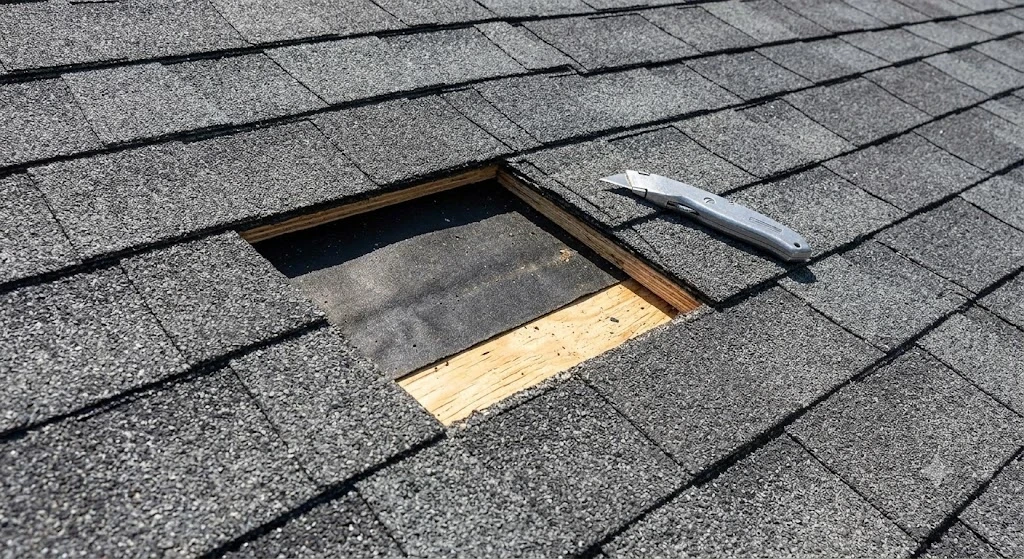
Almost nobody discovers a roofing violation because they went looking. They discover it two weeks before closing.
Roofing Network | Oakland Park, FL
Frequently asked
How do I close an open roofing permit in Florida?
If the permit is still active, request the final inspection, which the original contractor can often do on your behalf. If the permit has expired or the contractor is unreachable, apply to revive it where the jurisdiction allows, or file an after-the-fact permit. The outstanding inspections must be completed either way.
What happens if my roof was replaced without a permit?
You apply for an after-the-fact permit, disclosing that the work is complete. The department requires evidence the assembly meets code, usually through exposure cuts that let an inspector see the deck attachment and underlayment, or a signed affidavit from a Florida-licensed engineer. Expect increased fees, commonly a multiple of the standard permit fee.
Will insurance cover a roof that was installed without a permit?
A carrier can decline a claim on unpermitted work, and unpermitted roof work is one of the clearer grounds available to them. In practical terms an unpermitted roof is an uninsured roof, which is usually the strongest argument for resolving it before you need to find out.
Do I have to tear off my roof to fix a code violation?
Usually not. Most violations are resolved with an after-the-fact permit, exposure cuts and an inspection, or an engineer's affidavit. Removal is generally required only where the assembly genuinely does not meet code, most often a missing secondary water barrier or incorrect deck attachment that cannot be corrected from the surface.
How long before a Florida roofing permit expires?
Permits generally expire if work does not commence within a set period, or if no inspection is requested within 180 days of the last approved inspection. A job that stalled between the dry-in and the final inspection can leave an expired permit with the roof covering already installed.
Keep reading
More answers on the same topic.
HVHZ Roofing Requirements in South Florida
Two counties, one set of rules that does not apply anywhere else in Florida. Here is what HVHZ changes on your roof and your quote.
View details
Does Insurance Cover Roof Deck Replacement?
Storm damage is covered. Rot is not. Code upgrades sit in a third category that most Florida homeowners have never checked their limit on.
View details
How Much Down Payment Do Roofers Require in FL?
Ten to thirty percent is normal. Half before materials arrive is a warning sign, and Florida law gives you specific protection.
View details