
Insurance & Claims
Does Insurance Cover Roof Deck Replacement?
Insurance covers roof deck replacement when the deck was damaged by a covered peril such as wind or falling debris. It does not cover deck rot from long-term water intrusion, age or deferred maintenance. Code-required upgrades discovered during the work, including deck re-nailing, fall under ordinance or law coverage, which is a separate limit on your policy.
John Kraja
Certified Roofing Contractor, License CCC1329271 | Roofing Network
7 min read
Key takeaways
Deck damaged by a covered peril is covered; deck rotted by long-term leaking is not.
Code-required deck re-nailing at re-roof falls under ordinance or law coverage, a separate limit worth checking now.
Deck damage is usually found after tear-off, so it is handled as a supplemental claim.
Photograph every sheet before it is replaced. Unphotographed deck is unpaid deck.
Florida allows supplemental claims up to eighteen months from the date of loss.
Insurance covers roof deck replacement when the deck was damaged by a covered peril, typically wind, falling debris or impact. It does not cover deck that has rotted from years of slow leaking, because policies exclude wear, deterioration and deferred maintenance. There is a third category people miss entirely: code-required upgrades such as deck re-nailing, which are triggered by the repair rather than the damage, and which fall under ordinance or law coverage. Whether you have that coverage, and at what limit, is worth checking before the tear-off, not after.
The deck is the sheet of plywood or board under everything else. Nobody sees it, nobody thinks about it, and it is the single most common reason a Florida roofing invoice comes in above the estimate.
It is also the item where the difference between a covered claim and a rejected one comes down to a distinction most homeowners have never been told about.
The distinction that decides everything
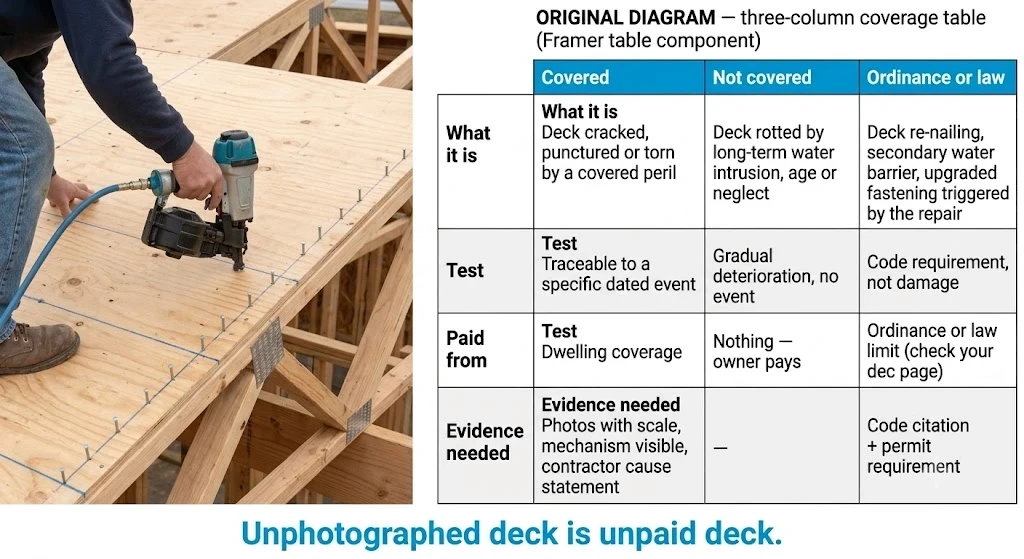
Florida property policies cover sudden accidental damage. They exclude wear, deterioration, rot and neglect. Applied to a roof deck, that produces three separate outcomes:
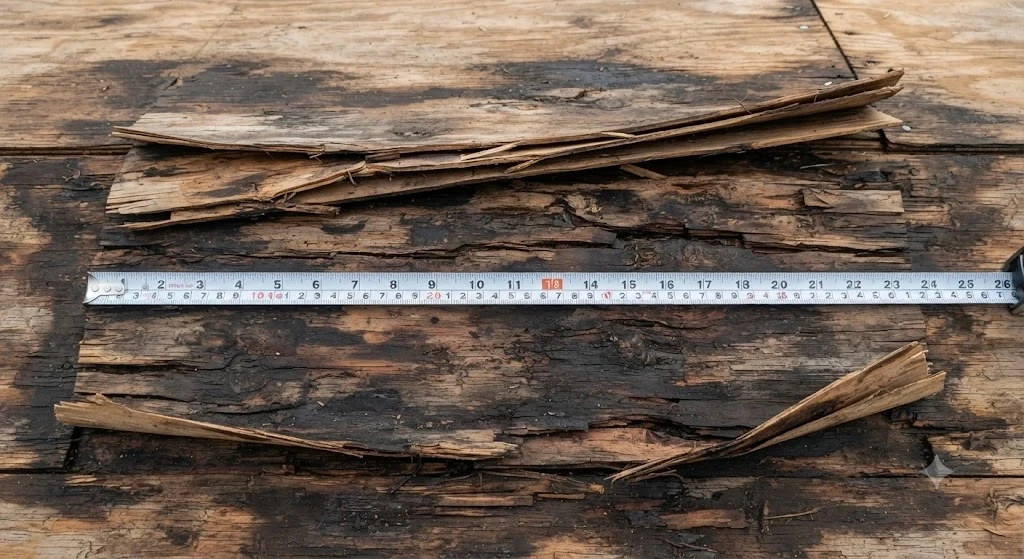
Covered: deck cracked, punctured or torn by a tree limb, wind-driven debris or the covering being ripped off in a named storm. The damage is traceable to a specific dated event.
Not covered: deck darkened, delaminating and soft around a valley or a pipe penetration where water has been getting in for three years. That is deterioration, however genuinely unlucky it feels.
A third category: deck that is structurally fine but must be re-nailed to current code because you are re-roofing. Nothing damaged it. The code triggered it.
Key takeaway: Adjusters are looking for a mechanism and a date. Damage with both is a claim; damage with neither is maintenance.
Ordinance or law coverage: the part nobody checks
This is the most useful thing on this page, and it is worth five minutes with your declarations page today.
Ordinance or law coverage pays for the additional cost of complying with current building codes when repairing covered damage. It matters enormously in South Florida, because the code has moved a long way and older roofs frequently fail current requirements even where they are undamaged.
What it typically picks up on a roof:
Deck re-nailing to the current nail type and spacing, where the original deck was stapled or under-nailed.
Secondary water barrier installation, required on High Velocity Hurricane Zone re-roofs.
Upgraded fastening at perimeter and corner zones.
Approved edge metal where the existing does not meet current approval.
Coverage is usually expressed as a percentage of the dwelling limit, and policies vary considerably. Some Florida policies carry a meaningful limit; some carry very little. Find the line, note the number, and if it looks thin, ask your agent what increasing it costs at renewal. It is one of the cheaper endorsements relative to what it pays out on a South Florida roof. Our guide to HVHZ roofing requirements sets out exactly which code upgrades get triggered.
Why deck damage is nearly always a supplemental claim
Sequence explains this. The adjuster inspects a roof that still has its covering on. Nobody can assess a deck through tile or shingle. The claim is scoped and approved on visible damage. Then the tear-off happens, and the deck condition becomes visible for the first time.
That is a supplemental claim: additional damage discovered after the original scope was agreed. It is routine, carriers expect it, and the process works when the documentation is right and stalls when it is not.
Florida gives you up to eighteen months from the date of loss for a supplemental claim, against one year for a new claim, under Florida Statute 627.70132. You can read the section at flsenate.gov. The clock runs from the date of loss, not from the date you discovered the deck.
What has to be documented, and when
Once a sheet of decking is in the skip, its condition is unprovable. Everything depends on what was captured before that.
Wide photographs of the exposed deck before any replacement, showing the whole roof plane with a recognisable reference point.
Close photographs of each damaged area, with a tape measure in frame for scale and, where possible, the damage mechanism visible: an impact fracture reads differently from rot.
A marked roof diagram showing which sheets were replaced and where.
A count and measurement, in sheets and in square feet, matching the invoice line.
A written statement from the contractor describing the cause: impact, wind uplift, water intrusion, or code-required re-nailing. The adjuster is deciding between categories, so name the category.
Notification to the carrier before replacement where practical, or at minimum the same day. Some carriers want the chance to re-inspect.
Key takeaway: Unphotographed deck is unpaid deck. Every roofing contractor working insurance claims in South Florida knows this; ask yours to confirm the protocol in writing before the tear-off starts.
What it costs when you are paying yourself
Most Florida roofing contracts include a deck repair allowance and price additional sheets separately, because nobody can see the deck when quoting.
Typical South Florida pricing runs roughly $70 to $130 per 4x8 sheet installed for standard plywood replacement, higher for tongue-and-groove board decks on older homes where matching is harder, and higher again where trusses or rafters are involved rather than just sheathing.
On a 2,000 square foot roof, replacing ten percent of the deck is roughly six to eight sheets, so several hundred to around a thousand dollars. Replacing all of it is a different conversation entirely and belongs in the replacement decision rather than the repair one.
Two things to insist on in the contract: a stated per-sheet price rather than "at cost", and a requirement that you are notified with photographs before replacement exceeds the allowance. That single clause prevents most deck-related billing disputes. Our roof deck replacement page covers how we scope and price it.
Board decks, trusses and the jobs that get bigger
Not every deck is plywood, and the difference matters to both the cost and the claim.
Older South Florida homes, particularly pre-1970s construction, frequently have tongue-and-groove board decking: individual timber boards rather than sheets. Two complications follow. Matching board thickness and width for a partial repair is harder and slower than dropping in a sheet of plywood. And board decks generally cannot be re-nailed to modern uplift standards the way sheet decking can, so bringing them to current code sometimes means overlaying with plywood, which is a materially larger job.
Then there is the layer below. Sheathing sits on trusses or rafters, and where water has been getting in long enough, the structural member below can be affected too. That moves the work from roofing into structural repair, which usually means an engineer, a separate permit line and a longer schedule.
Three practical points:
Ask what the deck type is at quoting stage, not at tear-off. A contractor who has inspected the attic already knows.
Structural damage is a different claim conversation. If a truss is compromised by a covered peril, it is covered on the same basis as the deck, but it needs its own documentation and often an engineer's report.
Board decks and code upgrades interact. Where an overlay is required to meet current attachment standards, that is a code-triggered cost and belongs in the ordinance or law conversation rather than the damage one.
Key takeaway: On a home built before roughly 1970 in South Florida, ask about the deck type before you accept any roofing quote as final.
If the claim is denied
A denial on deck replacement usually says one of two things: the damage is deterioration rather than a covered peril, or the damage is not attributable to the reported date of loss.
Three responses are worth making before accepting it:
Ask for the denial in writing with the policy language cited. A specific exclusion clause is something you can respond to; a general refusal is not.
Provide the mechanism evidence. Impact fracture, uplift pattern, or debris damage looks materially different from rot, and photographs taken at tear-off are what show it.
Check the ordinance or law angle separately. Even if the deck damage itself is deterioration, code-required re-nailing triggered by the covered repair may still be payable under that coverage. These are two different questions and carriers sometimes answer only the first.
Our roof insurance claim guidance covers what documentation carriers accept, and storm damage roofing covers the inspection and reporting that supports a claim from day one. If the damage is fresh and water is still coming in, start with emergency stabilisation and documentation instead, because mitigation comes before the paperwork.
The short version
Storm damage to the deck: covered. Rot from long-term leaking: not covered. Code upgrades triggered by the repair: covered if you carry ordinance or law, at whatever limit you carry. Everything hinges on photographs taken in the two hours between the covering coming off and the new deck going down, which is why the conversation to have with your contractor is about documentation protocol rather than price.
Unphotographed deck is unpaid deck. Everything hinges on the two hours between the covering coming off and the new sheets going down.
Roofing Network | Oakland Park, FL
Frequently asked
Does homeowners insurance pay for roof decking replacement?
Yes when the deck was damaged by a covered peril such as wind, impact or falling debris, traceable to a specific date of loss. No when the deck has rotted from long-term water intrusion, age or deferred maintenance, which policies exclude as deterioration. Code-required re-nailing falls under ordinance or law coverage instead.
What is ordinance or law coverage on a roof claim?
A coverage that pays the additional cost of meeting current building codes while repairing covered damage. On a South Florida roof it typically picks up deck re-nailing, secondary water barrier installation, upgraded perimeter fastening and approved edge metal. It carries its own limit, usually a percentage of the dwelling limit, and policies vary widely.
Why was my roof deck damage not in the original claim?
Because nobody can assess a deck through tile or shingle. The adjuster scopes visible damage, then the tear-off reveals the deck for the first time. Deck damage is therefore handled as a supplemental claim, which Florida allows up to eighteen months from the date of loss.
How much does it cost to replace roof decking in South Florida?
Roughly $70 to $130 per 4x8 sheet installed for standard plywood, higher for tongue-and-groove board decks on older homes and higher again where trusses or rafters are involved. Insist on a stated per-sheet price in the contract rather than an at-cost arrangement.
What should my roofer photograph before replacing damaged decking?
Wide shots of the exposed deck with a recognisable reference point, close shots of each damaged area with a tape measure for scale, a marked roof diagram showing which sheets were replaced, a sheet count matching the invoice, and a written statement naming the cause. Notify the carrier before replacement where practical.
Keep reading
More answers on the same topic.
What Counts as a Roofing Emergency in Florida?
Water actively entering, structure compromised, or somebody could get hurt. Those three define it. Everything else is urgent, not emergency.
View details
HVHZ Roofing Requirements in South Florida
Two counties, one set of rules that does not apply anywhere else in Florida. Here is what HVHZ changes on your roof and your quote.
View details
Wind Mitigation Inspections and Insurance Discounts
Under $150, valid five years, and insurers are required by Florida law to discount for what it documents. Most owners never order one.
View details