
Insurance & Claims
Wind Mitigation Inspections and Your Insurance Discount
A Florida wind mitigation inspection documents seven construction features on the standard OIR-B1-1802 form, and insurers are required to offer premium discounts for the qualifying ones. It typically costs $75 to $150, stays valid for five years, and the roof-to-wall attachment and opening protection categories usually account for most of the saving.
John Kraja
Certified Roofing Contractor, License CCC1329271 | Roofing Network
7 min read
Key takeaways
The inspection is recorded on form OIR-B1-1802 and is generally accepted as valid for five years.
Florida law requires insurers to offer discounts for qualifying wind-resistant construction features.
Roof-to-wall attachment produces the largest single discount step, from toe nails through clips to double wraps.
A hip roof scores better than a gable, and a secondary water barrier earns its own credit.
Order the inspection immediately after a re-roof, because that is when your scores change.
A wind mitigation inspection documents seven construction features of your home on Florida's standard OIR-B1-1802 form, and insurers use it to apply premium discounts they are legally required to offer for qualifying features. It costs roughly $75 to $150, takes about an hour, and the resulting form is generally accepted for five years. The two categories that move the premium most are roof-to-wall attachment and opening protection. The best time to order one is immediately after a re-roof, when several of your scores have just improved.
Most South Florida homeowners are paying a premium calculated on assumptions about their house that the insurer has never verified. When a carrier has no wind mitigation form on file, it prices as though the house has none of the features. Many houses have several.
What the inspection actually is
A licensed inspector, general contractor, building inspector or engineer visits the property, photographs specific construction details, and completes the Uniform Mitigation Verification Inspection Form, OIR-B1-1802. It is a standard form across every Florida carrier, which is why one inspection works no matter who you are insured with or who you switch to.
It takes around an hour and usually involves attic access, because several of the categories can only be verified from inside the roof structure. The completed form goes to your insurer, who reprices the wind portion of your premium.
The seven categories, and what each looks for
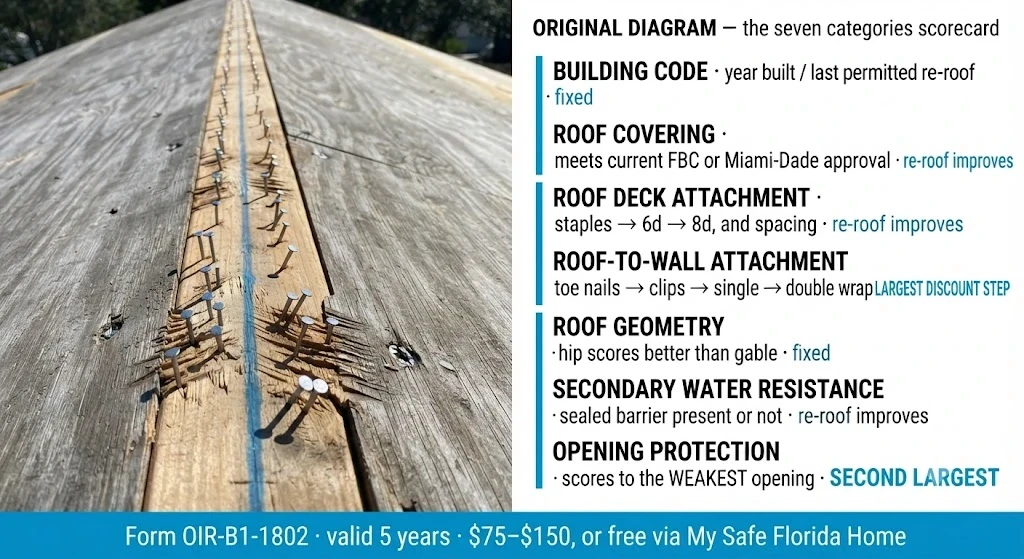
1. Building code
The year the home was built or last re-roofed, and whether it was built to a code edition with meaningful wind provisions. This is fixed history and not something you can change, except through a permitted re-roof.
2. Roof covering
Whether the roof covering meets current Florida Building Code or Miami-Dade product approval requirements, evidenced by the permit record and the product on the roof. A permitted modern re-roof scores here; an unpermitted one usually cannot.
3. Roof deck attachment
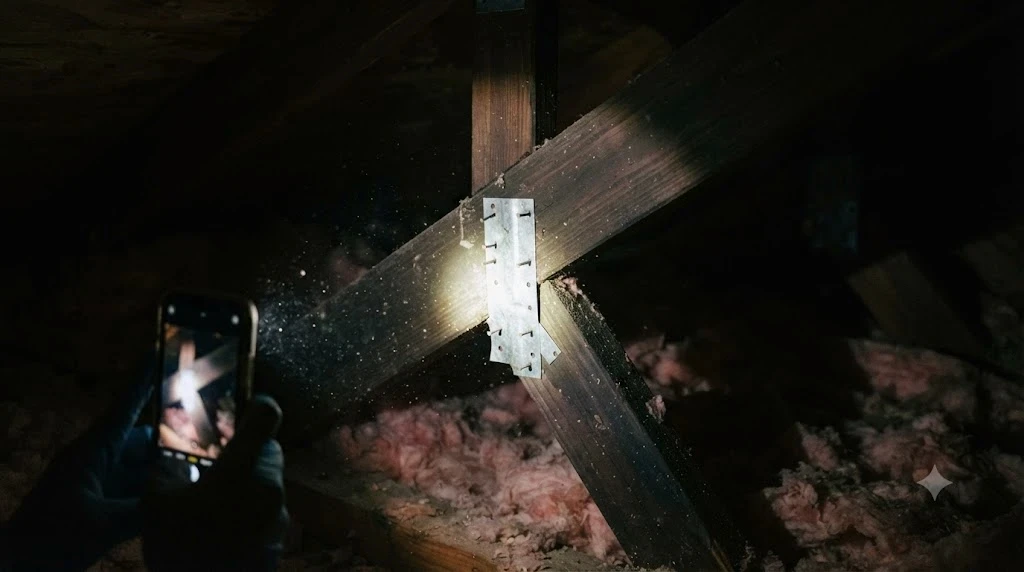
How the plywood or sheathing is fastened to the trusses: staples, 6d nails, 8d nails, and at what spacing. Older South Florida homes are commonly stapled, and re-nailing during a re-roof improves the score permanently.
4. Roof-to-wall attachment
How the roof structure connects to the walls: toe nails, clips, single wraps or double wraps. This is usually the largest single discount step on the whole form, because it is the connection that decides whether the roof stays on the house.
5. Roof geometry
Hip, gable, or other. A hip roof, sloping on all four sides, performs measurably better in high wind than a gable and is scored accordingly. Not something you would change for the discount, but worth knowing you have.
6. Secondary water resistance
Whether a sealed secondary water barrier exists over the deck. Required on High Velocity Hurricane Zone re-roofs, and it earns a credit here, which is one reason the cost of it is not really a cost.
7. Opening protection
Shutters, impact-rated windows and doors, and garage door rating. The other large mover on the form. The catch is that it scores to the weakest opening: one unprotected window can cost you the whole category.
Key takeaway: Categories 4 and 7 produce most of the money. Categories 3 and 6 are the ones a re-roof can improve.
What it saves
Honest answer: it varies widely, and anyone quoting a single number is guessing about your house.
What is consistent is the structure. Wind coverage is a large share of a South Florida homeowner premium, and mitigation credits apply against that portion rather than the whole policy. A home moving from toe nails to documented clips, with a hip roof and a secondary water barrier recorded, can see a substantial annual reduction. A home already scored at its maximum sees nothing, which is still worth knowing.
The economics rarely fail: a one-off cost under $150 against a discount that recurs annually for five years before re-inspection. Even a modest reduction returns the cost several times over. The Florida Office of Insurance Regulation publishes consumer information on mitigation discounts at floir.com.
Timing: order it right after a re-roof
This is the part homeowners most often get wrong, and it costs them a year of discount.
A permitted re-roof can improve roof covering, roof deck attachment and secondary water resistance simultaneously. Those three scores change on the day the final inspection passes. If your wind mitigation form is three years old, your insurer is still pricing the old roof.
So the sequence is: complete the re-roof, pass final inspection, order the wind mitigation inspection, send the new form to your carrier and ask for the policy to be rerated. Some carriers will backdate to the completion date; many will not, which is the argument for doing it immediately rather than at renewal.
If you are planning a replacement, it is also worth asking your contractor which optional upgrades would change a score. Improved roof-to-wall connections, where structurally feasible, are the clearest example. Our wind mitigation installation work covers those upgrades, and commercial wind mitigation covers the equivalent on commercial buildings.
How to get one, including free routes
My Safe Florida Home. When the programme is funded, it provides free wind mitigation inspections to qualifying homeowners, along with matching grants for hardening improvements. Availability changes by legislative cycle, so check current status directly.
Your insurer or agent. Some carriers arrange or subsidise the inspection, because a documented home is a better-understood risk for them too. Ask before paying for one.
An independent inspector. $75 to $150 in most of South Florida. Confirm they are licensed to complete the form and that the fee includes sending it to your carrier.
One caution worth stating plainly: an inspection form is a record of what exists, not a negotiation. If a provider offers to score features they cannot verify, walk away. A form with unsupported entries is insurance fraud exposure sitting in your file, and it will be revisited if you ever make a claim.
Common reasons a form scores worse than the house deserves
A wind mitigation form records what the inspector can verify. Anything that cannot be verified is scored at the lowest value, which means a well-built house can score badly for entirely administrative reasons.
Four recurring causes:
No attic access. Roof deck attachment and roof-to-wall connection can usually only be confirmed from inside the roof structure. A sealed or inaccessible attic means both categories default downward. If access is difficult, arrange it before the inspection rather than rescheduling afterwards.
Missing permit records. The roof covering category leans on the permit history. A re-roof that was never permitted often cannot be credited, which is one more cost of unpermitted work that nobody mentions at the time.
One unprotected opening. Opening protection scores to the weakest opening on the property. A house with impact glass throughout and one unrated garage door or a single unshuttered bathroom window loses the category outright.
Insulation covering the connections. Blown insulation packed against the truss-to-wall connection can genuinely prevent verification. An inspector who cannot see the strap cannot record it.
All four are worth checking before the inspector arrives, because a re-inspection costs the fee again. If a category is scored low, ask the inspector specifically why, and whether it was a construction finding or a verification problem. Those are two different situations with two different remedies.
Key takeaway: A low score is not always a weak house. Sometimes it is an inaccessible attic and a sealed hatch.
What to do with the form once you have it
Send it to your carrier and ask in writing for the policy to be rerated, then confirm the credit actually appeared on the declarations page. It does not always apply automatically.
Keep a copy with your policy documents. When you shop the policy, the same form goes to every quoting carrier, which makes comparison quotes meaningfully more accurate.
Note the expiry. Five years, so diary it.
Re-order it after any qualifying improvement, not at the next renewal.
Check the credit survived a carrier change. Mitigation credits do not follow you automatically when a policy moves, and a lapsed credit on a new policy is one of the easier premium errors to correct once you notice it.
One more use worth knowing about: the form is a negotiating document. When shopping carriers, sending the same OIR-B1-1802 to every quoting insurer removes the guesswork from their pricing, and quotes come back tighter and more comparable. Carriers price uncertainty conservatively, so a documented house is often quoted better simply for being known. That effect is separate from the mitigation credits themselves and it is why the form is worth having even on a home that scores poorly.
The form is also useful outside insurance. It documents roof deck attachment, roof-to-wall connection and secondary water resistance in one page, which is a genuinely useful record when selling the house, and a helpful starting point for any roof insurance claim. Our guide to funding a Florida roof covers how mitigation grants fit alongside the other routes, and a free roof inspection will tell you which categories your roof could realistically improve.

When a carrier has no wind mitigation form on file, it prices as though the house has none of the features. Many houses have several.
Roofing Network | Oakland Park, FL
Frequently asked
What is a wind mitigation inspection in Florida?
An inspection that documents seven wind-resistant construction features of a home on the standard OIR-B1-1802 form: building code year, roof covering, roof deck attachment, roof-to-wall attachment, roof geometry, secondary water resistance and opening protection. Insurers use it to apply premium discounts they are required by Florida law to offer.
How much does a wind mitigation inspection cost and how long is it valid?
Typically $75 to $150 in South Florida, and the completed form is generally accepted as valid for five years. Free inspections are available through My Safe Florida Home when the programme is funded, and some carriers arrange or subsidise the inspection directly.
Which wind mitigation feature saves the most money?
Roof-to-wall attachment usually produces the largest single step, moving from toe nails through clips to single or double wraps, because that connection determines whether the roof stays on the house. Opening protection is the other major mover, and it scores to the weakest opening on the property.
When should I get a wind mitigation inspection after a new roof?
Immediately after the building department's final inspection passes, not at your next renewal. A permitted re-roof can improve roof covering, deck attachment and secondary water resistance at once, and until the new form reaches your carrier they are still pricing the old roof. Some carriers backdate; many do not.
Can a roofing contractor improve my wind mitigation score?
Yes, on several categories. Re-nailing the roof deck to current nail type and spacing, installing a secondary water barrier, and improving roof-to-wall connections where structurally feasible all change scores permanently. Ask which upgrades are available on your structure before the replacement is scoped, not after.
Keep reading
More answers on the same topic.
HVHZ Roofing Requirements in South Florida
Two counties, one set of rules that does not apply anywhere else in Florida. Here is what HVHZ changes on your roof and your quote.
View details
How to Pay for a Roof With No Money (Florida)
Seven funding routes for a Florida roof, ranked by what they really cost. One of them follows the property to your buyer.
View details
Does Insurance Cover Roof Deck Replacement?
Storm damage is covered. Rot is not. Code upgrades sit in a third category that most Florida homeowners have never checked their limit on.
View details