
Commercial Roofing
Where to Buy Replacement Concrete Roof Tiles in Florida
Replacement concrete roof tiles come from five sources in Florida: the original manufacturer if the profile is still made, a roofing supply yard, a salvage or reclaimed tile dealer, a tile matching service, or your own roof. The last one is what experienced roofers use most, because a new tile never matches a twenty-year-old one.
John Kraja
Certified Roofing Contractor, License CCC1329271 | Roofing Network
7 min read
Key takeaways
Even a perfect profile match will not colour-match weathered tile, so placement matters more than sourcing.
The professional method is to harvest matching tile from a hidden slope and install the new tile there instead.
Identify your profile first: flat, low-profile S, or high-barrel two-piece mission.
On a Florida tile roof the underlayment is the waterproofing, so a broken tile is often not why it is leaking.
Keep 2 to 3 percent of tile as attic stock at every replacement. It costs almost nothing and solves this problem permanently.
Replacement concrete roof tiles in Florida come from five places: the original manufacturer if your profile is still in production, a local roofing supply yard, a salvage or reclaimed tile dealer, a specialist tile matching service, or your own roof. Start by identifying the profile and manufacturer, because that determines whether this is a phone call or a hunt. And know before you begin that new tile will not match weathered tile in colour, which is why the standard professional solution is to relocate tile rather than simply buy it.
Someone throws a ball, a branch comes down, or a technician walks a tile roof in work boots. Now there are four broken tiles on the front slope and a homeowner searching for a profile that was discontinued in 2011.
There is a good answer to this, and it is not the one most people go looking for.
First, identify what you actually have
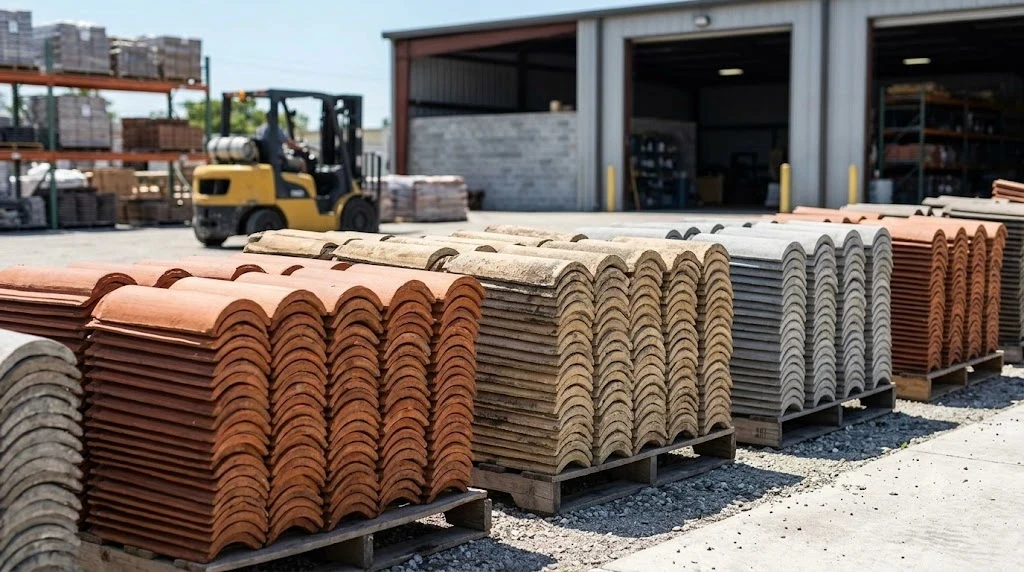
Three broad concrete tile profiles dominate South Florida roofs:
Flat tile. Slate or shake appearance, no curve. Common on newer builds and contemporary homes.
Low-profile S tile. A gentle S curve, the most common profile across South Florida.
High-barrel or two-piece mission tile. Deep half-round barrels, sometimes as separate pan and cap pieces. Mediterranean and Spanish-style homes.
Then look for the manufacturer. Most concrete tiles carry a stamp on the underside with the maker and often a mould or profile number. Lift one broken piece and photograph the underside. That stamp turns a guessing exercise into a specific product enquiry, and it is what any supply yard will ask you for first.
Also count carefully and add a margin. Tile breaks during handling and installation, so ordering exactly four tiles to replace four is how you end up making the same call twice.
The five sourcing routes
1. The original manufacturer
If the profile is still in production, this is the cleanest route. Florida has a substantial concrete tile manufacturing base, and current profiles are readily available through distribution. The limitation is that profiles are discontinued regularly, and a roof older than fifteen years frequently sits on something no longer made.
2. A roofing supply yard
Local distributors carry current profiles and often hold odd pallets of discontinued stock in the yard. Call rather than browse online: this is inventory that rarely appears on a website and that a counter staff member will know about from memory. Bring the underside photograph.
3. Salvage and reclaimed tile dealers
Specialist yards buy tile from demolition and re-roofing projects and resell it by profile. For a discontinued tile this is often the only route to a genuine colour and profile match, because the tile is the same age as yours. Expect to travel, expect the stock to be inconsistent, and inspect before buying: reclaimed tile with hairline cracks is worthless.
4. Tile matching services
Some suppliers specialise in identifying and sourcing discontinued profiles, working from a photograph and a measurement. Useful when you have a large repair area and no time to hunt. They charge for the service, and it is generally worth it when the alternative is re-roofing an entire slope for cosmetic consistency.
5. Your own roof
The method professionals actually use, and the reason it works is colour.
The relocation trick, and why colour makes it necessary
A concrete tile roof in South Florida weathers hard. Ten years of UV, salt air and rain lightens the pigment, fades the surface slurry, and adds a patina that no new tile has. Even a genuine, correct, same-manufacturer, same-profile, same-colour-code tile arrives looking obviously new next to it.
So instead of putting new tile on the slope everyone sees, you take tile from a slope nobody sees, use it for the visible repair, and install the new tile in the hidden location. A rear slope, a section behind a chimney or a low area screened by landscaping all work. The visible repair matches perfectly because the tile is the same age as its neighbours.
This is standard practice on any competent tile roof repair, and it is worth asking about explicitly, because it takes more labour than simply laying new tile and a contractor optimising for speed will not offer it.
Key takeaway: The sourcing problem is really a placement problem. Solve the placement and the sourcing gets much easier.
The thing most people miss about tile roofs
On a Florida tile roof, the tile is not the waterproofing. The underlayment beneath it is.
Tile is a wear surface: it takes the UV, the impact and the wind, and it sheds most of the water. What actually keeps the building dry is the membrane on the deck below, and concrete tile routinely outlasts that membrane by decades.
Two consequences follow. A leak on a tile roof with no broken tiles is entirely normal, and it usually means the underlayment has failed rather than the tile. And replacing broken tiles on a roof whose underlayment is at the end of its life fixes the appearance without fixing anything else.
So before sourcing tile for anything beyond a handful of pieces, get the underlayment condition assessed. If it is failing, the answer is a lift-and-relay, where the existing tile is carefully removed, stacked, a new underlayment installed, and the same tile re-laid. That solves the matching problem completely, because you are reusing your own tile. Our tile roof replacement page covers how a lift-and-relay is scoped.
HVHZ: the tile is only half the requirement
In Broward and Miami-Dade, tile and its attachment method both need a current Miami-Dade Notice of Acceptance or Florida Product Approval, and the installed assembly has to match the fastening or adhesive pattern named in that approval.
This affects tile repairs in a way people do not expect. Reclaimed tile from an unknown source may have no traceable approval, and mixing an approved tile with an unapproved attachment method produces a non-compliant assembly. For a handful of tiles on a repair this is rarely a permit issue; for a substantial area it can be. Verify approvals at floridabuilding.org, and see our guide to HVHZ roofing requirements for how assembly approval works.
Handling and storage, which is where most tile gets broken
More replacement tile is broken between the yard and the roof than by weather. Concrete tile is heavy, brittle at the edges and unforgiving of being stacked badly.
Four things worth knowing whether you are collecting tile yourself or watching a crew do it:
Stack on edge, not flat. Tile stacked flat in a tall pile puts the full weight on the bottom pieces and cracks them invisibly. Hairline cracks are the ones that fail two years later.
Support the load. Transporting loose tile in a car boot or truck bed without padding produces breakage on the first pothole. Pallets, straps and cardboard between layers cost nothing.
Do not walk the roof to fetch them. Walking a concrete tile roof cracks tile underfoot, which is frequently how a four-tile problem becomes an eleven-tile problem. Tile is walked on the lower third of the pan, or not at all, and it is a skill rather than an instinct.
Store the attic stock properly. On edge, off the ground, dry, out of direct sun, somewhere you will remember. Tile stored flat under a tarp in a side yard for six years is usually unusable when you finally need it.
If a repair needs more than a handful of tiles, this is a strong argument for using a contractor rather than sourcing and carrying tile yourself. The tile is not the expensive part; the breakage, the fall risk and the collateral damage from walking the roof are.
Key takeaway: Every tile you handle is a tile you might break. Handle them once, on edge, and let someone with roof experience do the walking.
What it costs
Individual concrete tiles: roughly $2 to $6 each for current profiles, more for reclaimed or rare ones where scarcity sets the price.
Small repair, a handful of tiles: commonly a few hundred dollars including labour, because mobilisation and safe roof access dominate the cost rather than the tile itself.
Lift-and-relay, reusing existing tile with new underlayment: substantially less than a full replacement, and it is the right answer far more often than it is offered.
Worth noting on the labour side: a small tile repair is priced mostly by mobilisation and safe access rather than by the number of tiles, which is why replacing four tiles and replacing fourteen often cost broadly similar amounts. If you know there are marginal tiles elsewhere on the roof, having them done in the same visit is close to free by comparison. Ask for a walk of the whole roof rather than just the reported area.
One habit worth adopting: at any tile replacement, order 2 to 3 percent extra and store it flat and dry in a corner of the garage or under the house. It costs very little at the time and permanently solves the problem this article exists to answer. Roofing Network works on tile roofs across Broward, Miami-Dade and Palm Beach counties under Florida license CCC1329271, and a free roof inspection will tell you whether you have a tile problem or an underlayment problem.

The sourcing problem is really a placement problem. Take tile from a slope nobody sees, and put the new ones there.
Roofing Network | Oakland Park, FL

Frequently asked
Where can I buy replacement concrete roof tiles in Florida?
Five routes: the original manufacturer if the profile is still made, a local roofing supply yard which often holds discontinued stock not listed online, a salvage or reclaimed tile dealer, a specialist tile matching service, or harvesting matching tile from a hidden slope of your own roof. Photograph the manufacturer stamp on the underside first.
What if my concrete roof tile profile is discontinued?
Reclaimed tile dealers are usually the best route, because salvaged tile is the same age as yours and therefore matches in colour as well as profile. Failing that, relocate existing tile from a hidden slope to the visible repair area and install the closest available new tile out of sight.
Why does new roof tile not match my existing tile?
Concrete tile weathers hard in South Florida. UV, salt air and rain lighten the pigment and wear the surface slurry over years, so even a genuine same-manufacturer, same-colour-code tile arrives looking obviously new beside a ten-year-old roof. Placement, not sourcing, is what solves this.
My tile roof leaks but no tiles are broken. Why?
Because on a Florida tile roof the tile is a wear surface and the underlayment beneath it is the actual waterproofing. Concrete tile routinely outlasts the membrane below it by decades, so a leak with no visible tile damage usually means the underlayment has failed and needs a lift-and-relay rather than tile replacement.
What is a tile roof lift-and-relay?
The existing tile is carefully removed and stacked, a new underlayment is installed on the deck, and the same tile is re-laid. It costs substantially less than a full replacement, solves the colour matching problem entirely because you reuse your own tile, and is the right answer far more often than it gets offered.
Keep reading
More answers on the same topic.
HVHZ Roofing Requirements in South Florida
Two counties, one set of rules that does not apply anywhere else in Florida. Here is what HVHZ changes on your roof and your quote.
View details
How 5V Crimp Metal Roofing Is Installed in Florida
Cheapest route onto a metal roof in Florida, and the least forgiving of a sloppy install, because every fastener is exposed to the weather.
View details
Does Insurance Cover Roof Deck Replacement?
Storm damage is covered. Rot is not. Code upgrades sit in a third category that most Florida homeowners have never checked their limit on.
View details